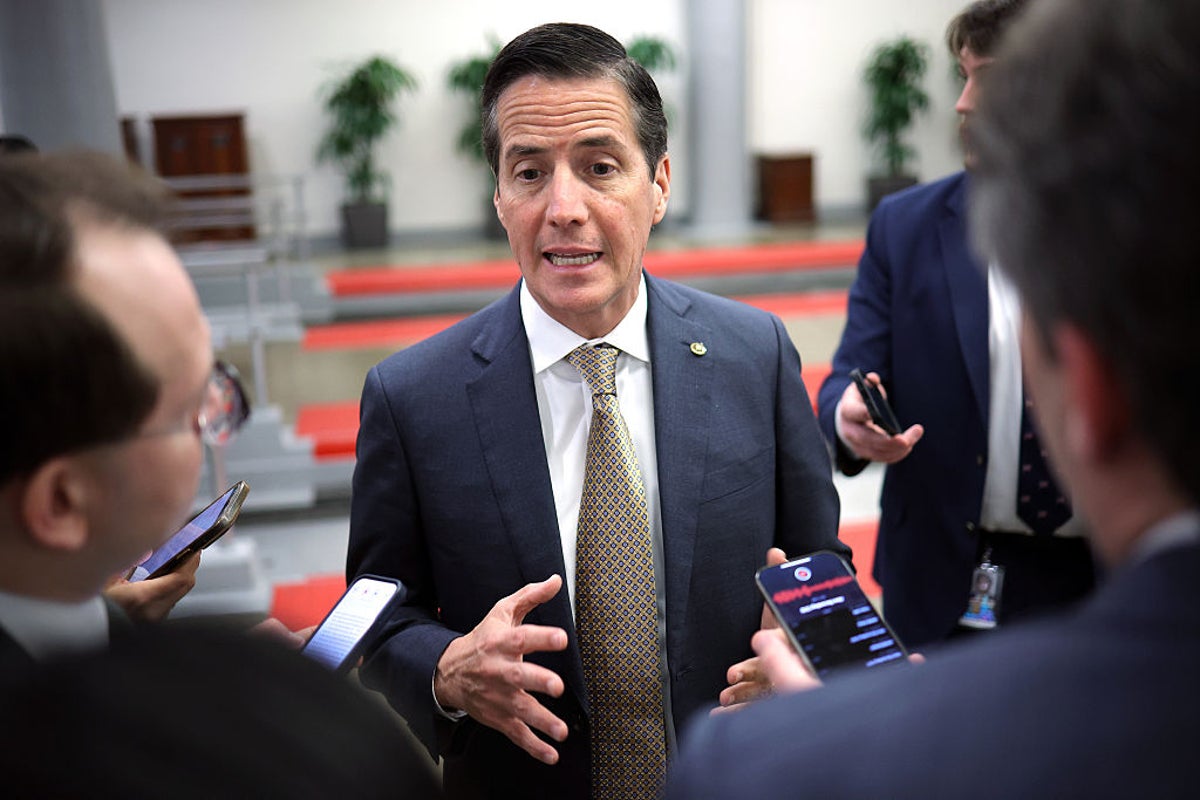
A Republican senator who is helping lead discussions over a potential extension of the Obamacare subsidies that President Donald Trump has maligned now says that the chamber likely won’t have a deal on the legislation until the end of January.
Sen. Bernie Moreno told reporters on Tuesday that the end of the month was the new goal for reaching a deal to extend the federal subsidies — passed under the Inflation Reduction Act in 2022 — which are needed by millions of Americans to afford the health care plans they purchased on the Affordable Care Act’s public exchanges. Those subsidies expired at the end of December.
Now it could be weeks before they resume, if at all. Concerns about the Hyde Amendment, which bars federal funds from being used to fund abortion care, appear to still be the main obstacle blocking progress on the negotiations, which Democrats took away as a consolation prize for their failed bid to force the extension through in order to end a government shutdown.
Punchbowl News reported on Tuesday that Moreno was hoping to get Republicans and Democrats on board with new penalties for insurance companies that violate the Hyde Amendment. In an interview with the conservative Washington Examiner, Moreno separately said that he wouldn’t go forward without the support of a majority of the Republican caucus for the bill.
That could be a hard sell, given Donald Trump’s continued vocal opposition. The president told reporters on Air Force One on Sunday that he may even issue a veto if legislation extending the subsidies reaches his desk; Trump has instead floated the idea of direct payments to Americans. Republican senators have translated that suggestion into the notion of putting money once used for the subsidies into health savings accounts (HSAs) that could be used by consumers for a variety of healthcare options, while doing nothing to address spiking premiums.
Senators have separately spoken about the need to address those rising premiums, but have not yet offered a policy-based solution for the problem. On Wednesday, senators in the bipartisan working group met again to discuss a bill to extend the subsidies, but indicated that nothing would likely come together before next week’s Senate recess ended.
Moreno, who voted against a Democratic bill seeking a clean three-year extension of the subsidies in December, is leading the negotiations with Democrats on the issue with Sen. Susan Collins of Maine. Unlike Moreno, Collins is up for re-election this year in a race that is already drawing significant national attention. She voted for the Democrats’ clean extension bill last month.
The Ohio senator said he wouldn’t provide that kind of optics win for the Democratic Party.
“I have no interest in a bill that divides our conference, so we would have to have a bill that would, at a minimum, have the majority of our conference supporting it,” he told the Washington Examiner.
“We’re not interested in a defection bill, a bill that would have 13 Republicans join all Democrats. We want a bill that gets the majority of our conference. It doesn’t have to be all 53, by the way, but that would get something along the lines of 35 Republican votes.”
It’s still unclear how much coordination Moreno and Collins’s efforts have with the White House, especially given Trump’s rocky relationship with the Maine senator. Moreno is much closer to the president than Collins and campaigned alongside him in 2024, during his bid for the seat once held by Sen. Sherrod Brown. Collins received the opposite treatment last week in the wake of her vote on the Venezuela War Powers resolution when Trump issued a statement on Truth Social urging voters to never support her (and the four other GOP defectors) ever again.
Moreno’s bid to get the Senate GOP caucus on board first may be necessary to avert the veto threatened this weekend by Trump. Though the president wouldn’t likely set himself up for a defeat in such a manner, the support of both Republicans and Democrats in the chamber could build a veto-proof majority.
Millions of Americans rely on the Affordable Care Act’s public exchanges to purchase health care plans that are not provided by an employer for a variety of reasons. The vast majority of those plans, more than 90%, were affected in some way by the premium tax credits that expired in December.
The first figures available from the Centers for Medicare and Medicaid released since the subsidies expired show that the open enrollment period beginning in November represented a sharp drop in the number of people signed up for plans on the public exchanges. Roughly 1.5 million Americans have dropped off their health plans entirely, according to the data. The amount that plans are increasing varies nationwide and is generally lower in states that operate their own exchanges. On average, states that use the federal healthcare.gov exchange are seeing premiums rise by around 30 percent according to a KFF analysis.
Even an extension of the subsidies now will have meant financial anguish for millions of Americans at the beginning of an election year when Republicans are playing defense in both chambers of Congress.
Democrats continue to hammer their opponents for not extending the subsidies last year, particularly when they drew a line in the sand and demanded Republicans vote for the subsidies to be extended in exchange for votes to stop a shutdown of the federal government. The effort failed when a group of Democrats capitulated and voted to end the shutdown after more than a month, drawing intense scorn from the party’s base. But the party remains hopeful it can hang the political consequences of spiking premium costs around Republicans’ necks this fall.
Senate Minority Leader Chuck Schumer and others in the party have made clear, however, that there’s no appetite among their members in the chamber to pick another shutdown fight in the new year.
“Why are tens of millions of Americans facing this reality? Well, because congressional Republicans failed to act,” Sen. Amy Klobuchar said in a floor speech on Wednesday. “Last Thursday, the House passed legislation to extend these tax credits for three years…[Republicans] could have done this months ago! Months ago!”
