There are several reasons Agatha Christie is hailed as one of the greatest murder mystery writers ever – her novels are timelessly entertaining and clever, and will always leave you desperate to know “whodunit”. I should know, I’ve read all of her books.
I first got into them after watching and falling in love with ITV’s classic Poirot and Marple adaptations over 20 years ago when I was in my early teens. I was enthralled, and began to read all of her classics – from Death on the Nile to Murder on the Orient Express to The Seven Dials Mystery.
Netflix’s adaptation of the latter hits screens this week, but Christie purists know the greatest joy comes from sitting down in a comfy chair and reading the originals.
Here are the very best of them.
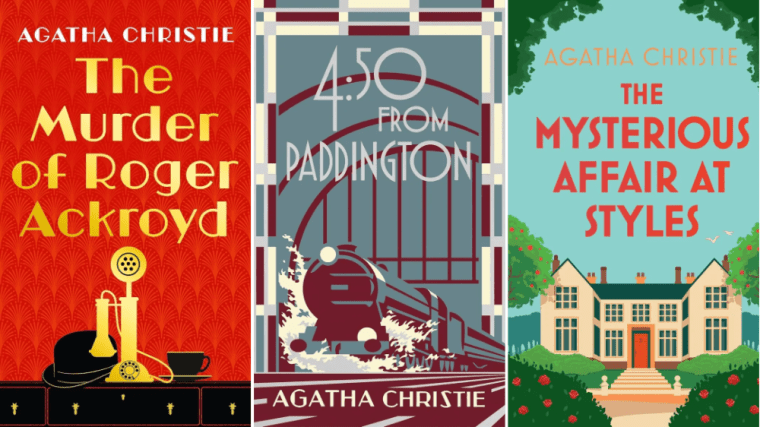
The Mysterious Affair at Styles
The first in the Poirot series, The Mysterious Affair at Styles introduces some of Christie’s most beloved characters, including Poirot’s loyal sidekick Captain Hastings and Inspector Japp.
The plot revolves around the poisoning of the wealthy Emily Inglethorp at Styles Court during the First World War. There are a number of suspects including her younger husband, Alfred, two stepsons and several peripheral friends. Set in a manor house, the story includes multiple twists and the kind of red herring that would come to define Christie’s inimitable style.
The Murder of Roger Ackroyd
Christie leads the reader on a rollercoaster right up to the last sentence in her third Poirot book. Narrator Dr James Sheppard walks us through the deaths of wealthy widow Mrs Ferrars, who died by suicide, and, shortly afterwards, her secret fiancé, the titular Roger Ackroyd.
Enter the recently retired Hercule Poirot, at the beck and call of Ackroyd’s niece. As he always does, the Belgian (never ever to be confused with a Frenchman) gets to the bottom of the matter in his usual logical fashion. Pure brilliance.
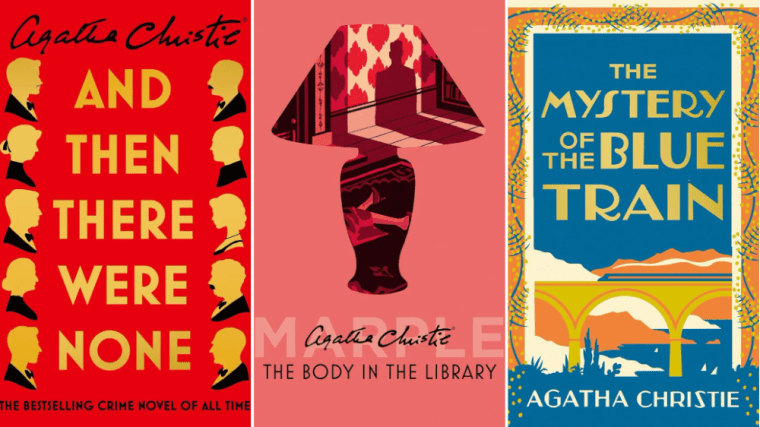
The Mystery of the Blue Train
Christie is at her best when transporting the reader to exotic locations. The Mystery of the Blue Train is set – no surprises here – on Le Train Bleu heading to the French Riviera with our favourite Belgian detective on board.
The story takes us back to the 1920s where there has been a murder onboard the luxury train, with American heiress Ruth Kettering found strangled to death in her compartment.
A famous ruby, known as the Heart of Fire, which had recently been given to Ruth by her father, the American millionaire Rufus Van Aldin, is discovered to be missing. He and his secretary, Major Knighton, convince Poirot to take on the case.
Cue a journey through France, still on the train, to narrow down the suspects, with Poirot dramatically revealing the murderer with his usual flourish and his now statement method – by gathering all the suspects in one room.
And Then There Were None
This book doesn’t feature either Miss Marple or Poirot, and has been published under racist titles. But it’s one of Christie’s most ingenious plots and possibly one of her best-known works.
The reader is transported to an island, cut off from the mainland, to which eight people have been summoned by an unexpected invitation. A butler and a housekeeper are there to greet the guests and advise that their host, Mr Owen, will not arrive until the next day.
Everyone claims they don’t know why they’re there – yet all are keeping a dark secret. One by one, they are picked off in a number of grisly manners – shootings, poisonings and hangings are all involved – until none are left, leaving the police stumped.
Of course, Christie explains in fine detail how it was all possible. In my view, it is one of the strongest but also the saddest of her books, lacking the usual cosy feel and witty quips the others deliver. Still, it is a must-read.
Hallowe’en Party
Featuring one of Poirot’s recurring assistants, the mystery novelist Ariadne Oliver, Hallowe’en Party uncovers the murder of 13-year-old Joyce Reynolds at – you guessed it – a Halloween party.
It’s one of the more outlandish murders in Christie’s novels – the poor girl was drowned in an apple-bobbing bucket after seeing something she shouldn’t.
A satisfying tale, made all the more fun by the ever-entertaining Ms Oliver, Hallowe’en Party is one that always springs to mind when I think of the novels I have enjoyed the most – even if it’s not considered a classic.

4.50 From Paddington
My favourite of the Marple novels, and yet another that features a train as the scene of the crime, 4.50 from Paddington is a complex story with a long list of characters.
It revolves around Miss Marple’s friend, Elspeth McGillicuddy, witnessing a woman being strangled on the train stopped next to hers – not that anyone believes her apart from our trustworthy armchair detective.
This sets the scene for a twisty narrative where Rutherford Hall, a nearby estate, becomes the likely location of the (suspected) body.
Several deaths later, and after probing events in years past that may have had a bearing on the murder, we reach the conclusion of what actually happened on the train and why. Christie pulls all the characters together masterfully.
The Body in the Library
One of Christie’s very best novels, The Body in the Library kicks off with the maid for Dolly and Colonel Bantry finding the body of a young woman in their library. How she got there is anyone’s guess – until friend of Dolly, Miss Marple, gets involved.
We’re led to believe the body is that of missing dancer Ruby Keene – but everything is not quite as it seems.
Another novel with a long list of suspects and too many twists and turns to count. The reveal of who did it is one of my favourites of all time.
Curtain: Poirot’s Last Case
This novel is the final outing for Poirot and comes full circle, taking us back to Styles mansion – of The Mysterious Affair at Styles fame.
Poirot invites his sidekick Captain Hastings to Styles, explaining he is convinced that there is just one person involved in five murders that have been committed, despite there being clear suspects in all but one of the cases. The murderer, “X”, he says, is among them.
Christie experiments here with character in ways she hasn’t before and the ending remains controversial. But it’s a compelling and essential final story.
