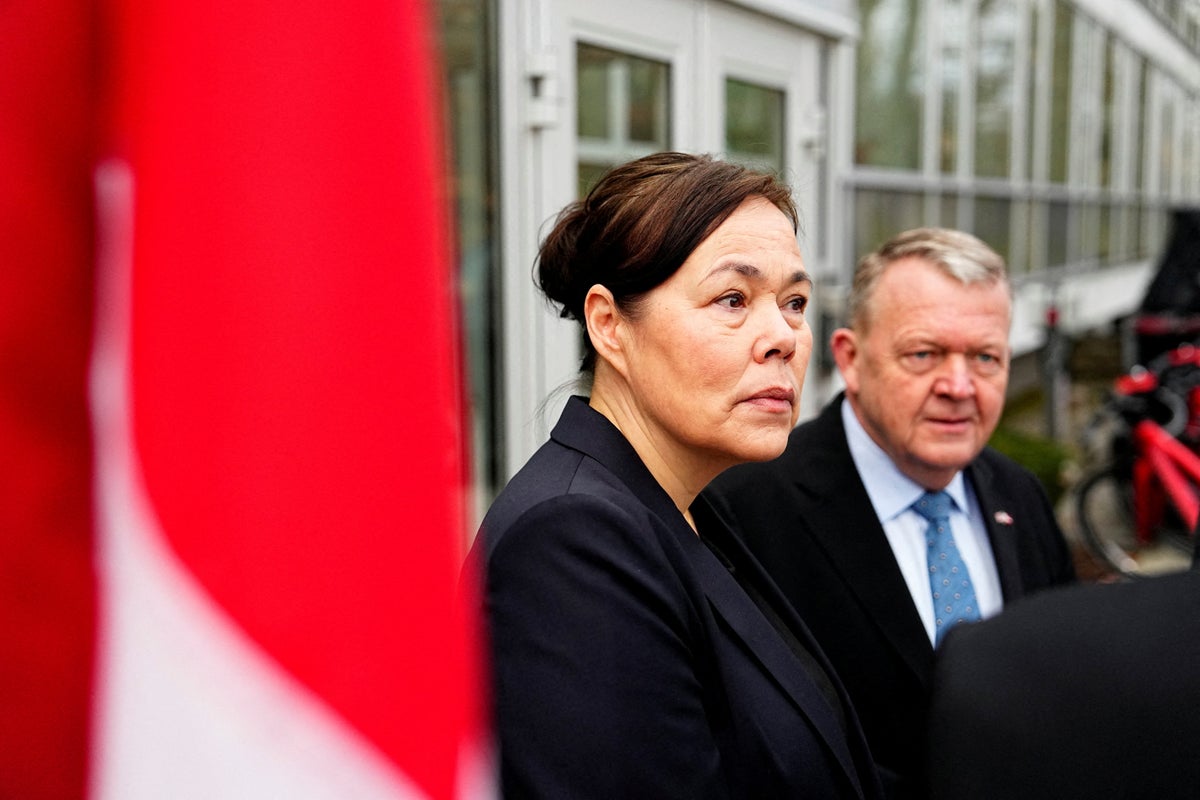
The United States, Denmark and Greenland will convene a “high-level working group” for talks on a “common way forward” after diplomats met i Washington, D.C., amid President Donald Trump’s campaign of threats to acquire the Arctic territory by force or by purchase.
Speaking outside Denmark’s embassy shortly after he and Greenlandic Foreign Minister Vivian Motzfeldt left a Wednesday sit-down with Secretary of State Marco Rubio and Vice President JD Vance at the White House, Danish Foreign Minister Lars Loekke Rasmussen told reporters the meeting had been “a frank but also constructive” discussion on “how to ensure the long-term security in Greenland.”
Rasmussen said the American and Danish perspectives on the dispute “continue to differ” even as he acknowledged that Trump “has made his views clear” on his desire to have Washington take control of Greenland. But he stressed that Copenhagen’s view is that Greenlandic security can be addressed sufficiently under the terms of a 1951 defense agreement that gives Washington carte blanche to place troops and other military resources on the island.
“For us, ideas that would not respect territorial integrity of the Kingdom of Denmark and the right of self determination of the Greenlandic people are, of course, totally unacceptable, and we therefore still have a fundamental disagreement,” he said.
“But we also agree to disagree, and therefore we will, however, continue to talk.”
Rasmussen said the “working group” that will be convened to continue discussions about the matter should work towards ways to address America’s security concerns about Greenland’s strategic position at a time when Russia and China are growing more aggressive in the Arctic Region while also “respecting the red lines of the Kingdom of Denmark.”
He added that the group should meet “within a matter of weeks.”
The high-stakes meeting, which Vance hosted in his office suite in the Eisenhower Executive Office Building, came just hours after Trump claimed in a Truth Social post that U.S. control of Greenland was “vital” for the “Golden Dome” missile defense system he has commissioned from American defense contractors and suggested that NATO — the 32-member defensive alliance to which both the U.S. and Denmark belong — should “be leading the way” for an American annexation of what has been Danish territory for centuries, lest Russia or China somehow seize it by force.
He further argued that NATO would be “far more formidable and effective” with Greenland under American control and said anything less than that would be “unacceptable.”
Although Trump and some of his aides have suggested that the United States has had legitimate claims to Greenlandic territory and questioned the legitimacy of Denmark’s control of the island, Denmark has had claims and presence there since 1721 — more than a half-century before American independence.
While the United States once had a tenuous claim on some of Greenland’s territory after American explorers mapped the island’s northernmost reaches, Washington formally surrendered such aspirations in 1916 as part of a treaty signed with Copenhagen where Denmark gave the U.S. what were then the Danish West Indies — now the U.S. Virgin Islands — in exchange for $25 million paid in gold.
Rasmussen, the Danish foreign minister, did concede that there is “a bit of truth” to Trump’s concerns about what he called “a new security situation in the Arctic and high north” and suggested that the current American and NATO security footprint in Greenland had been deliberately downsized after the fall of the Soviet Union as a joint American and Danish decision to keep the Arctic as a “low tension region.”
But he also noted that it’s been entirely Washington’s choice to keep the number of U.S. personnel on the island at around 200, far lower than the 10,000 who were stationed there across 17 different bases during the Cold War.
“Now the situation is entirely different. And of course, we have to respond to this. The big difference is whether that must lead to a situation where the U.S. acquires Greenland, and that is absolutely not necessary,” Rasmussen said.
While he acknowledged that there is “clearly a disagreement” between the American and Danish governments on that matters, he said all parties agreed that it still “makes sense to try to sit down on a high level to explore whether there’s possibilities to accommodate the concerns of the president while we, at the same time, respect the red lines of the Kingdom of Denmark.”
“So this is the work we will start. Whether that is doable, I don’t know,” he said.
