Speculation is growing over possible US military strikes as Donald Trump threatens action against the regime in Tehran
The United States is withdrawing some troops from key bases in the Middle East as a precaution given heightened regional tensions, US diplomats said on Wednesday, prompting speculation that military action in Iran could be imminent.
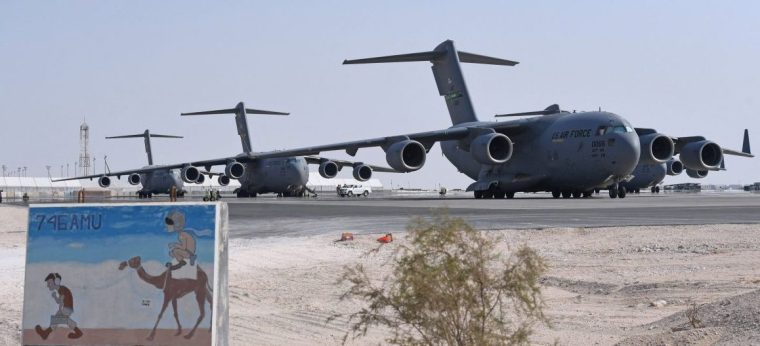
Some US military personnel at al-Udeid airbase in Qatar were told to depart by the evening, with fears escalating of a strike on Iran following Donald Trump’s repeated threats.
It follows a brutal Iranian government crackdown on protesters that has led to the deaths of at least 2,500 people.
Al-Udeid, Washington’s largest base in the region housing around 10,000 American troops, was targeted by Iranian missiles in June after the US strike on its nuclear sites.
“It’s a posture change and not an ordered evacuation,” one diplomat told Reuters, adding that they did not know the reason for the change.
Last year, some personnel and families were moved off US bases in the Middle East a week before the US launched air strikes on Iran.
The International Media Office of the State of Qatar said the measures to remove troops at al-Udeid “are being undertaken in response to the current regional tensions”.
A senior Iranian official told the news agency earlier that Tehran had warned regional countries it would strike US military bases if it intervened in Iran.
Meanwhile, questions swirled after Israel’s Boeing 767 “Wing of Zion”, the official aircraft for transporting the president and prime minister, travelled from Nevatim airbase in southern Israel on Wednesday morning to the Greek island of Crete.
Israeli officials said that the flight was a pre-scheduled routine training exercise.
Open intelligence sources said there had not been a “surge” of US assets towards the Middle East despite some claims, but the fact the US administration intends to look at options on Wednesday evening indicates this may change.
Trump has repeatedly threatened to take military action in Iran, with a senior Iranian official earlier telling Reuters that direct communication between Iranian foreign minister Abbas Araghchi and US special envoy Steve Witkoff had been suspended as a result.
The US President promised “help is on the way” on Tuesday, urging Iranians to “take over institutions” and to remember the names of “killers and abusers” as they will “pay a very big price”.
Asked to clarify this statement by CBS News, he said: “There’s a lot of help on the way, in different forms, economic help from our standpoint, and we’re not going to help Iran very much.”
Amid reports of a possible planned execution of a protester by the regime on Wednesday, Trump said the US would take “very strong action if they do such a thing”.
Could the UK get involved?
Trump’s repeated threats of taking military action against Iran have prompted speculation over whether or not Britain could take joint or supporting action against its regime as it applies more pressure on the regime.
Yvette Cooper, the Foreign Secretary, told MPs on Tuesday that the UK had imposed “full and further sanctions” on Iran, targeting finance, energy, transport, software and other significant industries.
She said she had spoken to the Iranian foreign minister on Monday to emphasise the UK’s “total abhorrence of the killings, the violence, and the repression that we are seeing”, as the biggest anti-regime protests in years sweep Iran.
Heidi Alexander, the Transport Secretary, told Sky News that the Islamic Republic was a hostile state but stressed that the Government wanted to see a “peaceful transition” to democracy and a reduction in violence.
The UK Government has also rejected calls to proscribe the Islamic Revolutionary Guard Corps (IRGC), an arm of the Iranian military, as a terrorist organisation.
Professor HA Hellyer, senior associate fellow at the Royal United Services Institute specialising in geopolitics, said: “I don’t think anyone in the British Government is thinking of military intervention. It would be extraordinary if they were.”
He added that the UK did not have a good track record with military interventions, referencing the invasions and occupations of Afghanistan and Iraq.
He also pointed out that it was unclear if the Iranian people would even support military action from foreign countries including the US and UK.
What would UK military intervention in Iran look like?
If the UK did decide to take military action, it would most likely be to take a supporting role for intervention by the US, providing fighter jets, refuelling tankers and spy planes, ex-RAF Air Marshal Greg Bagwell told The i Paper this week.
Any ground forces deployed would likely be “a token effort”, he added. But Britain does have advanced capabilities that would prove useful, including tankers for use of US navy aeroplanes, as well as intelligence, surveillance, target acquisition and reconnaissance platforms.
However, there are doubts about whether the UK would even be asked to aid the US in any intervention in Iran.
During last year’s bombing campaign against Iran’s nuclear sites, the US military acted unilaterally.
How would Iran respond?
Iran’s foreign minister has warned that his country will defend itself against “evil and foreign interference” following Trump’s comments urging civilians to “keep protesting”.
Hellyer said: “Iran has threatened to respond by attacking US allies in the region. There has been reporting indicating that they will go big or go home because the regime is very desperate right now.”
One of the diplomats told Reuters: “It’s a posture change and not an ordered evacuation,”
In Britain, Iran’s proxies could step up terrorist campaigns against Iranians in exile. Nick Aldworth, a former national co-ordinator for counter-terrorism policing, told The i Paper this week that the regime could “cause problems on British streets”.
He added that Iran was already effectively waging a proxy war on British streets mostly directed towards Iranian dissidents rather than British institutions.
However, if intervention led to regime change, there was a lower likelihood of risk to the UK public, he added.
Your next read
How likely is a conflict involving Iran?
With reports that one protester, 26-year-old Erfan Soltani, is due to be executed today, this may be the event that sparks US action.
Hellyer pointed out that it was not the first time that Iran had executed protesters. However, the fact that Trump has threatened action means that there is an expectation for him to go through with it.
Hellyer suggested that the UK might take a similar stance as that taken after the US attacked Venezuela and captured its president, Nicolás Maduro. While Keir Starmer has said he supports regime change, he has offered no definitive answers on whether or not he agreed with the way it had been brought about.
