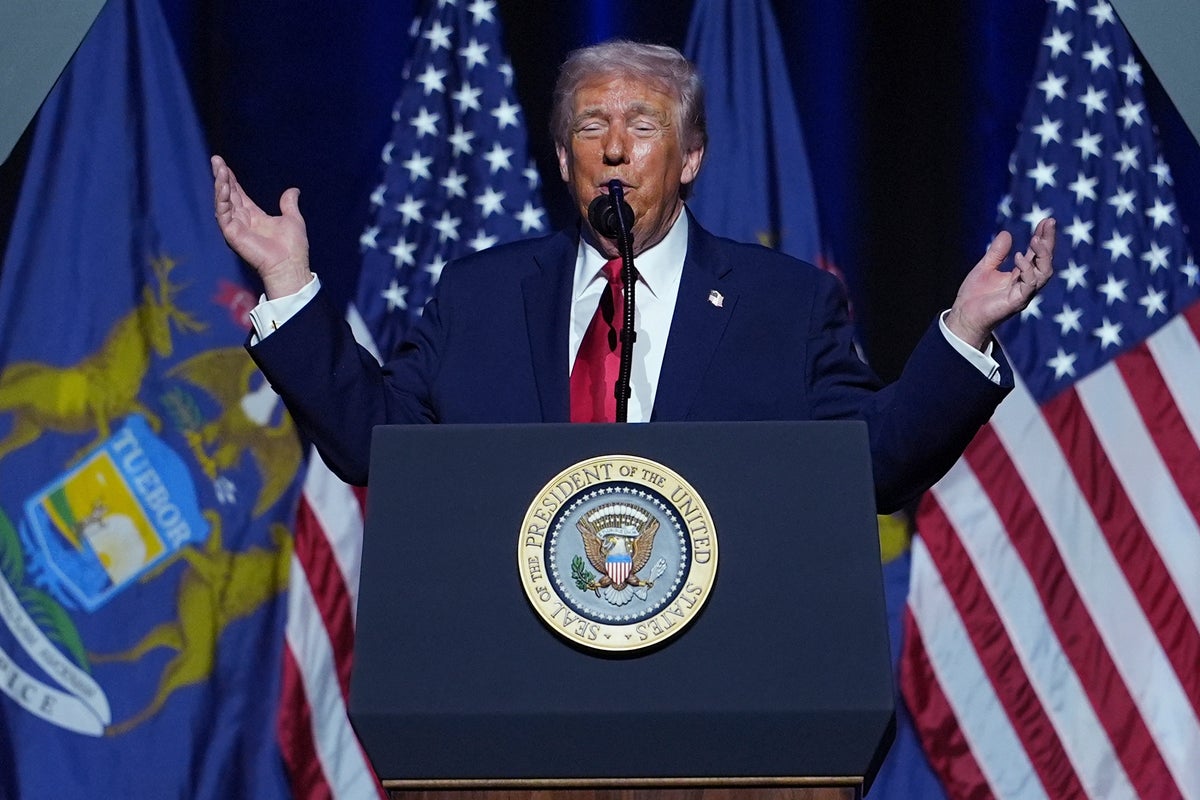
President Donald Trump on Tuesday turned what was supposed to be a routine address to Michigan business leaders to highlight his administration’s economic policies into an hour-long airing of grievances and empty boasts that offered little in the way of details on how he will address Americans’ concerns in the months before voters decide whether to permit his party to retain unified control of Washington.
The president’s annual appearance before the Detroit Economic Club started off with the usual Trumpian platitudes and shout-outs to the club’s leadership and other Motor City and Wolverine State business and political luminaries, but quickly pivoted to partisan conspiracy-mongering as Trump, who lost the 2020 presidential election to Joe Biden, falsely claimed to have won Michigan’s electoral votes in all three of his runs for the White House.
He continued bragging about his 2024 election win, which included a popular vote victory over former vice president Kamala Harris, before turning to complaints about Democrats and a few Republicans who have criticized his recent military intervention in Venezuela and for good measure insulting his predecessor, former president Joe Biden, as “a real dope.”
Finally turning to the topic on which he’d been planning to speak — the economy — the president said the U.S. had experienced what he called “the strongest and fastest economic turnaround in our country’s history” since he returned to office last January.
“There’s never been anything like this. You are so lucky I allow you into this room to even be with me,” he said.
The assembled business leaders laughed nervously as he assured them he was only kidding before again claiming they were “so lucky” to be under his administration because American economic growth was “exploding.”
“Productivity is soaring, investment is booming, incomes are rising. Inflation is defeated. America is respected again like never before,” he said.
After more boasts about his administration’s economic record and swipes at both Biden and elected leaders in states such as California that did not vote for him or his party last year, the president began accusing Federal Reserve leaders — including Board of Governors Chair Jerome Powell, who he called a “stiff” — of trying to sabotage the country’s economy by failing to lower interest rates in response to positive economic numbers.
“In the old days, when you had good numbers, interest rates would go down. When you had good numbers, the market would go through the roof. That’s the way we’re going to make it again. That’s the old fashioned way. That’s the right way,” Trump said. “Today, if you announce great numbers, they raise interest rates to try and kill it, so you can never really have that kind of rally.”
Trump’s desire for lower interest rates has led to him to conduct a months-long campaign of browbeating and intimidation against Powell and other members of the central bank’s board that recently escalated after a federal prosecutor in Washington launched a probe into whether the Fed chair lied to Congress during testimony about a long-running renovation of the bank’s headquarters which Trump has accused him of mismanaging.
He claimed the bank once hewed to an “old standard” that lowered rates when the economy was doing well, but that has not been the case in the central bank’s modern history.
When the Fed began raising interest rates during Biden’s presidency, it was to tamp down on inflation not seen since the mid to late 1970s after then-President Richard Nixon browbeat then-Fed chair Arthur Burns into slashing rates ahead of his 1972 re-election campaign.
Nixon ultimately reaped the short-term benefits in the form of his historic 1972 landslide victory which saw him win 49 of 50 states over Democratic nominee George McGovern, but by the end of the decade the artificial stimulation he had championed brought about crushing “stagflation” — a combination of low growth and high inflation — that would only be tamed in the mid 1980s after then-chair Paul Volcker instigated a recession by leading the central bank to jack up rates to 20 percent.
Trump, who will nominate a replacement for Powell when his term as chair expires in May, said he wants Powell’s replacement to push for lower rates “because our country becomes stronger” that way.
After a brief interlude during which he took credit for increased military recruiting that began under his predecessor, Trump claimed the country’s alleged recent economic success was due to his use of exorbitant tariffs on almost all American trading partners — import taxes which he falsely claims are paid by foreign countries as a kind of tribute for the privilege of having Americans import their products.
The president proceeded to embark on an extended stem-winding rant about how the country’s greatest period was during the late 1800s and early 1900s when tariffs were the main source of revenue for a far smaller federal government.
He claimed — without offering evidence — that the government’s use of an income tax after ratification of the 16th Amendment to the U.S. Constitution had roots in a foreign conspiracy to “convince” the United States that tariffs were “no good.”
“So some genius … said, ‘oh, let’s go to an income tax system.’ So instead of foreign companies and countries paying everything, the people started paying,” he said before claiming that the start of the income tax in 1913 caused the Great Depression (it did not).
Trump’s defense of his tariff policies comes as the Supreme Court prepares to rule on whether he exceeded his authority by unilaterally imposing the import taxes on most of the world without involving Congress.
He accused the American business owners who brought a lawsuit to invalidate the taxes as being “China-centric” and suggested that his administration will “figure something out” to impose new tariffs if the high court rules against him.
Roughly 40 minutes into his nearly hour-long remarks, he finally returned to the topic of affordability, which he called “a fake word by Democrats,” and promised that he’d roll out new ideas to bring housing costs down while attending the World Economic Forum in Davos, Switzerland next week.
He promised “much more detail” about policies that would permit more Americans to enjoy home ownership when he visits the Swiss resort town while also teasing a new “health care affordability framework” that he’ll introduce later this week.
While Americans who purchase health insurance on Affordable Care Act exchanges are reeling from massive premium increases due to his refusal to support extending Covid-era tax credits that kept costs lower for consumers, Trump claimed the forthcoming plans would “reduce premiums for millions of lower drug prices” while “delivering price transparency and demand honesty and accountability from insurance companies all over the country.”
