Khamenei’s only tools are force to suppress his people as the Islamic Republic is irredeemable in the eyes of the Iranians protesting, one expert told The i Paper
Iranian protesters are facing increasingly brutal repression from regime security forces as the country’s ageing dictator digs in ever harder to preserve his Islamic theocracy.
More than 500 people have reportedly been killed in the protests, which broke out nearly two weeks ago and spiralled into some of the most significant anti-government unrest since the “Woman, Life, Freedom” demonstrations of 2022.
Sparked in Tehran in December by the plunging value of the rial and other economic woes, the protests swiftly turned on the regime. Chants of “death to the dictator” and “death to the Islamic Republic” are now heard across the country.
The US President, Donald Trump, who has threatened to intervene if protesters are killed, is believed to be weighing up options including military strikes against Iranian security forces.
However, that does not appeared to have deterred them, with 538 people killed, according to the US-based Human Rights Activists News Agency, including 490 protesters and 48 Iran security personnel, as well as 10,000 arrests.
Iran has not given an official toll and the numbers are unverified. With Iran under an internet blackout, however, those numbers are only likely to grow.
Khamenei’s only tool is force
It is “clear that the authorities don’t want the world to see that people have turned out and they want to use the darkness of the total internet shutdown to brutally suppress protesters”, said Holly Dagres, senior fellow at the Washington Institute’s Iran programme.
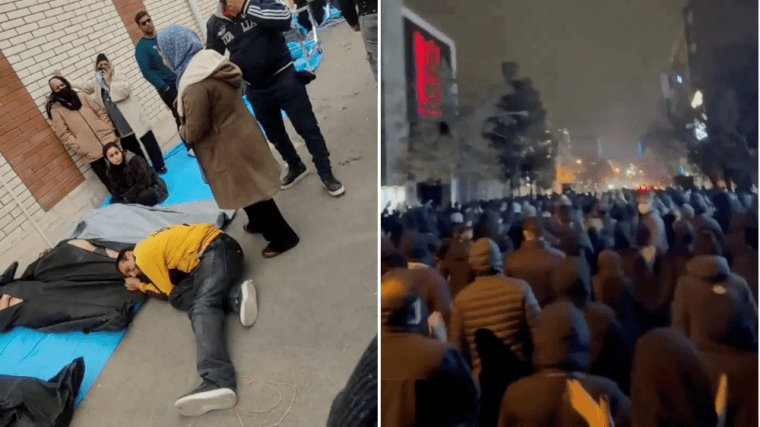
Iranian state TV broadcast footage of dozens of body bags outside the Tehran coroner’s office on Sunday, saying the dead were victims of events caused by “armed terrorists”.
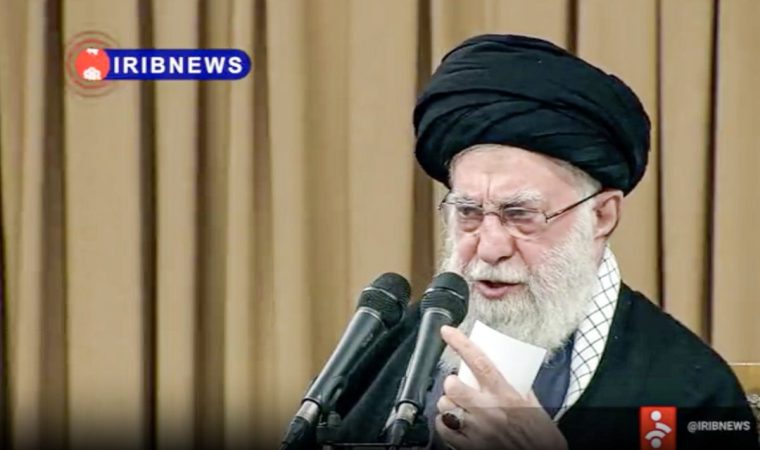
Iran’s Prosecutor General, Mohammad Movahedi Azad, has said anyone committing sabotage, burning public property or clashing with security forces will face the death penalty. “Proceedings must be conducted without leniency, compassion or indulgence,” he said, according to the state-run IRIB News.
Iran’s Supreme Leader, Imam Sayyid Ali Hosseini Khamenei came out in a defiant appearance on Friday that threatened a greater crackdown, warning that “rioters should be put in their place”.
“Let everyone know that the Islamic Republic came to power through the blood of several hundred thousand honourable people and it will not back down in the face of those who deny this,” he declared, claiming that foreign actors were behind the protests.
Those words have been taken as a warning that security forces will show no mercy in putting down the rallies.
“Khamenei’s public remarks project a tacit acknowledgement of regime shortcomings coupled with deflection, defiance, and conspiratorial thinking,” Jason Brodsky, policy director of United Against Nuclear Iran and former editor at Iran International TV, told The i Paper.
“The Supreme Leader had a front row seat to the 1979 Islamic Revolution. He felt the Shah’s biggest mistake was making concessions at the end of his reign as that paved the way for his ouster. This is why Khamenei has held firm. Khamenei’s only tools are force to suppress his people as the Islamic Republic is irredeemable in the eyes of the Iranians protesting.”
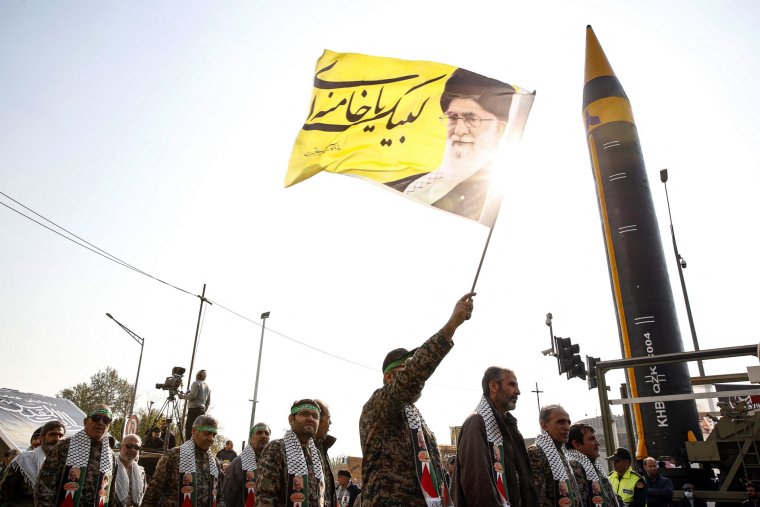
Anger is deeper – and fear has lost much of its power
Khamenei, 86, is an adherent of the brand of hardline Shia Islam that has dominated Iran since the revolution. During that time, Iran has seen waves of protests, often quickly and brutally repressed by regime forces including the Islamic Revolutionary Guard Corps (IRGC) and Basij militia. Some 551 protesters were killed by Iran’s security forces during the 2022 protests, according to a UN fact-finding mission.
“Khamenei’s latest speech told us exactly what we expected: move quickly to contain and crush protests before they evolve into a unified political movement,” said Alex Vatanka, senior fellow at the Middle East Institute. “This is Khamenei’s governing philosophy distilled: survival for the sake of survival — one more day, with no strategy for resolution.”
Khamenei has ruled Iran since the 1989 death of Ayatollah Ruhollah Khomeini, the founder of the Islamic Republic. One of Khomeini’s hardcore acolytes, he believes fervently in the religious rule on which the Islamic Revolution is founded, especially the velayat-e faqih, or guardianship of the Islamist jurist, over any kind of secular or democratic political leadership.
As a result, he has concentrated power in himself and the small cabal around him, establishing a network of patronage among the clerical and military elite to ensure their loyalty. Strongman tactics including quashing free speech, free assembly and the free press have helped him clamp down on public challenge to his rule. Token “reformists” such as the president, Masoud Pezeshkian, have been brought in to pacify the population, then sidelined by the clerics.
The ayatollah’s government has been marked by industrial-scale corruption, brutality towards the population – 1,500 people were executed last year according to Norway-based Iran Human Rights group – and the shovelling of huge amounts of money into violent proxies across the Middle East and further afield, as well as its nuclear programme.
Rob Macaire, the former UK ambassador to Iran, told the Atlantic Council on Friday: “The proportion of people who are supportive of the regime is incredibly small and it is shrinking further. That circle of power gets tighter and tighter and as these protests show, the regime finds it very difficult to do anything other than to double down on a repressive policy.”
Brodsky said: “The Islamic Republic has proven itself incapable of reforming.”
Footage posted on social media from Tehran on Saturday showed crowds marching along a street at night and chanting against the regime, while footage from the northeastern city of Mashhad, where Khamenei was born, shows masked protesters and smoke from fires in the street. Explosions can also be heard.
Today, Iran’s ayatollahs are more vulnerable than ever. Everything has changed since 2022, when Tehran wielded a powerful militia network across the region.
Now, its formerly feared Lebanese proxy Hezbollah has been dismantled by the Israelis in Lebanon, its Syrian ally has been toppled, Hamas is devastated in Gaza and its militia networks across Iraq have been badly weakened. US strikes last year nearly obliterated its nuclear facilities, while Israeli operations destroyed many of its air defences and took out much of its military leadership.
“Today, its military power has been badly eroded due to its proxies being damaged and its nuclear programme being decimated,” said Brodsky. “This, coupled with President Trump’s risk-readiness and demonstrated track-record of a willingness to use force, has imperilled the regime.”
Nearly two weeks into Iran’s protests, one thing is unmistakable: this is not routine unrest, said Vatanka. “The anger is deeper, broader, and more hopeless than anything the Islamic Republic has faced before.
“This is not a movement driven by optimism. It’s driven by exhaustion. Large parts of society no longer believe the system can improve — and fear has lost much of its power.”
