American military centres, bases, and ships in the region could become ‘legitimate targets’, a senior regime figure warns
With Iran under a four-day internet blackout, Donald Trump has claimed members of the country’s regime have shown an interest in holding talks with Washington, even as he weighed up an armed response to the violent crackdown on protesters.
Speaking to journalists aboard Air Force One on Sunday, the US President suggested Iran was getting close to what he had previously called a “red line”, noting that the number of protesters being killed appeared to be rising.
Trump said the unrest was being closely monitored at the highest levels of government, including by the US military. “The military’s looking at it. We’re looking at some very strong options, we’ll make a determination,” he said.
As the situation escalates, experts have warned that a military approach could be detrimental to the US, and not work to quell the violence. Since Iran could target US assets in the region, using force is unlikely to deliver a beneficial outcome, and could create an even bigger political headache for America.
How has Iran responded to Trump?
While the US President stopped short of outlining any specific action, he stressed that the administration viewed the escalation “seriously” and would decide how to proceed following further evaluation.
He claimed Iranian officials had made contact to propose negotiations, framing the approach as evidence that pressure on Tehran was having an effect, saying Iran was seeking talks after sustained pressure from the US.
However, he offered no details on when such discussions might take place or what they would involve.
On Sunday, the conservative speaker of Iran’s parliament, Mohammad Bagher Ghalibaf, said in a speech that the regime was currently at war with the US on four fronts, the “economic, cognitive, military, and terrorist wars”.
Responding to recent statements from Trump saying that the US “stands ready to help” Iranian protesters, Ghalibaf said: “So that you do not make any miscalculation, be aware that in case of an attack on Iran, both [Israel] and all the American military centres, bases, and ships in the region will be our legitimate targets.”
For Professor Anoush Ehteshami at Durham University, Trump might feel Ghalibaf’s comment isn’t worth responding to.
“I think he would ignore Ghalibaf’s comment because even the leader of the regime has said something along these lines, as have other members. This is not the first time something similar along these lines has been said.
“But I do think he is biding his time over something, otherwise he would have responded.”
What actions could Trump take?
“There are three or four that are correct on the table,” Dr Sanam Vakil, director of the Middle East and North Africa Programme at Chatham House, told The i Paper.
“The first is using physical forces, but this could depend on Trump’s objective. What is he trying to achieve and is the objective to support the protesters? If he does strike bases around the country, the risk is great as it’s unknown what it might facilitate.”
Vakil said a second option would be cyber aid, such as getting Starlink up and running, and a third would be providing symbolic support such as putting posts on social media.
Your next read
Early in the protests, Trump warned the Iranian regime that if it shot at demonstrators, “the United States of America will come to their rescue. We are locked and loaded and ready to go”.
But Trump is aware that a military approach would meet major challenges in Iran, and is too dangerous for now, added Vakil.
“The third option [symbolic support] would mean Trump wouldn’t need to put his money where his mouth is,” she said. “Right now the risks are too many and too uncertain and the US government is watching the situation very carefully.”
Professor Ehteshami, said the first potential option – striking – might be more ruinous than beneficial.
“Military forces are becoming increasingly redundant, he said. “The Iranians are offering to negotiate. I don’t think he cares much about what happens inside Iran as long as Iran’s power doesn’t damage the interest of The US or Israel and that is contained.”
He added that the first course of action is to wait and see what Iran is offering, particularly in regards to its nuclear programme.
Last June, Israel and the United States heavily bombed three of Iran’s main nuclear sites, Fordo, Natanz and Isfahan, over the course of 12 days in an operation codenamed ‘midnight hammer’.
The US strikes were a response to Iran bombing parts of Israel amidst growing tensions in the area, which stemmed from the ongoing situation between Gaza and Israel.
“We currently have no idea what Iran’s nuclear programme looks like,” he continued. “It’s been set back for some years, but it is not done and dusted in the slightest.”
“I think the regime is dangling this in front of Trump’s face.”
He added that if members of the regime keep negotiations in progress they would have gotten their own way as they would have kept “Trump hanging”.
“We have to wait for what Iran is offering. I personally think they are buying time until they have restored ‘order’ everywhere which they seem to be doing savagely. But to say this isn’t a continuation of the 12 days war would be naive.
“I think Trump would like to see the back of these guys. But just doesn’t know if this is much bigger to swallow than he first imagined.”
What has happened in Iran in the past 48 hours?
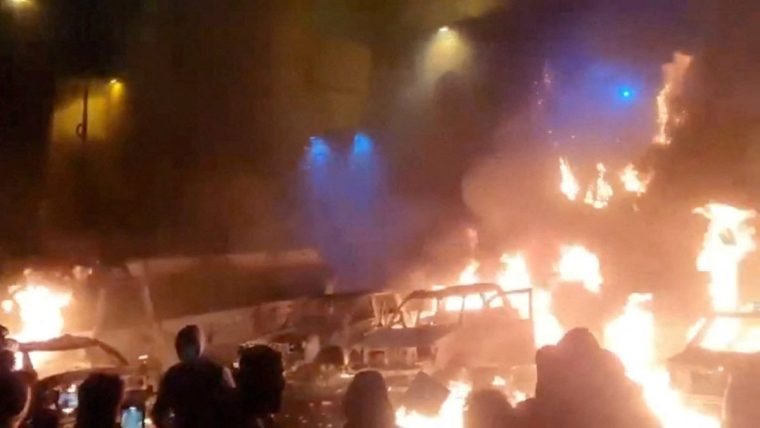
Two weeks of protests have now taken place and blackouts imposed by the regime have remained in place for almost 96 hours, with internet and landlines cut.
British-Iranian campaign group United4Mahsa said that in the past 48 hours, there had been an escalation in Iran’s national uprising, with protests reported in all of the country’s 31 provinces.
It reported that the death toll from protest-related violence in Iran has risen dramatically since 28 December, with at least 538 people reportedly killed — nearly 10 times higher than earlier figures that stood at 62. The numbers are unverified and an official death toll is yet to be released.
The campaign group said witnesses across the country had described overwhelmed hospitals and disturbing scenes, including in Rasht in Gilan Province, where dozens of bodies were reportedly brought to a hospital in a single night, filling the morgue to capacity.
Arrests have surged, with at least 10,600 protesters detained, a sharp increase from the previously reported 2,200.
State officials have taken an increasingly hardline stance. On 11 January, the head of the judiciary issued what he called a “last ultimatum” to protesters, announcing the formation of special courts to swiftly prosecute those deemed responsible for unrest.
Senior security and political figures characterised protests as terrorist activity comparable to Isis, rejecting claims that security forces were responsible for protester deaths and instead alleging the involvement of foreign-trained agents.
State media has focused heavily on security force casualties while downplaying civilian deaths. Regime outlets reported that at least 114 members of the police, Islamic Revolutionary Guard Corps (IRGC), and Basij militia were killed outside Tehran, declaring three days of national mourning and urging participation in pro-regime rallies.
“No matter what has been said by whom, it’s important to remember we have not had full access to Iran for almost four days now,” said Dr Sanam Vakil.
“It has been an extremely violent round of protests in Iran. I would argue the most destabilising for the republic. The fact that the protests might be tapering down is merely a result of government violence and repression.”
