Moscow claimed this week that Ukraine launched a drone attack on one of the Russian president’s residences
On Monday, Russia’s foreign minister, Sergei Lavrov, claimed that Ukraine had launched a major drone attack on one of Vladimir Putin’s palaces. This seems highly implausible, not least because of just how well protected his residences are. Instead, it was likely an attempt to win Donald Trump’s sympathy at a crucial time in the peace talks.
The US President, after all, seemed visibly shocked at the news, saying that while Ukraine had the right to fight back, “it’s another thing to attack his house”.
Meanwhile, Kyiv has rejected the claims, calling them “typical Russian lies” intended to undermine the progress made by Volodymyr Zelensky’s latest meeting with Trump in Florida on Sunday.
On the face of it, the Russian allegations are hard to credit. They have not yet provided any evidence of the claimed 91-drone attack. The Dolgiye Borody residence, on the shores of Lake Valdai, is some 250 miles north-west of Moscow, and to get to it Ukrainian drones would have had to cross hundreds of miles of Russian airspace. There have been no accounts of notable air defence activity, no social media videos of missiles in the night and no photos of wreckage.
Although it would have been technically possible for Kyiv to launch such an attack, the odds of success would have been slim, to say the least. Moscow has been steadily beefing up its defences against long-range drone strikes, and around 90 per cent of those launched recently into the Russian heartlands have either been shot down or jammed.
Putin is also at the centre of an extraordinarily complex and extensive set of security arrangements aimed at keeping him safe.
It is not just the black-suited bodyguards of the presidential security service who shadow his every move (and taste his food before he eats it), or his armoured Aurus Senat limousine, with its smoke screens and tear gas launchers. Nor the federal protection service (FSO) snipers and spotters who provide an outer perimeter of security, as well as the crews for his Ilyushin Il-96-300PU jet, fitted with the Prez-S laser system to blind incoming missiles. Not to mention his armoured train, painted to look like any other passenger hauler.
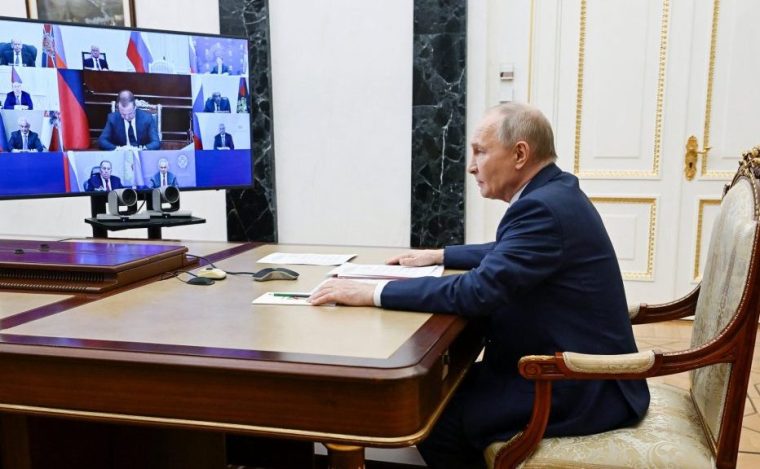
It is also the complex array of defences and precautions which make his palaces virtual fortresses. On the ground, they are surrounded not just by fences but by patrols of armed FSO troops and dogs, while being watched over by a battery of cameras and other sensors. Each residence has a complex electronic warfare suite designed to jam incoming drones or else spoof them if they are navigating by GPS, convincing them they are in the wrong place.
If all else fails, each also has anything up to a dozen Pantsir S1M/2 air-defence systems, using a mix of guns and missiles to claw incoming drones out of the sky.
If Ukraine was to try to go after Putin, it would have to know where to target in the first place. Putin’s movements are often kept secret, or else made deliberately misleading. At least three of his residencies – Dolgiye Borody, Novo-Ogaryovo outside Moscow and Cape Idokopas on the Black Sea – have an identical office space, so photos or video footage from inside cannot reveal his whereabouts.
Putting all that aside, launching such an attack would be strategically counter-productive for Ukraine. As we can already see, Moscow would use any attack, real or otherwise, to cast Kyiv as escalating the war in a dangerous way – breaking the unspoken rule that leaders do not target other leaders.
Your next read
At the start of its full-scale invasion, Russia sent hit squads to Kyiv to try to kill Zelensky and senior Ukrainian commanders. Since then, though, despite an essentially symbolic attack on the Kremlin in May 2023 – which did no real damage and was at a time when Putin was not present – there have been no attacks on each other’s leaders or main government buildings. Both Russian and Ukrainian leadership are probably happy to keep it that way.
Perhaps the greatest security for Putin is uncertainty over who might follow him. The odds are that under normal circumstances, he would be replaced by a typical representative of the next younger political generation. Rather than a product of the Soviet Union, still traumatised by its collapse and angrily demanding a return to superpower status, they tend to be opportunist kleptocrats, more interested in stealing on an industrial scale and enjoying the fruits of their theft.
Were Putin to be assassinated, though, the odds are far greater that the ensuing chaos and fury would lead to the rise of a representative of the hawks and siloviki – the “men of force”, as the veterans of the security forces are known. This could be another Putin, but a younger, more energetic and perhaps smarter one, with more to prove and a successor to avenge. That could be an even greater nightmare for Kyiv.
