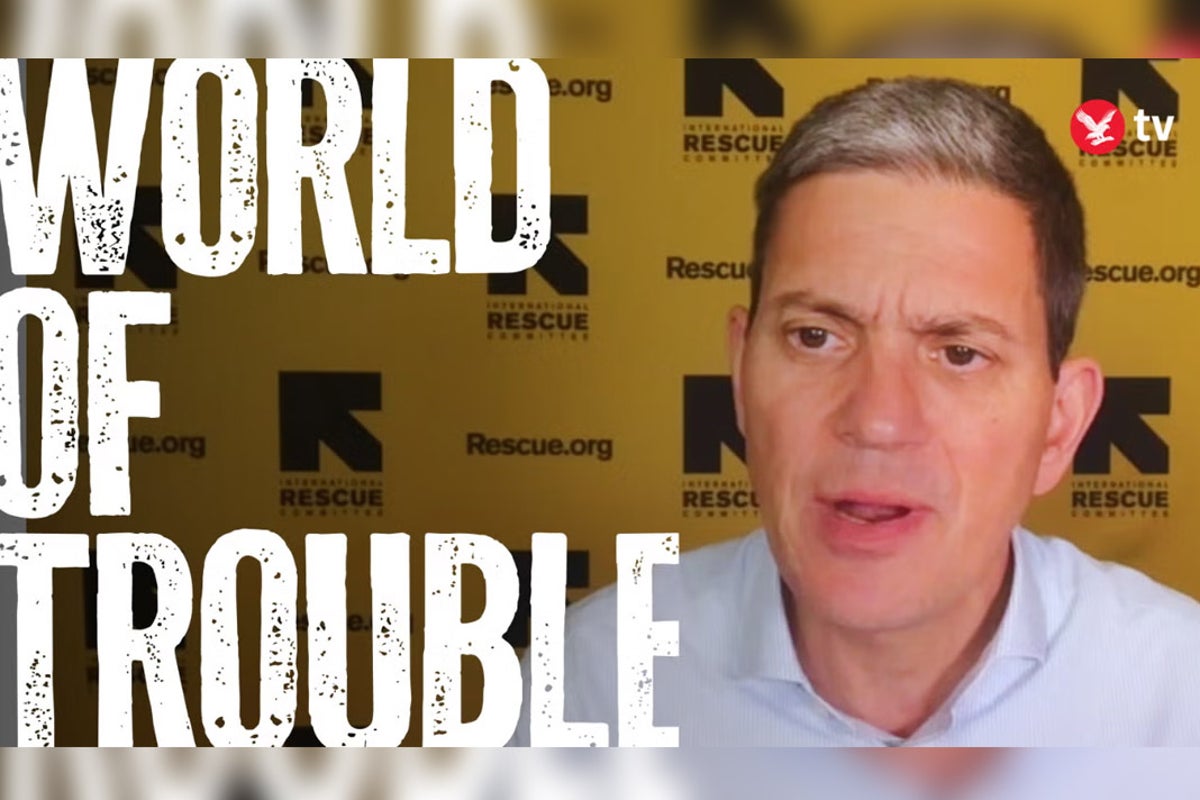
A chaotic world of fragmenting powers is causing conflicts around the globe while democracy is “in retreat and impunity is on the march”, David Miliband has warned.
The former foreign secretary, who now heads up the International Rescue Committee (IRC), told the World of Trouble podcast that his organisation now operates in 35 countries, serving 36 million people – among them two million children.
Citing at least 59 ongoing conflicts around the world, he says there appears to be little prospect of peace breaking through amid western aid cuts and a decline in the rule of international law.
“There is a global mess because the world is so interconnected. The governing guardrails that protected people against danger are in retreat we see that a lot in the conflict zones where we work.
“Now right is in retreat and norms and laws are in retreat impunities on the march. That makes for danger.”
The former Labour politician, who has led one of the world’s biggest aid organisations for 12 years, says global decline in his field had been going on for two decades.
He names the Democratic Republic of Congo, Sudan, Ukraine and Myanmar among the many troubled places.
In its annual list of countries most likely to face a worsening humanitarian crisis in 2026, the IRC’s top five are Sudan, Occupied Palestine territory, South Sudan, Ethiopia and Haiti.
“The wave of democratisation was real in the 1990s and the wave of international determination to curb the abuse of power was real,” he says.
“Since 2006, there’s clearly been a significant retreat of international institutions from their role, not exactly policing the world, but safeguarding the world.
“And there’s been a retreat – not just from the liberal international order – but there’s been a democratic retreat as well.”
Known for his focus on policy and data, Miliband throws out numbers to prove his claims.
“If you look at any of the surveys of democratic health, it’s now the case that 91 countries are considered autocratic and 88 democratic in the project run by the University of Gothenburg,” he adds.
Miliband says the retreat from democracy has been driven by mistakes in the 2000s, including the US-led invasion of Iraq, which was carried out without a United Nations mandate on a false premise.
The refusal of countries like the US, Russia, India and Indonesia to recognise the international criminal court (ICC) has also proved harmful.
But he talks in general terms and is reluctant to criticise nations where his teams work or from which the IRC may get funding, especially since a drastic cut in support from the US treasury after Trump shut down USAID, America’s global humanitarian arm.
The IRC has lost about a third of its $1.5bn funding since the shutdown was announced almost a year ago and the organisation says wider aid cuts also endanger 200 million people affected by conflicts and 120 million who have been forced to flee their homes.
But aid does not always do good.
When asked about evidence over many decades that shows misplaced humanitarian aid can fuel conflicts, Miliband says: “If you’re saying the world’s full of fourth, fifth and sixth best options, you are right and there’s very difficult trade-offs; the abuse of power is very serious.
“You get around it by sticking to your principles, by upholding humanitarian principles which are about independence, neutrality, impartiality and humanity – using them as a shield as well as a sword.”
But he will not say whether he feels “uncomfortable” in Trump’s America – given that he has pointed out how democracy is in retreat around the world as its drifts towards authoritarianism.
There is, though, more than a hint he may return to Britain depending on the demands of his family.
He gives a typically political answer ruling nothing out, or in, when asked whether he would return to UK politics.
“What I would say is that our democracy is precious. Our liberties are precious. They protect minorities as well as majorities. That is the the brilliance of the liberal order… I’m a social democrat, but I defend the liberal order.
“The liberal order says there are different ways of leading a good life, and a healthy community respects all those different ways of leading a good life that respect points of view.
”The human tribe comes in all sorts of different forms, and that’s a good thing – not a bad thing.”
