Despite the mixed rhetoric from Washington, US military planning and capability remains key to Nato war plans
In Estonia, the arrival of 14 US Army M1A1 main battle tanks in October was greeted with a sense of relief. “Whether we have to fight here or somewhere else in the world, Americans do not run from a fight,” US Lieutenant Colonel Andrew Jenkins told local journalists.
Whether such US forces will be there to make that promise throughout future winters, though, is very much in question.
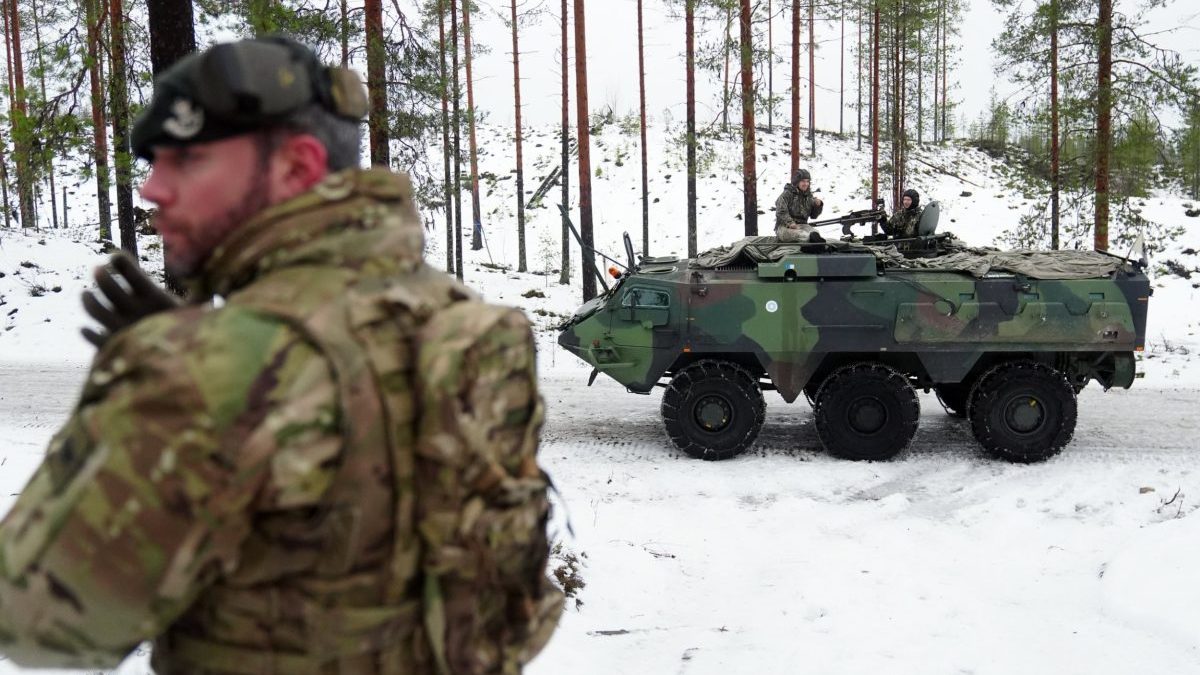
Arguably the most exposed to Russia of the Baltic states, Estonia has since 2017 been home to roughly a thousand British troops and much smaller detachments of French and European forces that make up Nato’s Enhanced Forward Presence in the country.
However, the fact that far more capable US forces could be called in is what has made that deterrent credible.
Despite the mixed rhetoric from Washington, US military planning and capability remains key to Nato war plans.
Last summer, Lieutenant General Chris Donahue, the head of US Army Europe and Africa, outlined elements of the largely secret strategy to use high-tech and heavy forces to defeat any Russian assault.
Even those in Washington who back a strong American presence in Europe warn US strategic focus is shifting to deterring China in the Pacific – and that in a worst-case scenario, a larger conflict in Europe might come at the same time as a Chinese attack against Taiwan.
Meanwhile, the US National Security Strategy published last month left no doubt of the distaste from some in the Trump administration – including potential future presidents – for the European continent.
That – alongside the fact that both Russia and China have become increasingly open in their willingness to use military force to redraw the global map – are central to understanding why European government and military leaders have begun issuing sometimes awkwardly worded warnings that their populations must be prepared to fight.
As head of MI6 Blaise Metreweli put it, the situation sits uncomfortably “between peace and war”. In Ukraine, British, European and US officials have become increasingly significant players in an actual shooting conflict – while across the rest of the continent, the Kremlin steps up its “hybrid warfare” tactics to intimidate, divide, and spread chaos and disillusion.
There is a risk that the sort of vague but melodramatic language used by Anglo-French defence chiefs in recent weeks simply speeds that process. Last month, new French army chief General Fabien Mandon ignited a ferocious row in France when he said the nation must be prepared “to lose its children” to keep Russia in check.
Britain’s Chief of the Defence Staff Sir Richard Knighton was deliberately vaguer – but still unsettling – when he suggested on 15 December that “more families will know what sacrifice for our nations means” as Britain built a “whole of society response” to growing threats.
For all the suspected Russian drones and jets incursions of the recent months, most analysts believe the wider military threat to Europe remains limited for as long as the Kremlin remains engaged in large-scale fighting in Ukraine – although Polish intelligence in particular has warned that Vladimir Putin could still launch another, limited operation now if he truly wished.
But once Ukraine fighting stops or slows, it might not take long – perhaps even as little as a year – for a highly militarised Russian state to rebuild its forces. Then, it may attempt to act to permanently shatter Nato cohesion – particularly if European forces are further divided by sending troops to a post-ceasefire mission in Ukraine.
In theory, Russia might attack at any point along its border or through its ally Belarus into nations including Finland, Poland and any Baltic state. In practice, hefty Polish rearmament and a stepped-up German force in Lithuania mean the options are fewer – with the most exposed Baltic states of Estonia and Latvia by far the most at risk.
It might just be a land grab for a small piece of territory – perhaps a patch of forest or an island, more likely a settlement such as the eastern Estonian town of Narva, the largest Russian-speaking population centre on EU or Nato soil. But it could also be much larger.
Once such territory was seized, the only way for Nato and Europe to regain credibility would be to take it back by force or impose such damage to Russia elsewhere – perhaps through long-range conventional missile strikes – that the Kremlin pulled back. That’s where the clout of the UK and its European allies fast becomes an issue.
The problem is less Britain’s past military spending – at 2024 prices, it spent some £500bn on the military in the last decade, making it Europe’s largest spender, only now being outstripped by a fast-rearming Germany. Those purchases, however, have frequently been of costly systems like aircraft carriers and armoured vehicles – often now seen as easy targets for cheaper enemy drones and missiles.
Britain and France are also spending heavily on atomic arms, which – while critical in deterring Russian nuclear attack on Europe if the US leaves – do much less to reduce the threat of conventional military attack, let alone the targeting of undersea cables, vital shipping routes, or other vulnerabilities.
Britain is purchasing smaller drones it says would make its force in Estonia more potent, as well as pledging to weld the remainder of its army – its two combat divisions – into a single, battle-ready corps for Nato to throw into the fight where needed.
Given long-running issues with UK equipment and personnel numbers – as well as logistics – there are plenty of analysts who do not yet see that UK force as particularly credible. Even if it was, it might only be a short matter of time until such troops were exhausted.
The good news is that other European nations – particularly near Russia’s frontiers – are stepping up, and with a clearer idea of the threat are now spending differently, not just on drones but relatively cheap truck-mounted long-range rockets as well as air defences.
Finland retains a tiny regular army of barely 20,000 – but can mobilise more than 250,000 well-trained reservists in times of conflict, and is sometimes claimed to be the most militarily trained population in history since the ancient Greek city state of Sparta for a fraction of the UK cost. Poland and the Nordic and Baltic states have their own versions of such plans.
Your next read
Germany is looking for ways to mobilise its industrial and human strength in time of crisis, Berlin’s decisions arguably the most important to keeping Russia permanently deterred – although the further one goes from the front line with Russia, the less popular such steps become, particularly with far-right parties that might soon take power.
Britain is also now making sensible choices, often with its allies – for example, linking up with Norway and other nearby partners to secure the North Sea not just with new technology, but also jointly building warships. Much cheaper weapons can now be produced at speed – even if manufacturers are often struggling to get contracts given slow-moving bureaucracy and ministerial spending caution.
Finding the resources to do this properly still looks like a battle – and the wider conversation with society is still hardly getting started.
