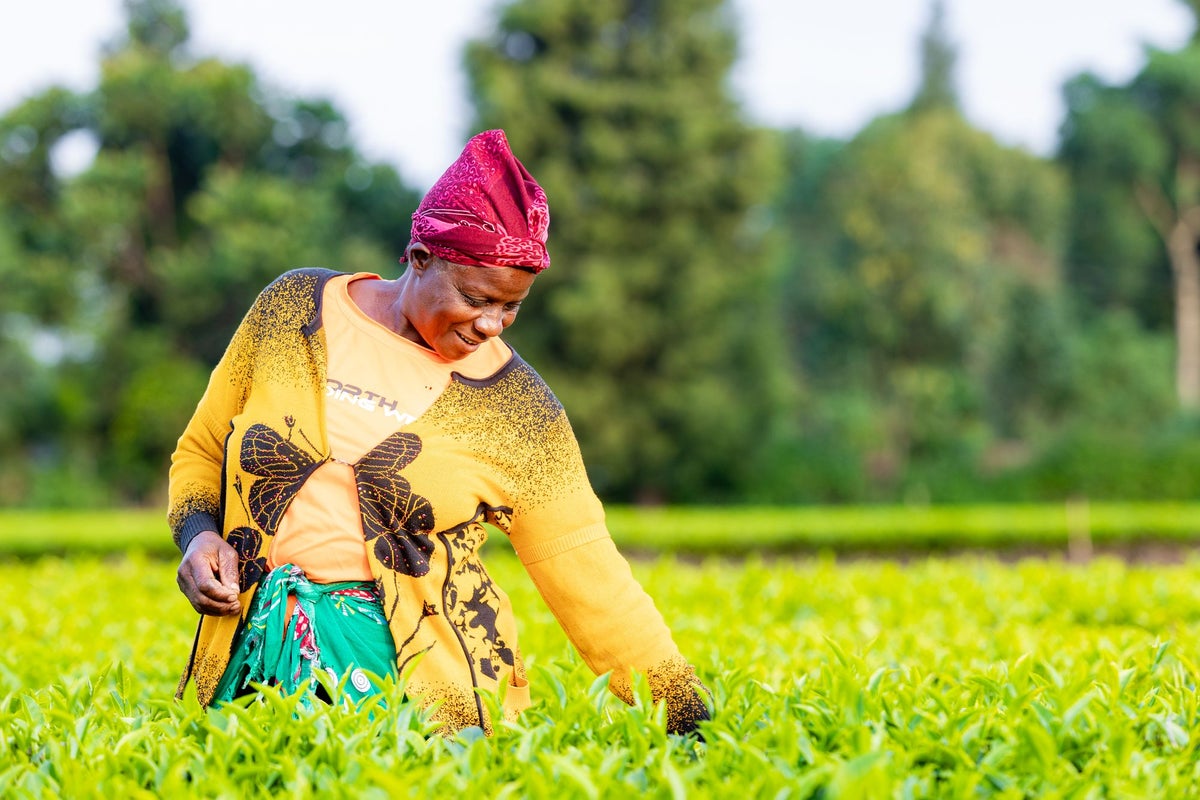
24-year-old Simon lives among the lush, green hills of Kenya’s central highlands, near the bustling regional town of Nyeri. His father owns a small plot of land where the family grows tea, making him one of an estimated 600,000 smallholder tea farmers in the country. The industry provides around half of the tea that we drink in the UK.
As things stand, Simon works online as an “academic writer”: One of thousands of highly-eductated, unemployed young Kenyans ghost-writing essays, PhD dissertations and other academic papers for students in wealthy countries like the UK and US. But he hopes that one day he will be able to save enough money to buy a plot of land so that he too can become a farmer.
“At the moment, I need to stay in employment, so that hopefully one day I will be able to save enough to buy some land of my own and begin farming,” he says, speaking during a visit by The Independent to Iriaini, his tea farming cooperative. “That’s the only option for young guys like me who are passionate about farming: to work hard and to save.”
A growing clamour of voices, however, are warning that young farming enthusiasts in Africa’s up-and-coming economies are increasingly hard to come by. Globally, the share of young people working in agrifood systems has decreased from 54 per cent in 2005 to 44 per cent in 2021, according to a recent report from the UN’s Food and Agriculture Organisation (FAO), while some estimates put the average age for for a farming family in Africa at more than 60.
The allure of the big city (with an estimated 50 per cent of Kenyans set to live in cities by 2050) and the prospect of fast cash from a modern professional role are all cited as reasons why young people are looking for life beyond the plough. Other problems cited include access to land, with plots becoming smaller and smaller as they are split down the generations, as well as the impacts of climate shocks, with an estimated 395 million rural youth living in locations expected to experience declines in agricultural productivity due to climate change, according to the FAO report.
While he remains set on his dream, these are all concerns recognised by Simon. “My family will not give me land at the moment, so all I can do is work hard and save for my own land,” he says. Climate change is also a big worry, he adds, with temperatures higher than they used to be at certain times of year, and at other times rains coming too strongly or not at all.
“If I look ahead fifty years, which is as long as I might be a farmer, then climate change is certainly a big worry,” he says. “We need to do much more now to secure our future.”
His comments come as a survey carried out earlier this year by the Fairtrade Foundation found that 50 per cent of young people in the tea industry believe that climate change is the biggest challenge facing the tea industry. More broadly, only one in five tea farmers said that they earn enough income each month to support their families with the essentials.
For other young Kenyans, the stigma that has developed around farming means that the industry has completely lost its appeal. Dennis, a 30-year-old NGO worker living in Nairobi, has no desire to head back to his village and work on the farm.
“People don’t want to get into farming because for a long time we have associated it with being poor, or we have associated it with old people and retirement,” he says. “My parents’ generation and before that were always into farming, but my generation wants to try out life in the big city – and then maybe when we are older we will go into farming. That’s how it is here.”
Elliot, a labourer in his early 20s working on his father’s tea farm, which is part of the Momul tea factory in the West of the country, is far from happy with his lot. “I am working here because I do not have an option,” he says. “I would love to be doing something else – when you are jobless, it is when you go and work on the family farm.”
Recent years have seen Elliot’s family’s tea farm seriously impacted by climate change, with the crop increasingly impacted by drought at certain times of the year, and hailstorms at others. Last year, the 4,098kg of tea the farm produced was around 30 per cent below the 5,794kg he produced the previous year.
‘Climate change is really bringing about huge losses’
The transition from a largely smallholder-farming population to a more urbanised, educated population is a classic development pathway that countries like Kenya will inevitably pass through as they progress. But with smallholders providing some 80 per cent of Kenya’s agricultural output, and agricultural products representing by far Kenya’s biggest export area, there is a real concern that the cornerstone of the East African nation’s economy could be under threat.
African countries also currently import a large chunk of its food – including a third of cereals consumed on the continent, and 64 per cent of its wheat – so young people turning away from agriculture also raises alarm bells from a food security point of view.
Climate change, which is pushing up the price of food in many countries and threatening the livelihoods of smallholders, is a further complicating factor that previous emerging economies have not had to grapple with in quite the same way that Kenya and other African countries are having to.
“Smallholders are definitely facing a number of constraints at the moment that are concerning to us, including related to land rights, a lack of skills and knowledge around doing farming well, and now everything is being really complicated by climate change,” explains William Matovu, Africa strategy lead at the development charity Heifer International.
“Climate change is really bringing about huge losses across the continent now. The numbers are really massive, with around 3.5 million people impacted by the recent drought in the North of Kenya alone,” he adds.
Concerns around climate change among Kenyan farmers are so great that many existing older farmers also express the hope that the generation ahead of them are able to forge new paths, rather than deal with the same challenges that they have faced.
“I feel sad when I think about the future. Climate change is messing things up so much, and it will take a lot of resilience and lot of training for someone to keep this up once I am gone,” says Martha Mukundi, who also lives in Iriaini, and has recently – with the help of money received from selling tea with the Fairtrade label – bought a cow and started farming avocados in order to diversify her income as climate threats increase.
“The way things are, I would not encourage any of my family members to grow tea because it has become so difficult,” explains Evaline Cherugut, another smallholder tea farmer at the Momul Tea Factory, who now makes more money from beekeeping than from tea farming. “Hailstones, which we never used to see, are wrecking the crop – and the payments are also too low.”
Safeguarding farming for the future
Food systems experts stress that with targeted interventions from NGOs and governments, then the agricultural sectors in countries like Kenya can continue to attract young people, and the industry can continue to thrive.
For William Matovu at Heifer International, a big part of the solution is around developing climate-resilient solutions, so that young people perceive the sector as one that can support them long-term. These include everything from supporting communities to collectively purchase a tractor to boost their efficiency, to making satellite monitoring of weather patterns more accessible and developing early warning systems, to selling insurance products for farmers and pastoralists in case they lose output during extreme weather events.
“Africa has a massive youth population and 60 per cent of the world’s arable land – but it is not producing enough food, and it is not currently perceived as profitable,” he says. “So we have to think of innovative solutions to help the industry and change that reputation.”
Other organisations like the Fairtrade Foundation are also working to make farming a more sustainable sector by giving smallholder farmers a better deal on the products they sell – though the reach of their work depends on how many consumers in countries like the UK are willing to buy Fairtrade products.
Pathe Sene, managing director at the Africa Food System Forum, adds that young people can be encouraged to apply for jobs elsewhere in the food system value chain, where some of the stigmatising dynamics might not be so prevalent.
“There are jobs in food processing, packaging, marketing, transportation, and digital infrastructure,” he says. “We all have to eat, and we need to produce the food that we eat, so we have to make this system work.
“If we can demonstrate that you can work in agriculture, and you can make money and it can be sexy – and it is not the hard, grandparents-type work that uses obsolete equipment and tools – then I think a few more of those young guys will come and join the sector.”
This article was produced as part of The Independent’s Rethinking Global Aid project
