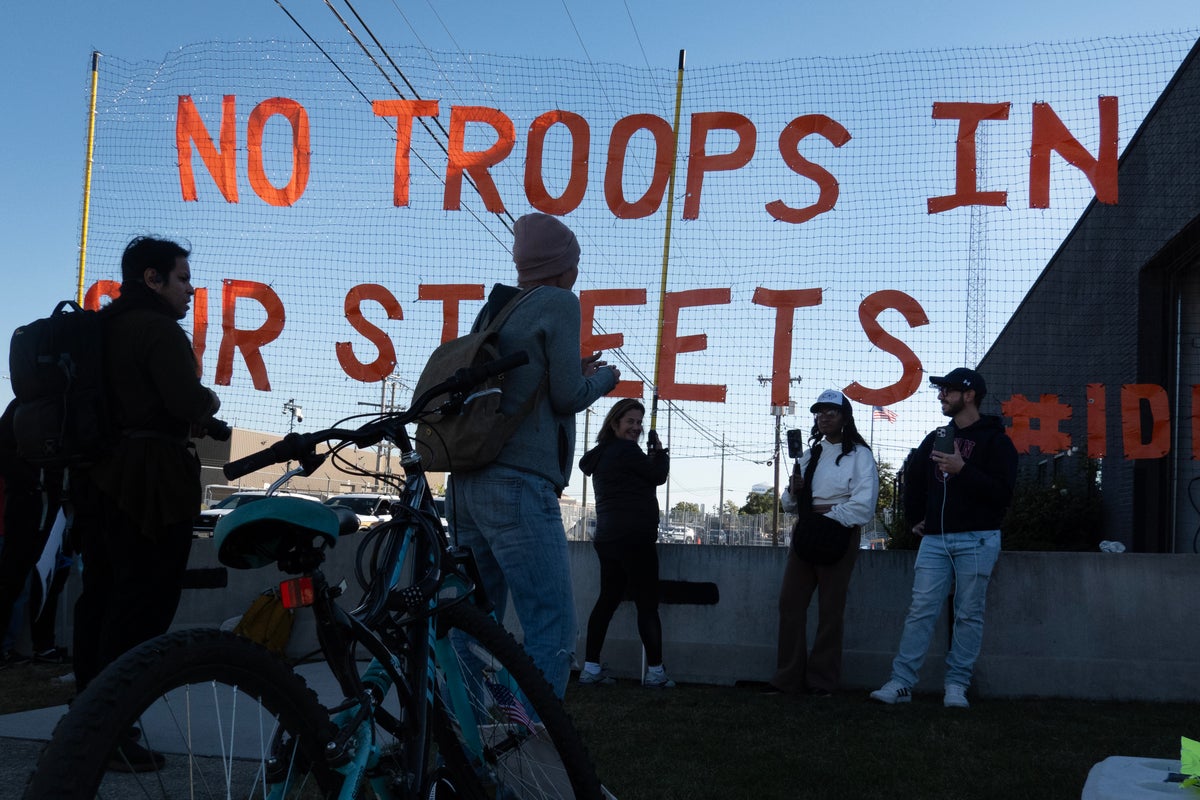
Donald Trump cannot deploy National Guard troops to Chicago, for now, after the Supreme Court refused to allow the administration to send in the military to support immigration enforcement.
Tuesday’s unsigned order from the justices appeared to reject the administration’s argument that protests against the president’s anti-immigration agenda are so volatile that only the National Guard, under Trump’s orders, can stop them.
Conservative justices Samuel Alito, Neil Gorsuch and Clarence Thomas dissented, marking a rare loss for Trump from the nine-member conservative-majority court, which has granted the president nearly two dozen emergency appeals since he returned to the White House and faced an avalanche of lawsuits challenging his agenda.
In this case, the Supreme Court took nearly two months to step in during the ongoing legal battle over boots on the ground in Illinois, as state officials firmly rejected the administration’s attempts to deploy National Guard service members into America’s third-largest city against their will.
The ruling could bolster similar legal arguments against troop deployments in other cities as the president faces widespread resistance from city and state officials over the use of military force on American streets.
The president can invoke the National Guard when “there is a rebellion or danger of a rebellion” or if “the president is unable with the regular forces to execute the laws of the United States,” according to federal law.
Here, the justices determined that “regular forces” likely refers to “the regular forces of the United States military,” and that for the president to call the Guard into service, he must be “unable” to “to execute the laws of the United States.”
But “at this preliminary stage, the Government has failed to identify a source of authority that would allow the military to execute the laws in Illinois,” according to Tuesday’s decision.
It appears Chief Justice John Roberts and conservative justices Amy Coney Barrett and Brett Kavanaugh, who wrote his own concurring opinion, sided with the court’s three liberal justices for Tuesday’s decision.
The order remains in effect while a legal challenge continues.
Illinois District Judge April Perry determined earlier this year that there is “no credible evidence that there is a danger of rebellion” in the state and issued a temporary restraining order blocking Trump from deploying National Guard troops.
A federal appeals court largely agreed, and the administration kicked the case up to the Supreme Court to overrule the lower-court decisions and give the president a greenlight.
The Trump administration argued that troops are necessary “to protect federal personnel and property from violent resistance against the enforcement of federal immigration laws.”
Meanwhile, the administration has surged federal law enforcement agents into several large cities and metropolitan areas to boost the president’s mass deportation campaign, sparking parallel legal battles challenging officers’ use of riot control weapons and sweeping arrests that met with large-scale protests.
The case is among several challenges against the president’s use of the National Guard, which one federal judge compared to Trump’s attempt at creating a national police force.
A federal judge in Oregon has permanently blocked National Guard service members from supporting federal agents in Portland, and another judge in California has said the president’s deployments in the Los Angeles area are illegal.
In Washington, D.C., a lawsuit from attorney general Brian Schwalb is trying to block hundreds of service members from patrolling the nation’s capital, an argument supported by nearly two dozen other states.
