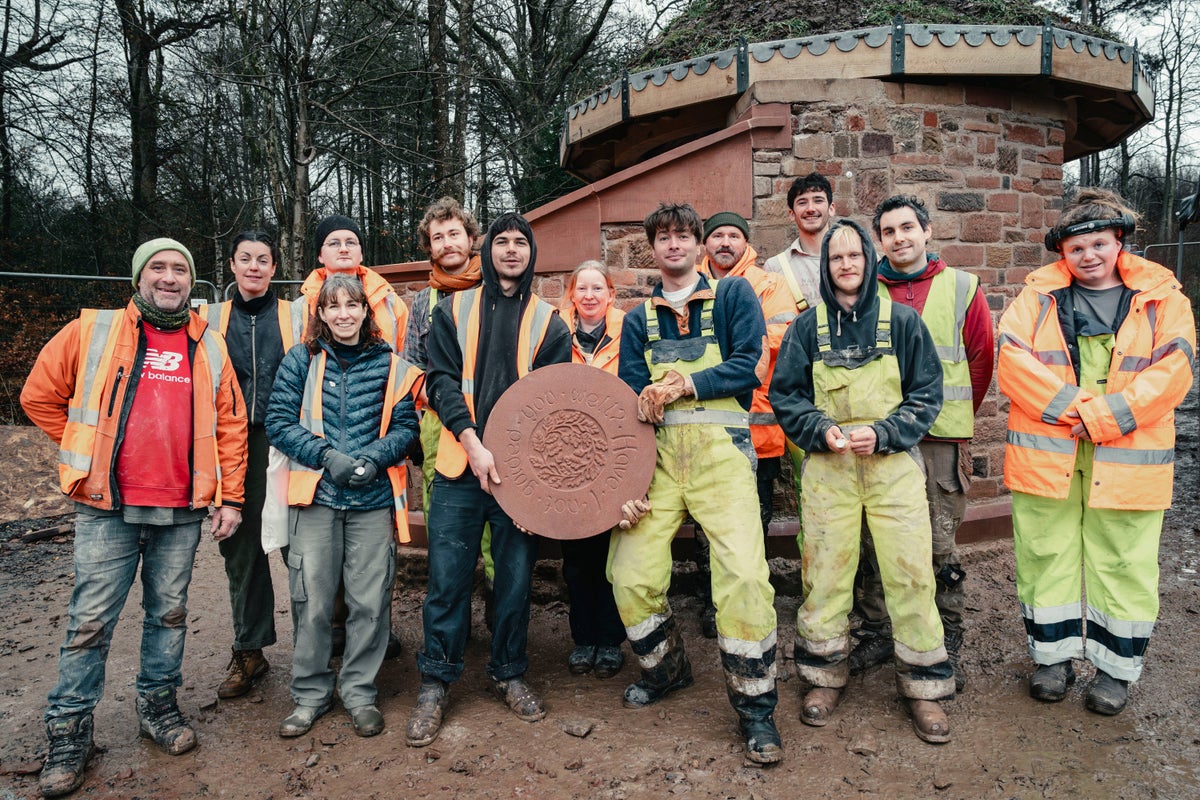
Students learning traditional building skills have described the “honour” of building a new nature hide at the headquarters of a foundation set up by King Charles.
The permanent structure has been built on the 2,000-acre Dumfries House estate in East Ayrshire by students on the building craft and conservation programme (BCP), which is run by The King’s Foundation.
It is the 35th “live build” construction project to be built by BCP students, and coincides with the foundation’s 35th anniversary.
The trainees, who are learning skills including heritage stone masonry, plastering and joinery, built the hide over 13 weeks as part of a nine-month course that has seen them undertake training and work placements at various sites around the UK.
The hide is in an area of woodland near the main house, and it is intended to provide a haven where visitors can spend time in harmony with nature while exploring the grounds.
The structure is inspired by the legend of Ghillie Dhu, a mythical being once thought to inhabit woodland near Loch a Druing in the Highlands, and who is said to have guided a little girl to safety when she got lost while out foraging.
It has a timber frame and an earth roof, and features intricate stone carvings, a woodcarved window, and ornate plasterwork depicting words and motifs from the story.
Jennie Regan, 45, who took up stonemasonry after working in university administration for 15 years, was responsible for carving the circular stone block in the centre of the floor of the hide.
Speaking to the Press Association the day before the hide was due to be completed she explained: “We’ve got six stonemasons, a heritage brick layer, a couple of plasterers and three carpenters working on the site together.
“It’s very stone-heavy, so there’s a lot of rubble wall, a lot of carving of newel posts and the ramp and twists, so there’s lots of different elements to it.
“I’m currently carving a piece for the centre of the floor. It’s going to have some leaves and a phrase from the story.”
Ms Regan, who comes from Somerset, added: “The lettering was OK, I think that will hold it nicely.
“As for the leaves that I’m carving, time will tell how they hold up.”
Aston Harrison-Taylor, 29, from Worcester, worked on the decorative plaster panels which contain images and words from the Ghillie Dhu story.
He said it was “wonderful” to be working on a live build for the Dumfries House estate.
“The King came down about a month ago to come and do a few things here and with a graduation for the last year’s group,” he said.
“He gave us some suggestions on craftsmen that he knew of … and just had a genuine appreciation for the sort of work we’re doing and the skills that we’re trying to learn here.”
Like his father and grandfather before him, Mr Harrison-Taylor works as a plasterer, but said he enrolled on the course because he wanted to learn traditional plastering skills.
“They’re much better for the environment,” he explained.
“A large percentage of our houses in the country are still old houses, and they still need these methods.
“I’ve personally seen quite a lot of people using the wrong materials, whether it’s for a money reason or just out of ignorance for the materials, the wrong materials end up getting used.
“So it would be nice for us to have people who can learn and still use these materials.”
He added: “It’s a real honour to have something in (Dumfries) House that’s actually going to be a permanent structure here, which people will be able to come and enjoy for hopefully a long time.”
Simon Sadinsky, The King’s Foundation executive director, said: “Since His Majesty King Charles III first founded the Institute of Architecture (which became The King’s Foundation) in 1990, our students – under the guidance of our specialist tutors – have established a proud tradition of designing, then constructing or restoring, buildings that enhance the public realm all across the United Kingdom.
“This latest addition, a nature hide, will stand as a monument to the skill of our 2025 BCP students, as well as the commitment of The King’s Foundation to preserving traditional craft skills, for generations to come.”
The 35 live builds constructed by King’s Foundation students can be found at various sites across all four UK nations.
They include include a “goose hoose” in Scotland that is home to rare-breed Shetland geese, a summerhouse in the historic walled garden at Hillsborough Castle in Northern Ireland, a pavilion at Poundbury in Dorset, and a thatched-roof bird hide at Llangorse Lake in Wales.
