First Fight aims to expose trainee soldiers to the stresses of the battlefield before they get there
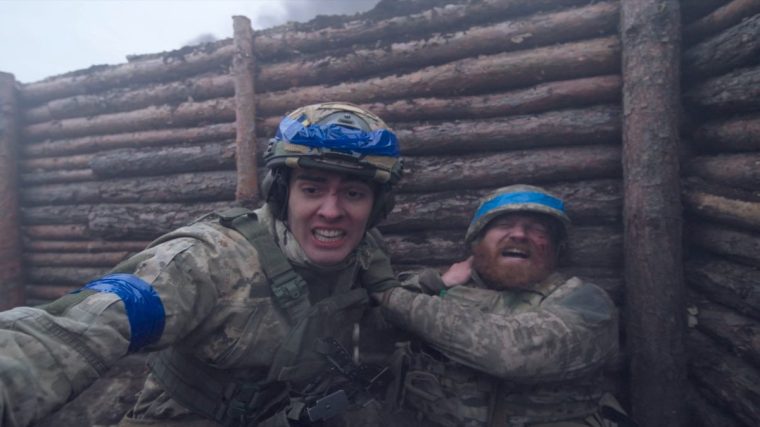
I’m standing in a trench on the Ukrainian front line, a rifle in my hands. Gunshots and blasts pierce the air. To my right, slumped against the wooden trench walls, is a soldier, his face covered in blood. I reach down to shake him by the shoulder, and he slides lifelessly sideways. Just yards away, a missile strikes, sending a plume of debris into the air.
Thankfully I’m not really there. I’m actually 1,600 miles away in London, wearing a virtual reality headset and a stupefied expression. The following five minutes are no easier: in startling and noisy 360-degree realism, there is blood, screaming and enemy soldiers galore.
What I’m watching is a VR experience, First Fight. It is being shown to every new Ukrainian recruit and is designed to provide a form of exposure to the stresses of the battlefield while they are in a safe training environment.
The tech has been developed by Ukrainian company Aspichi and the department of arms development and innovation at Ukraine’s Hetman Petro Sahaidachnyi National Army Academy.
Aspichi CEO Viktor Samoilenko says: “It’s not only about being prepared for something. It is about being prepared for learning under huge pressure.”
There are currently two versions: a more traditionally educational one that pauses at key moments – such as when an enemy soldier throws a grenade – and provides direction on dealing with it.
The other version, the one I watched, omits this educational overlay – it’s just about exposing you to the realities of combat.
Moving at the speed of war
VR and mixed reality has been used in military training for decades, providing a sort of familiarity with everything from flying an F-35 to modern-day first-person-view drone operations.
Aspichi, which began providing VR therapy in 2022, is trying to address Ukraine’s need – within a tight training window – to prepare tens of thousands of civilians-turned-soldiers for the stresses of warfare. It’s a problem with few precedents in modern European conflict.
In 2022, after the start of Russia’s full-scale invasion, Samoilenko and his CTO, Maksym Goncharuk, realised that there could soon be a mass demand for the treatment of traumatised Ukrainians – and not enough therapists to help them.
They developed a programme delivered via VR, combining calming images with cognitive behavioural therapy (CBT) prompts over audio, “and then we just started to evolve that concept,” Samoilenko said. They realised that not only could VR be used for therapy – it could also be used to help prepare and educate recruits.
“From that we started building immersive education,” he said, adding that it is about psychological preparation as well as getting basic survival knowledge. The goal is to develop a library of 30 or more immersive experiences for soldiers, covering everything from tactical medicine to defending against a drone attack.
It’s about the need to quickly take large numbers of Ukrainians “from pure civilian people into ready-to-survive-and-fight soldiers,” Samoilenko said.

Dominic Murphy, an expert in military psychology and head of research at veteran mental-health charity Combat Stress, compared First Fight to behavioural exposure or stress inoculation, where people are gradually exposed to stressful situations, while learning strategies to cope with them.
“Military training is often about being exposed to difficult situations repetitively,” he said. Over time, this can reduce the adrenaline spike, allowing better situational awareness, “which in theory could improve decision-making”.
That’s crucial not only for individuals but for reducing casualties across a unit, Samoilenko said. If a combatant panics or is in shock, it can put the whole operation in danger.
VR could present many advantages to complement other military training exercises. Compared to a realistic in-person training scenario, it is inexpensive and scalable. It is also far more vivid than any PowerPoint lecture or rote assault course a trainee can be put through.
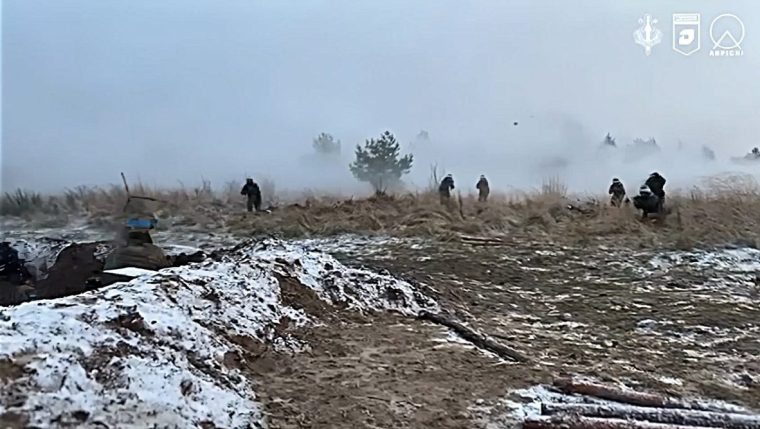
“We do have clinical research on the effectiveness, on the impact of rich audiovisual stimuli on the brain,” Samoilenko said.
Murphy said there is “very compelling evidence” that “virtual reality increases physiological arousal”. He is currently researching the effects of VR to treat mental-health difficulties in veterans.
Brutal – for a reason
While First Fight is not a pleasant experience, it is rooted in an urge to preserve Ukrainian soldiers’ well-being – a stark contrast to the disregard for human life shown towards Russian rank-and-file fighters by their own leaders in Moscow. In fact, one of the most traumatising things that Ukrainian fighters can see, Samoilenko said, is the walls of bodies that pile up in Russian “meat wave” attacks.
“Then our guys have a trauma because they cannot comprehend or accept that there could be such an attitude to the life of their own soldiers,” he said.
Your next read
Aspichi is currently offering its products free of charge to Ukraine’s military, but with the hope of commercialising the system internationally.
Could First Fight actually help prevent battlefield trauma, both in Ukraine and elsewhere? The research on the ability of behavioural exposure to do this is not particularly robust, Murphy said. But the need to support Ukrainian fighters – who often have short rotations in and out, and then return home to cities that are also under attack – is critical, he said. “There’s clearly a very important need.”
From my own brief experience with the tech, the brutal scenes left a lasting impression – one that helped me imagine what some Ukrainians are going through. It was a worrying experience indeed.
