WASHINGTON DC – Just a fortnight after Gianni Infantino bestowed the first-ever (and perhaps only ever) FIFA Peace Prize upon him, Donald Trump has gone all out on his attacks on Venezuela and is barely hiding the fact that he intends to wage a war for oil on the country.
In an astonishing move on Tuesday, the US President announced via his Truth Social platform the imposition of “A TOTAL AND COMPLETE BLOCKADE OF ALL SANCTIONED OIL TANKERS going into, and out of, Venezuela”.
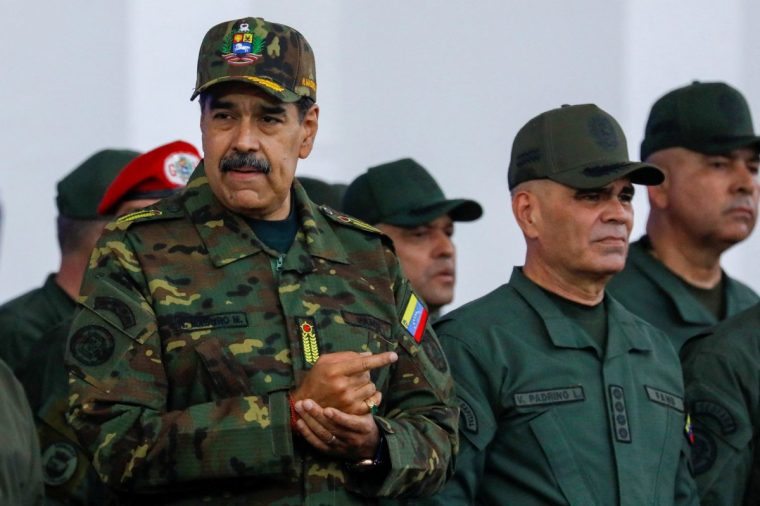
This came days after the White House was accused of piracy on the high seas by seizing the Skipper, a Venezuelan tanker believed to have been carrying 1.9 million barrels of sanctioned oil to Cuba. Trump is now vowing a dramatic expansion of his efforts to unseat Venezuelan President Nicholas Maduro in Caracas.
In his comments on Tuesday. Trump claimed that he had deployed the “largest Armada ever assembled in the History of South America”, and indeed the presence in the region of the USS Gerald Ford – the world’s largest aircraft carrier – serves as a potent warning that Trump means business.
Trump even claimed that US forces have Venezuela “completely surrounded”, which suggests he may not be fully aware of the region’s map. The country has land and maritime borders with 15 separate countries, including the UK (if you count tiny Montserrat in the Leeward Islands).
But Trump’s determination to try and effect regime change in Venezuela is intensifying. In his social media post, he raised the stakes further, for the first time designating the entire Venezuelan government a “FOREIGN TERRORIST ORGANIZATION”, and accusing Maduro and his colleagues of “using Oil… to finance themselves, Drug Terrorism, Human Trafficking, Murder and Kidnapping”.
Trump has repeatedly accused Caracas of smuggling narcotics into the US, though the Pentagon has provided no proof to support its claims that more than 20 speedboats and other maritime vessels destroyed by US air strikes since September were laden with drugs. At least 94 people have been killed in those attacks, and at least one family has already filed a lawsuit against the US government.
Maduro denies being a drug trafficking kingpin, and his Government described Trump’s latest warnings as “warmongering threats”. A Venezuelan statement said Trump is planning “to impose, in an utterly irrational manner, a supposed naval blockade on Venezuela, with the aim of stealing the riches that belong to our homeland”.
Accusations of oil theft, however, run both ways.
For the first time, Trump is now indicating that he believes Venezuela has stolen oil from the US, claiming that his military pressure on the country will continue “until such time as they return to the United States of America all of the Oil, Land and other Assets that they previously stole from us”.
This appears to be a reference to Venezuela’s nationalisation of its oil industry, which took place in 1976 under the leadership of former Venezuelan president Carlos Andres Perez and essentially derailed around $5bn (£3.8bn) in earlier investments by US companies, including Exxon, Gulf Oil and Mobil.
In 2007, Hugo Chavez, Maduro’s mentor and predecessor, expropriated additional assets held in the country by Exxon and Conoco, a move that directly led to the first US oil sanctions on Venezuela.
Some oil companies are sensing an immediate opportunity in Trump’s actions. At least two are reported to be in negotiations to acquire the oil aboard the Skipper from the US Government, after Trump claimed the US would assume ownership of it. Eighteen other sanctioned tankers are believed to be already loaded in Venezuelan ports and would be subject to US interdiction if and when they enter international waters.
For Cuba, which is heavily reliant on Venezuelan oil, the US military action poses enormous problems. The Cuban Government is accusing Trump of “maritime terrorism” aimed at creating “economic suffocation”.
Trump’s tightening of the noose around Venezuela comes barely a week after the publication of the US’s new National Security Strategy, which embraces the 1823 Monroe Doctrine, claiming that Latin America is Washington’s unique sphere of influence. That doctrine, promulgated by President James Monroe, was a 19th-century effort to warn European powers against colonial activity in the region.
How Trump manages to justify his bellicose intent towards Venezuela, while trying to maintain his position that he is the “peace president”, is unclear. On Capitol Hill, he is facing pushback over his contortion, with even some Republicans saying they are wary of the US President’s foreign policy moves.
Your next read
Senator Josh Hawley, a Republican from Missouri, said earlier this month that “there’s a difference between striking boats that are potentially [carrying] traffickers and landing troops in Venezuela”. The White House says there are no current plans for “boots on the ground” in Venezuela.
Meanwhile, Trump has claimed that each speedboat blown up by the US military was carrying enough narcotics to kill more than 25,000 people. Those numbers do not stand up to scrutiny. In the last year, federal government data shows that 82,000 Americans died of drug overdoses, a sad number but far below the number of lives that Trump already insists he has saved.
Trump has always been more interested in what he can grab. It is looking increasingly like Venezuela’s oil is the thing he is now eyeing up.
