Fire and Ash is just as interminable as the others – only this time there are AK-47s. Can it really save cinema?
Slagging off Avatar is a lazy pursuit. Unfortunately, given James Cameron’s $400m, 195-minute third instalment is being hailed once again as the saviour of cinema, it is impossible to avoid.
Avatar: Fire and Ash, comes 16 years after the “groundbreaking” original since that film’s protracted, washed-out follow-up The Way of Water. It takes those two already indistinguishable, repetitive, bladder-straining, $5.2bn-grossing films – about the skinny blue Na’vi humanoids, defending the lush moon Pandora against the existential threat of human greed – and adds AK-47s.
On its release in 2009, Avatar was a global phenomenon. It is hard to imagine a more hyped Hollywood event, more effusive praise for its storytelling feat, more reverence for its pioneering film-making. It was a must-see, and we all saw it, and it was quite stunning, but its legacy flatlined immediately.
That didn’t stop it inevitably being turned into a megabucks franchise with a series of what are proving to be very samey sequels. This one would like to be an allegorical epic about colonisation, capitalism, fatherhood, chosen families, indigenous peoples, environmental beauty, and grief. Alas, promise of depth of any kind is headed off at the pass as the word “bro” is spoken about eight times in the first three minutes.
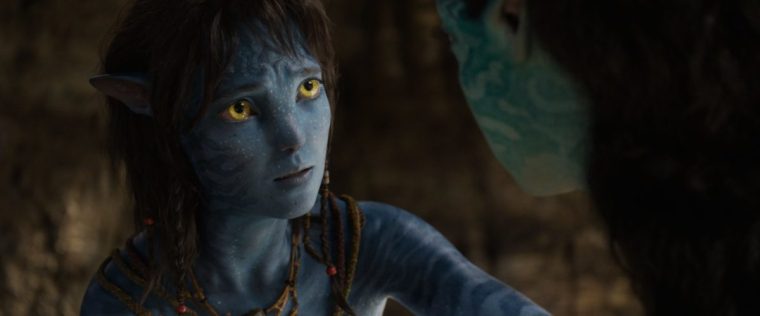
Don’t get me wrong – though my experience would have been significantly enhanced with the kind of psychedelic drugs inappropriate for a 10am press screening on a Monday morning, I did not suffer too badly on my return voyage to Pandora.
This was mainly because there is an enormous battle in the opening scenes that takes us soaring through the sea and sky on the back of some winged dino-beast darting the fire spears of an invading volcanaic Na’vi clan.
It is so thrillingly immersive that it immediately establishes the point of the film – that 3D is not yet passé – so convincingly you instantly stop hoping that the story will be good, or indeed in existence, and start to treat it like a theme park ride. (Which is clearly the final form of this franchise, and I rather think could have just been a Disneyworld extension and skipped the films altogether. There are two more sequels to go).
It’s probably because they’re in bright shiny colours, but I really did marvel at the action scenes, as loinclothed tribespeople charged through forests, as massive whale-like “Tulkun” creatures overturned ships, as our heroes – with no ostensible personalities, no development and no distinguishing characteristics to share between them – looped through the skies. These sequences were paeans to what I’m sure are Cameron’s inspirations for the franchise: Thunderbirds, Mad Max, Eiffel 65.
So pleasantly nullified was I that I began to hope he had abandoned all the abortive emotional stuff about love and extinction and racism, and stopped trying to deliver a message about the environment (which we can see out of the window with our own eyes and is only abetted by the resource required to execute this kind of technology) and conceded that Avatar is purely an SFX event. That I would have accepted. Sadly, however, it was also stuffed incredulously with plot.
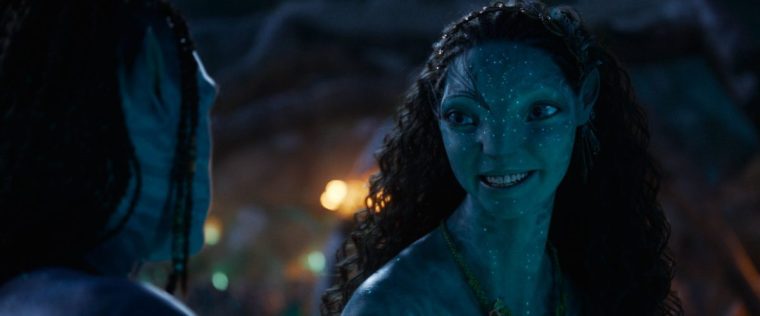
I’ll get some of that out of the way here. The Na’vi species are still at threat from the “sky people” (humans) who want to plunder Pandora’s natural resources and destroy their ways of life, just like they have to Earth. Ex-human Na’vi convert Jake Sully (Sam Worthington) still has a target on his back by his old marine mucker Miles Quaritch (Stephen Lang), who’s out for vengeance because Sully betrayed his people and shacked up and started a family with hot Na’vi Neytiri (Zoe Saldaña).
She continues to be an entirely lifeless “matriarch” who can’t forgive him for being born a human, while he can’t forgive his son for the foolishness that led to the death of their other son.
Their remaining kids, meanwhile, are going through some sort of coming of age adventure – one of them is bonding with whales, another is a human adoptee with an oxygen mask, and another used to be Sigourney Weaver and is now the Na’vi child of Sigourney Weaver (don’t ask).
Oh, and there’s a very scary sexy rival Na’vi queen with a gun fetish who’s shagging the marine and has teamed up with the sky people – Edie Falco is back in her big Transformersy robo-suit – to finish them all off and drill for Na’vi elixir of life. Or something.
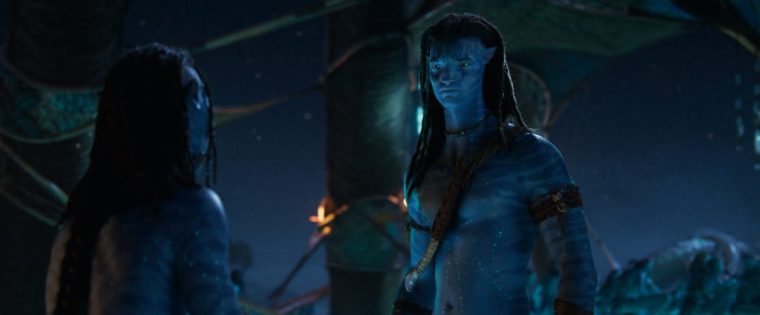
The only reason any of this is tolerable is because of the distraction of 3D. The impact of special effects long ago hit diminishing returns and in an age of AI, we have never been more jaded. Avatar: Fire and Ash does feel like being locked in a hyper-realistic video game, especially due to its relentless runtime and metastatic storyline and luminescent tentacles, but the details, like the dazzling pearlescent oysters strung on a tribesman’s necklace, still left me in awe.
Ironically though, the effect that most impressed me was how realistically it rendered water lapping over pebbles on a riverbank. Which does rather beg the question, much as in The Way of Water before it, if I wanted to appreciate the beauty of the aquatic world, couldn’t I have just gone to an aquarium?
At least there I would not have to endure the dialogue, which apart from being bad is so colloquial – particularly in the case of the adolescent brood exploding with “bullshit” and “leave my mother alone, bitch!”, and “that’s right, buttholes!” – that it prevents these films from ever being timeless.
Your next read
The Avatar universe has its real-world devotees and many of them have learned to speak the Na’vi language. This is especially bewildering given that aphorisms in this instalment include, “When you ride the beast, you become the beast”, “You got new eyes, Colonel, all you gotta do is open ‘em”, and “We do not suck on the breast of weakness”.
The film industry has a lot riding on Avatar: Fire and Ash. It is predicted to make billions of dollars worldwide, to salvage this year’s tanking box office sales, to powerfully remind the masses of the magic of a communal, theatrical spectacle and the importance of real cinemas in the face of streamers and second-screens and short-form video.
If this is achieved by eschewing new ideas and heart and storytelling and instead holding ticket-buyers hostage with a prolonged assault of the big, flashy, familiar and dumb, Avatar has not saved cinema but killed it for ever.
‘Avatar: Fire and Ash’ is in cinemas on Friday
