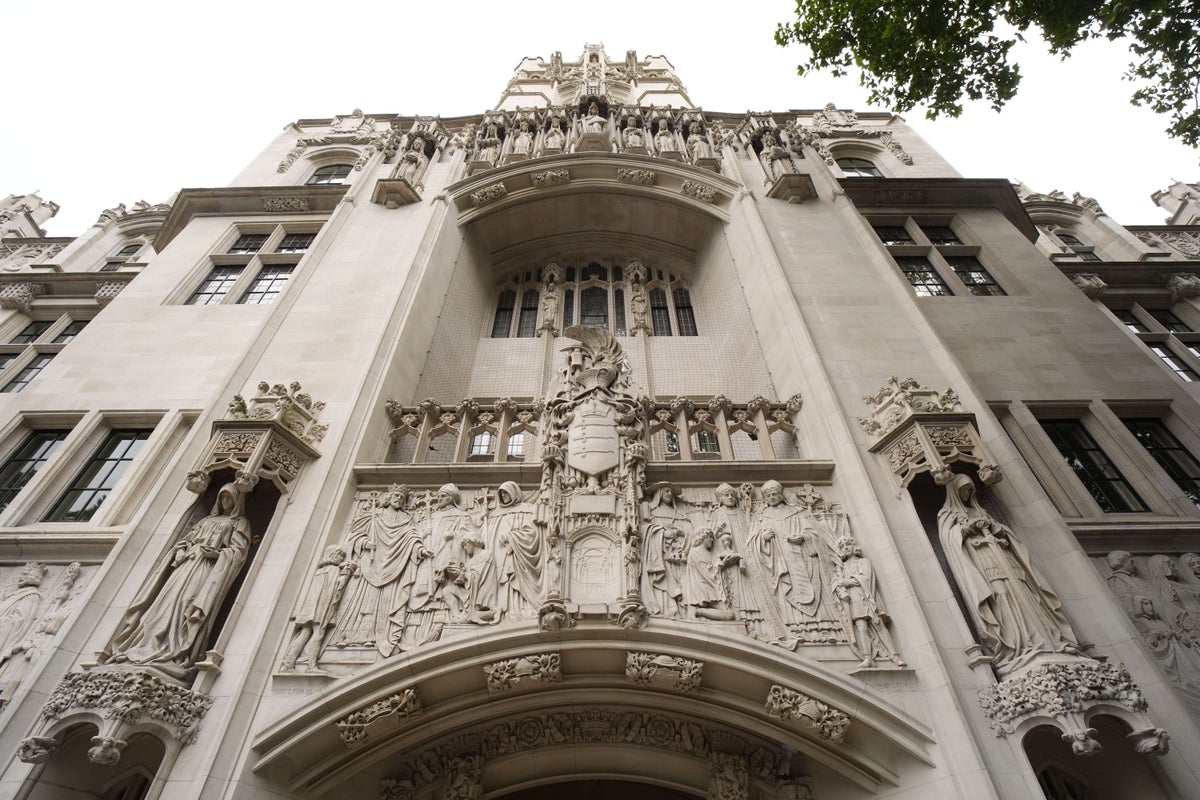
The Government has won an appeal which prevents a coroner in Northern Ireland disclosing certain sensitive material at a Troubles inquest.
The Supreme Court has overturned a decision by coroner Louisa Fee to disclose summaries, or gists, of the evidence in a sensitive security force file related to the murder of a man in west Belfast 30 years ago.
The court said while it has “considerable sympathy” with the desire of the Police Service of Northern Ireland (PSNI) Chief Constable Jon Boutcher to be transparent, the responsibility lies with the Northern Ireland Secretary over assessing risks to national security.
The ruling could have implications for a number of Troubles deaths involving state secrecy.
Liam Paul Thompson, 25, died on April 27, 1994 after being shot by loyalists in the area of Springfield Park.
His family believe there was state collusion in his murder.
The High Court and Court of Appeal in Belfast had previously backed the coroner’s decision to release the gists as part of her inquest findings, leading the Government to appeal against that decision to the UK’s highest court.
In his judgment, Lord Stephens said one of the issues for the coroner to consider had been the fact that the Ministry of Defence and PSNI held documents which were relevant to the issue of whether the security forces had received information from a covert human intelligence source in connection with Mr Thompson’s death.
He said the Government considered that “disclosing those documents would be contrary to the public interest in protecting national security, in particular because it would be contrary to the policy of neither confirming nor denying the use of informers or other secret source”.
The judgment said the coroner had made a number of errors in her decision to disclose the gists.
Lord Stephens said: “The Coroner failed to apply the correct test before departing from the assessment by the Secretary of State as to the nature and extent of damage to national security which would flow from disclosure.”
He added: “The Coroner wrongly failed to obtain the views of the Secretary of State before making any decision to disclose the gist of the information.”
The court referred to a “disagreement” between Mr Boutcher and Northern Ireland Secretary Hilary Benn as to the extent of risks to national security by disclosing the second gist.
Lord Stephens said: “We have considerable sympathy with the desire of the Chief Constable to demonstrate that the PSNI is seeking to be transparent.
“However, the Secretary of State is best able to assess the extent and nature of the risk to national security by consulting as appropriate with all relevant public authorities and weighing up and considering the views of those authorities.
“In forming his opinion, the Chief Constable has not consulted with other public authorities.
“Furthermore, the Secretary of State has the political authority and responsibility to make that assessment.
“The Chief Constable does not.”
Mr Thompson was shot in a taxi on his way home in an attack that has been attributed to loyalist paramilitaries.
His family believe that police were aware that the taxi firm had been under a credible threat from loyalists.
The State had sought to withhold some sensitive material from the inquest on Public Interest Immunity (PII) grounds.
