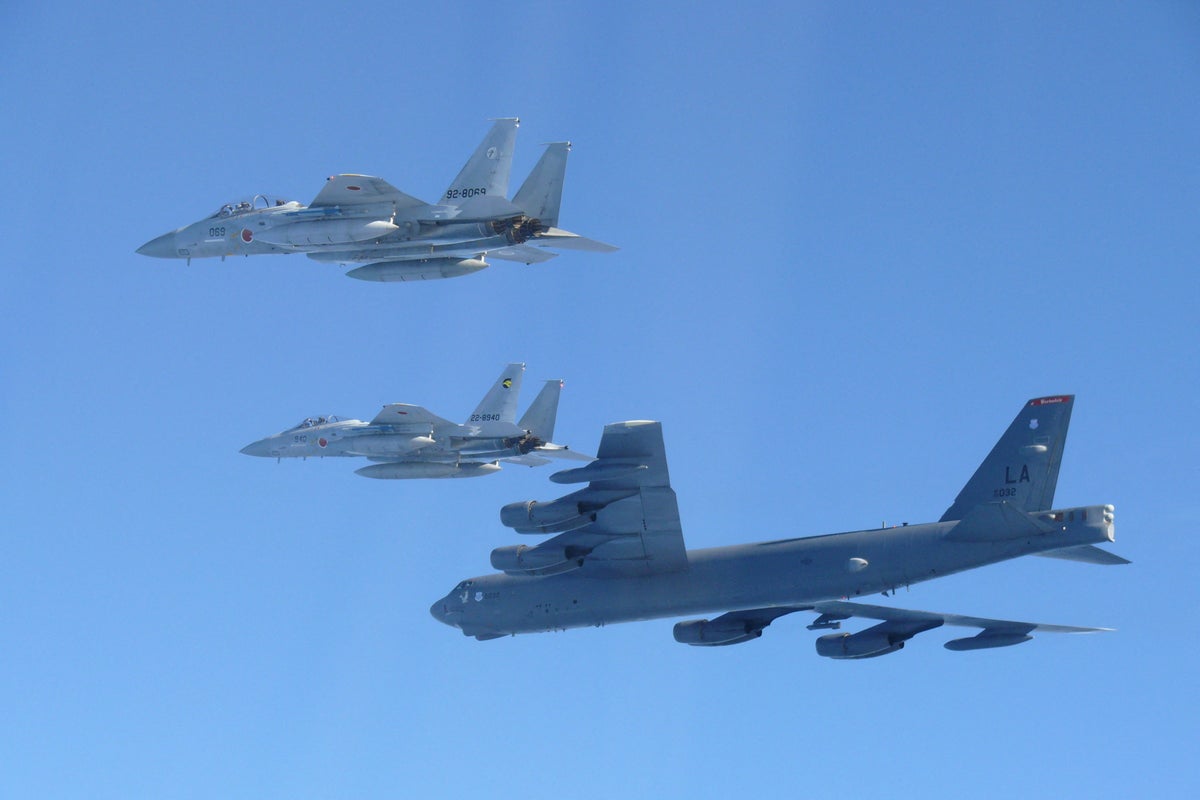
US nuclear-capable bombers conducted joint flights with Japanese fighter jets over the Sea of Japan on Wednesday, in a clear show of force following recent Chinese and Russian military exercises in the region.
Tokyo confirmed the operation, which saw two US B-52 strategic bombers fly alongside three Japanese F-35 stealth fighters and three F-15 air-superiority jets.
This marked the first time the US had asserted its military presence since China initiated a series of drills last week.
Japan’s defence ministry stated on Thursday that both nations “reaffirmed their strong resolve to prevent any unilateral attempt to change the status quo by force and confirmed the readiness posture of both the Self-Defense Forces (SDF) and US forces.”
The display comes after a joint flight of Chinese and Russian strategic bombers across the East China Sea and western Pacific on Tuesday.
Separately, Chinese aircraft carrier drills prompted Japan to scramble jets, with Tokyo alleging its aircraft were targeted by radar beams.
China, however, denied this accusation, claiming Japanese jets had endangered its air operations south of Japan.
Washington criticised China’s actions as “not conducive to regional peace and stability” and reiterated that its alliance with Japan remained “unwavering.”
Show of force
Both Japan and South Korea host US forces, with Japan home to the biggest concentration of American military power overseas, including an aircraft carrier strike group and a US Marine expeditionary force.
Japan’s Chief of Staff, Joint Staff General Hiroaki Uchikura, said the Chinese and Russian joint bomber flight was clearly a show of force directed at Japan.
“We consider it a grave concern from the standpoint of Japan’s security,” Uchikura, the country’s top uniformed military officer, said at a regular press briefing.
Defence Minister Shinjiro Koizumi also shared Japan’s concerns about the Chinese and Russian aircraft with the North Atlantic Treaty Organisation chief Mark Rutte in a telephone call on Wednesday.
Speaking in Beijing, Chinese Foreign Ministry spokesperson Guo Jiakun said the drills with Russia were part of the two countries’ annual cooperation plan, demonstrating both sides’ determination to “safeguard regional peace and stability”.
“The Japanese side has no need to make a fuss about nothing or to take this personally,” he added.
Activity near South Korea and Taiwan
South Korea’s military said it also scrambled fighter jets when the Chinese and Russian aircraft entered its air defence identification zone on Tuesday, an area that extends beyond its airspace and is used for early warning.
Chinese military ships and aircraft operate almost daily around Taiwan, in what Taipei says is part of Beijing’s ongoing pressure campaign.
On Thursday, Taiwan’s defence ministry reported a stepped up Chinese military presence for a second day in a row. It said it had detected 27 aircraft, including nuclear-capable H-6K bombers, conducting a “joint combat readiness patrol”, along with warships around the island.
Late on Wednesday, the ministry said Chinese J-16 fighters and H-6 bombers had again carried out long-range training in the Western Pacific after passing to the south of Taiwan.
Regional tensions have risen since Japanese Prime Minister Sanae Takaichi triggered a dispute with Beijing last month with her remarks on how Tokyo might react to a hypothetical Chinese attack on Taiwan.
China claims democratically governed Taiwan and has not ruled out using force to take control of the island, which sits just over 100 km (62 miles) from Japanese territory and is surrounded by sea lanes on which Tokyo relies.
