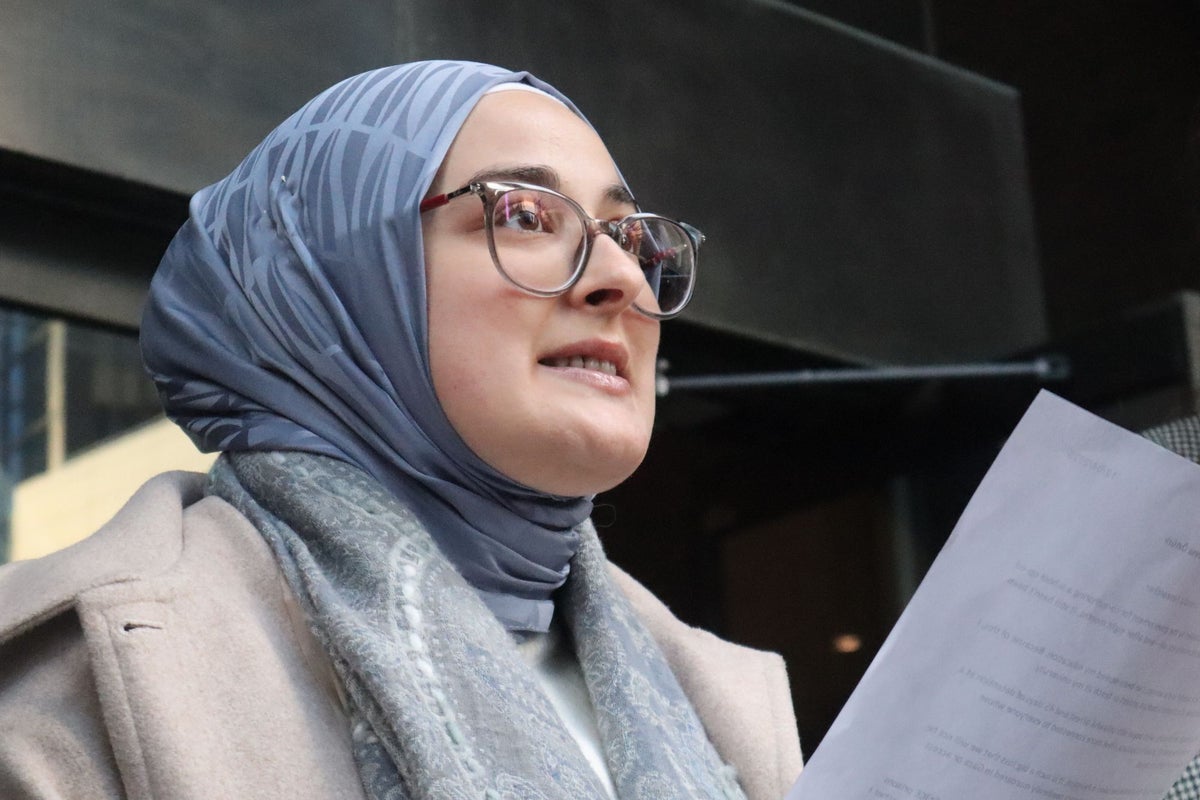
Federal agents had no basis to grab a Tufts University scholar off the street and send her to an immigration detention center in Louisiana more than 1,000 from her home in Massachusetts.
But more than seven months after a federal judge granted her release, Donald Trump’s administration is still trying to deport Turkish academic Rumeysa Ozturk, whose arrest by masked officers has been a defining image of the president’s campaign against international students for their Palestinian activism.
State Department officials admitted there was no evidence that Ozturk “engaged in any antisemitic activity” or “made any public statements indicating support for a terrorist organization.” She had only co-authored an op-ed in a student newspaper that criticized university leaders for dismissing students’ concerns about Israel’s war in Gaza.
Nevertheless, administration officials — relying on a pro-Israel activist group that created an online directory of student activists — canceled her student visa and signed a warrant for her arrest.
A sweeping two-part account of Ozturk’s case in The Boston Globe, detailing the days leading up to her arrest through her detention and return to Tufts, reports that the officers who grabbed her off the street told her “we are not monsters” and only “do what the government tells us.”
Despite spending more than six weeks in an Immigration and Customs Enforcement detention center, Ozturk is “optimistic about the American judicial system,” she told the Globe.
“I have spent nearly seven years in the United States, a formative period that has significantly shaped my young adulthood,” she said. “However, I have also faced deeply troubling and dehumanizing experiences.”
A scathing decision from a federal judge in May determined Ozturk was “simply and purely” arrested for “the expression she made or shared in the op-ed.”
“That literally is the case,” District Judge William K. Sessions III said at the time. “There is no evidence here as to the motivation, absent consideration of the op-ed.”
His order granted her immediate release from custody while she continues her parallel legal battles challenging her immigration proceedings and the constitutionality of what her attorneys argue is a retaliatory arrest.
Months later, the administration has not introduced any additional evidence.
In court testimony, administration officials described a “tiger team” deployed to quickly crack down on campus dissent. Homeland Security Investigations, an arm of ICE, had deployed hundreds of analysts to investigate foreign students, according to Peter Hatch, assistant director of HSI’s Office of Intelligence.
They reviewed names on a from pro-Israel group Canary Mission, which lists names and social media profiles of people it labels “far-right, far-left and by anti-Israel.” Ozturk’s name was on its list.
She was on the phone with her mother while she was on the way to break her fast with other Muslim members of the Tufts community March 25.
Masked agents, under strict instructions from top officials at the State Department to arrest Ozturk, emerged from the street and immediately grabbed her wrists.
She called out to her mother in Turkish to phone a friend for help before agents snatched her phone. They put her into a car and sped off.
Ozturk feared “they were going to kill me,” she later wrote.
As they transferred her across the country, she experienced several asthma attacks, struggling to breathe in an Atlanta airport as passersby saw her in pain, she said.
“I wanted to scream for help, but I noticed it wouldn’t matter,” she told the Globe. “That moment broke something inside me.”
Ozturk experienced more than a dozen more asthma attacks in Louisiana, where she faced “constant exposure to dust,” “no proper ventilation” and limited time outside while locked in a small cell she shared with 23 people, she testified.
While trying to get treatment, a nurse at the facility told her to “take the thing off my head,” said Ozturk, gesturing at her hijab.
Ozturk had obtained an F1 visa to study in the United States, where she earned her master’s at Columbia University on a Fulbright scholarship before enrolling in a PhD program at Tufts. There, she studies social media use among adolescents at the Department of Child Study and Human Development.
This week, another federal judge in Boston ordered the Trump administration to restore a critical government record for Ozturk that will allow her to continue performing paid work as part of her graduate studies.
After her arrest, the administration terminated her record in the Student and Exchange Visitor Information System, or SEVIS. That database, which is monitored by ICE, tracks students in the United States on certain visas. Without that record, foreign students are unable to work.
District Judge Denise Casper pointed to the Trump administration’s “irrational” basis for stripping her records.
“She continues to lose out on paid on-campus employment in which she would otherwise be engaged” and “is losing out on a unique opportunity to work with her advisor on a project that would further her doctoral training and professional development,” Casper wrote.
Ozturk is among several noncitizen students at critical junctures in high-profile legal battles against the administration.
Columbia University graduate Mahmoud Khalil continues to fight an order for his removal to Algeria or Syria months after he was stripped of his green card and arrested in front of his pregnant wife in their apartment building.
A blistering decision in a separate case against the Trump administration called the government’s threats to international academics a “full-throated assault on the First Amendment across the board under the cover of an unconstitutionally broad definition” of antisemitism.
That September ruling from Massachusetts District Judge William Young spent several pages rebuking the president’s campaign of “retribution” and “bullying” of political opponents while he “simply ignores” the Constitution as well as “our civil laws, regulations, mores, customs, practices, courtesies — all of it.”
Homeland Security has repeatedly defended its attempts to remove Ozturk, stressing that a visa “is a privilege not a right.”
“The United States is under no obligation to allow foreign aliens to come to our country, commit acts of anti-American, pro-terrorist, antisemitic hate, or to incite violence,” according to an agency spokesperson.
