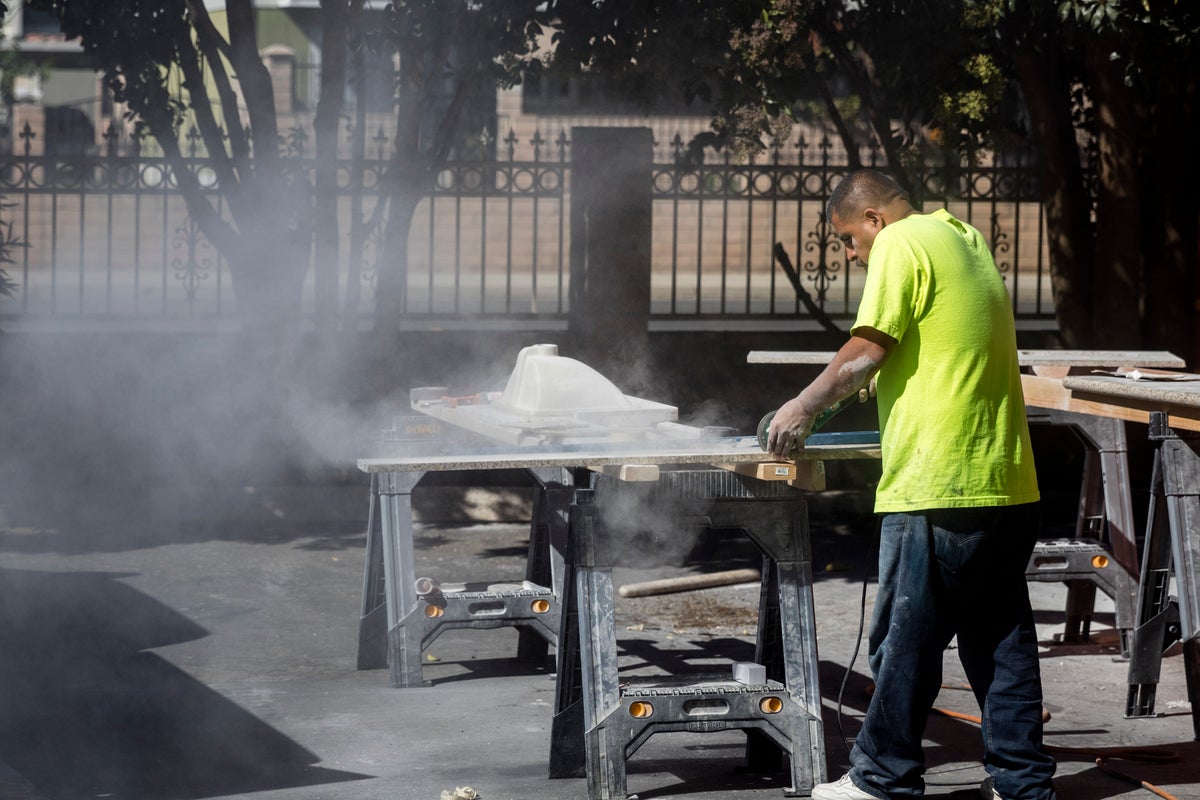
Massachusetts has reported its first case of silicosis, a fatal and incurable lung disease spread from dust produced when making stone countertops.
The state’s Department of Public Health said the Hispanic man in his 40s was diagnosed with the progressive condition earlier this year after inhaling respirable crystalline silica, a mineral found naturally in quartz and granite countertops.
The man, who was not identified, had worked for two stone countertop fabrication and installation companies for a total of 14 years.
He cut and shaped quartz, granite, marble and porcelain for both companies, but his first workplace of 12 years was very dusty, wet methods of cutting stone were not routinely used and he was given thin surgical masks to wear while on the job.
“After about ten years with that company, he started experiencing cough and shortness of breath. These symptoms persisted, and four years later — after several medical visits and tests — he was diagnosed with silicosis,” the department said.
The case has prompted officials to issue a safety alert to employers this week.
“Silicosis is a devastating, life-altering disease – and one that is also absolutely preventable,” Public Health Commissioner Dr. Robbie Goldstein said in a statement. “Massachusetts employers in industries where workers are exposed to silica dust have a responsibility to protect their workforce, including from harmful airborne dust.”
“No worker should have to suffer from a chronic and insidious lung disease or possibly die because of a preventable exposure at work,” he said.
People with silicosis often show symptoms following years of exposure, such as shortness of breath, cough, difficulty breathing, fatigue, fever, weakness, leg swelling and lips that turn blue. Infection increases the risk for other deadly lung diseases, such as lung cancer and tuberculosis.
It may take multiple visits to doctors to diagnose the disease, according to the American Lung Association. Doctors will listen to a patient’s lungs and test them, conduct X-rays or CT scans, biopsy the lung or even send a tube with a video camera into the windpipe and lung.
There are several risk factors for silicosis that both patients and doctors can keep in mind.
The majority of silicosis cases in the U.S. and around the world are work-related.
Silicosis has historically been associated with construction and mining. The disease has become more prevalent among stone workers due to the rise in popularity of quartz stone countertops, which are more than 90 percent silica compared to less than 45 percent in granite.
The first reported case in the U.S. was identified in Texas in 2014. Since then, other states have reported dozens of deaths, with recent cases in Michigan, Washington, Wisconsin and California.
California’s own health department has issued multiple health advisories related to silicosis this year.
In November, the department said the state had seen 432 confirmed cases, at least 25 deaths and 48 related lung transplants since 2019. Lung transplants cannot cure silicosis, but offer a chance for an extended life.
The Hispanic or Latino demographic makes up the majority of stone workers and most of the workers with silicosis are relatively young, male and Hispanic or Latino, Massachusetts health officials said.
While silicosis is incurable, it is also preventable. The U.S. Occupational Safety and Health Administration says workers can stay safe by wet cutting and using effective dust control methods, wearing appropriate respirators, using a HEPA-filtered vacuum to minimize dust in the air, tracking the levels of silica dust in the workplace, making sure the work is done in well-ventilated areas and getting periodic exams from qualified health care providers.
Early diagnosis can help to slow the progression of the disease.
“The confirmation of this case in Massachusetts is a tragic reminder that silicosis is not just a distant threat – it is here, and it is seriously impacting the health of workers in Massachusetts,” said Emily Sparer-Fine, Director of the department’s Occupational Health Surveillance Program.
