For all its inventiveness, the RSC’s production struggles with a puppetry predicament
It’s that time of the year when humans – or as the large and benevolent eponymous character would have it, “human beans” – are flagging but puppets are bouncing with energy and taking over our stages. Paddington looks set to eat marmalade in the West End forever and now the RSC, the wondercrump originator of Matilda the Musical, returns to Roald Dahl for a journey into Giant Country.
In food-theatrical terms, the result is clear: the bear’s marmalade sandwiches will long outlast the BFG’s snozzcumbers.
How to present said Big Friendly Giant successfully? Under the guidance of puppetry designer/director Toby Olié (who played a key role in the original production of War Horse) he is brought to life by four puppeteers who manipulate sections of his head and shoulders.
Yet that’s not all, as he is also played by the regularly sized John Leader; when Leader is on stage, everyone else is shown as tiny doll puppets in order to maintain a sense of scale. Such alternation is ingenious but unsettling, as too much over-elaborate puppetry – as well as too many puppeteers cluttering the stage – becomes cumbersome and detracts from what should be the very human heart of the story.
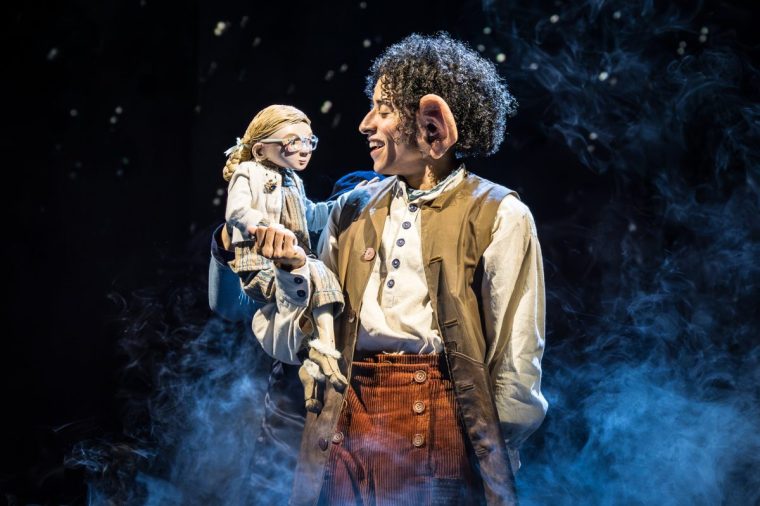
The big-eared BFG is, famously, the only vegetarian in the flesh-gobbling wilds of Giant Country, where the terrifying Bloodbottler roams free. After initial misunderstandings, the BFG soon acquires a collaborator in his task of spreading good dreams to the children of the world: eight-year-old orphan Sophie (played by Ellemie Shivers on opening night), a rather shouty young person who is short in stature but full of courage. Eventually, the pair find themselves at Buckingham Palace, where a benignly bored Queen (Helena Lymbery) is eager to join in the adventure.
For all its inventiveness and pleasing music (credit to composer Oleta Haffner), Daniel Evans’s production struggles with the puppetry predicament, which means that its two central performers can never be on stage simultaneously. This is an obstacle to emotional engagement and it’s telling that the delightful scenes at the Palace, with Lymbery a treat as a crisply humorous monarch frustrated by a pair of elaborately moustachioed guards, resonate more profoundly.
Tom Wells’s adaptation is on the slight side but still feels padded out at points; it also manages to render occasional plot developments a little bewildering, which is not ideal for a family audience. Even so, the eternal lure of Dahl’s storytelling will undoubtedly attract spectators of all sizes.
To 7 February (rsc.org.uk) and then at Chichester Festival Theatre, 9 March-11 April (cft.org.uk)
