Recent excavations in the ancient Roman city of Pompeii have revealed that some enslaved people, despite being considered mere “speaking tools,” received better food than ordinary people, Italy’s culture ministry has confirmed.
Evidence from a large villa in Civita Giuliana, a northern suburb, showed amphora jugs with fava beans and a substantial bowl of fruits – pears, apples, and sorbs – found on the first floor of a servants’ quarter.
This contrasts sharply with the slaves’ ground-floor living conditions: rat-infested, 16-square-metre cells often housing up to three people.
Archaeologists believe this enhanced nutrition was a deliberate strategy to maintain productivity.
The ministry highlighted the societal irony, stating: “It could thus happen that the slaves of the villas around Pompeii were better fed than many formally free citizens, whose families lacked the bare minimum to live on and who were therefore forced to beg from the city’s notables.”
Ordinary working-class people typically relied on a simple wheat-based diet.
Gabriel Zuchtriegel, Director of the Pompeii Archaeological Park, concluded that these findings expose “the absurdity of the ancient slave system,” which dehumanised individuals as “speaking tools.”
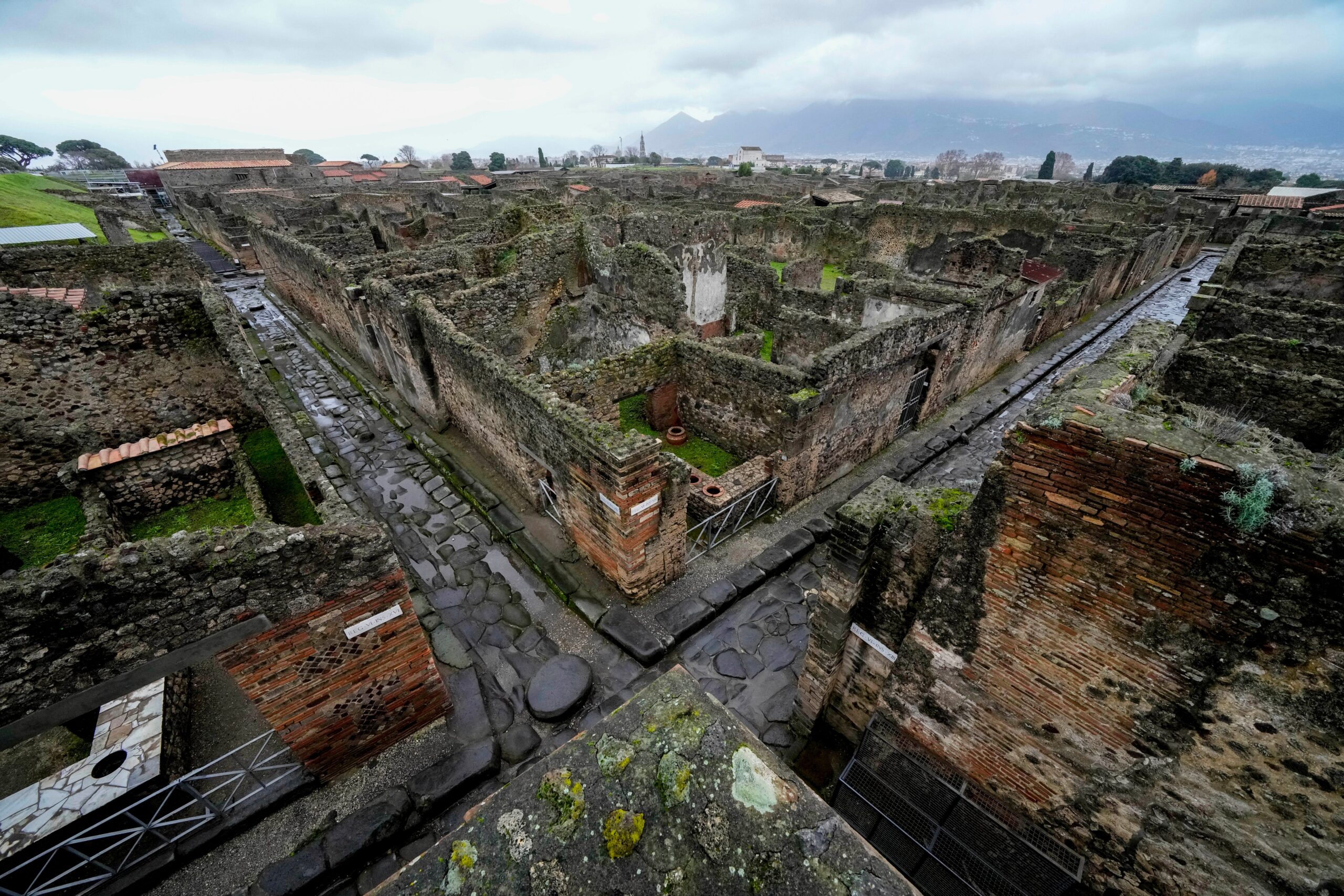
The once-thriving city of Pompeii, near Naples, and its surroundings were destroyed by the eruption of Mount Vesuvius in A.D. 79, but its remains have survived after being submerged for centuries by a thick blanket of ash and lava.
Earlier this year, a study into recent excavations at the archeology site revealed the final moments of some of Pompeii’s residents.
A scene discovered at the House of Elle and Frisso – named after the mythological painting found in one of the rooms – has provided an insight into how the inhabitants of the house desperately tried to save themselves from the historic eruption in 79AD.
In an attempt to escape the volcanic ash piling over the city, the victims had tried to take refuge in a bedroom and barred the door with a bed.
Archaeologists have been able to reproduce a cast of the bed after they identified the shape of the wooden frame in the solidified ash.
