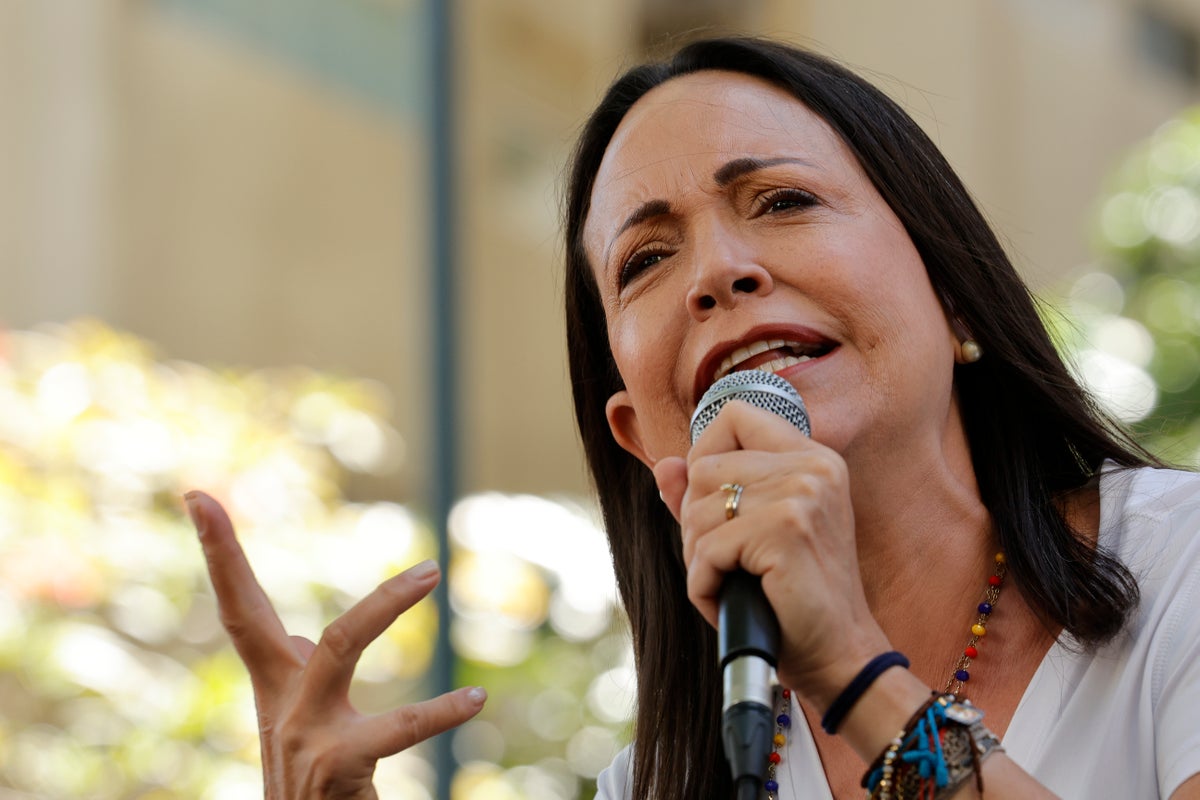
Maria Corina Machado, who has become a symbol of resistance in the face of growing authoritarianism in Venezuela, has been awarded the Nobel Peace Prize.
The opposition leader was forced into hiding and banned from running for office by the administration of President Nicolas Maduro. But her fearless campaigns and rock-star appeal have made her an incredibly popular politician in her country – and led her to beat US President Donald Trump in winning this year’s honour.
When her win was announced in October, the activist was lauded for being a “key, unifying figure in a political opposition that was once deeply divided – an opposition that found common ground in the demand for free elections and representative government”.
Jorgen Watne Frydnes, chair of the Norwegian Nobel Committee, added: “In the past year, Miss Machado has been forced to live in hiding. Despite serious threats against her life, she has remained in the country, a choice that has inspired millions. When authoritarians seize power, it is crucial to recognise courageous defenders of freedom who rise and resist.”
Machado’s ally, Edmundo Gonzalez, who lives in exile in Spain, posted a video of himself speaking by phone with her after she received the news. “I am in shock,” Machado said. “I cannot believe it.”
The award ceremony is due to take place on Wednesday, 10 December, but at the eleventh hour it was announced that Machado is not going to attend.
What is Machado’s background?
Machado, 58, was born in Caracas on 7 October 1967. Her father was a prominent businessman in Venezuela’s steel industry, with her upper-class roots making her a target of criticism from the country’s governing socialist party.
Now a mother of three children, Machado is an industrial engineer by training, studying engineering at university before she gained a master’s degree in finance, and went on to have a short career in business.
In 1992, she also started a foundation for orphaned children living on the streets of Caracas, the Atenea Foundation.
But she went on to co-found the vote-monitoring organisation Súmate in 2002, which aims to promote free and fair elections, marking her official entry into politics.
Banned from public office
In 2010, Machado won a record number of votes to get elected to the National Assembly, where she served from 2011 until the regime expelled her from office in 2014.
She later became the national coordinator of the liberal political party Vente Venezuela, which she co-founded in 2012 and currently leads. Five years later, she helped found the Soy Venezuela alliance, aimed at bringing together pro-democracy forces from across the political divide.
Machado won a resounding victory in the opposition’s primary election in 2023, and her rallies attracted large crowds. However, a ban from holding public office prevented her from running for president against Nicolas Maduro in an election in 2024, and she went into hiding. Mr Gonzalez took her place, having never run for office before.
The lead-up to the election saw widespread repression, including disqualifications, arrests and human rights violations, with Maduro’s government routinely targeting its real or perceived opponents.
The crackdown on dissent only increased after the country’s National Electoral Council, which is stacked with Maduro loyalists, declared him the winner despite credible evidence to the contrary.
The election results sparked protests across the country, to which the government responded with force and ended with more than 20 people dead. They also prompted an end to diplomatic relations between Venezuela and various foreign countries, including Argentina.
Machado emerged from hiding in January to make a brief appearance during a protest before the inauguration of Maduro – whose time in office has been marked by a deep economic and social crisis. She was briefly arrested and then freed.
The 20th woman to win the Nobel Peace Prize
Gonzalez – who has been granted asylum in Spain after a Venezuelan court issued an arrest warrant for him – celebrated Machado’s Nobel win in a post on X/Twitter, calling it a “very well-deserved recognition for the long fight of a woman and of a whole people for our freedom and democracy”.
Last year, Machado and Gonzalez were awarded the European Union’s top human rights honour, The Sakharov Prize.
Machado now becomes the 20th woman to win the Nobel Peace Prize, of the 112 individuals who have been honoured.
She advocates for liberal economic reforms, including the privatisation of state-owned enterprises such as PDVSA, Venezuela’s oil company. She also supports the creation of welfare programs aimed at aiding the country’s poorest citizens.
Her political activism has come at a cost, leaving her isolated as nearly all of her senior advisers have been detained or forced to leave the country. Machado herself has accused Maduro’s administration of operating as a “criminal mafia”.
Though sometimes criticised for being egotistical, even by her own mother, Machado rarely speaks about herself in public. Instead, she frames her campaign as a collective struggle for redemption and unity, aiming to inspire hope among Venezuelans weary of economic hardship and social decay.
What happened to Machado attending the ceremony?
Machado was due to receive the award in defiance of a decade-long travel ban imposed by authorities in her home country and after spending more than a year in hiding.
Last seen in public 11 months ago, she had been due to hold a traditional news conference by the laureate the day before the formal award ceremony.
But the lunchtime event was delayed without explanation, until the Norwegian Nobel Institute said three hours after the scheduled time that “it will not take place today.”
On the day of the ceremony, the organisers confirmed she would not be attending and the award will be accepted by her daughter instead.
“She is unfortunately not in Norway and will not stand on stage at Oslo City Hall at 1 p.m. when the ceremony starts,” Kristian Berg Harpviken, the director of the institute and the permanent secretary of the award body, told broadcaster NRK.
Asked where she was, Harpviken said: “I don’t know.”
Last month Venezuela’s attorney general said Machado would be considered a fugitive if she went to Norway to accept the prize.
