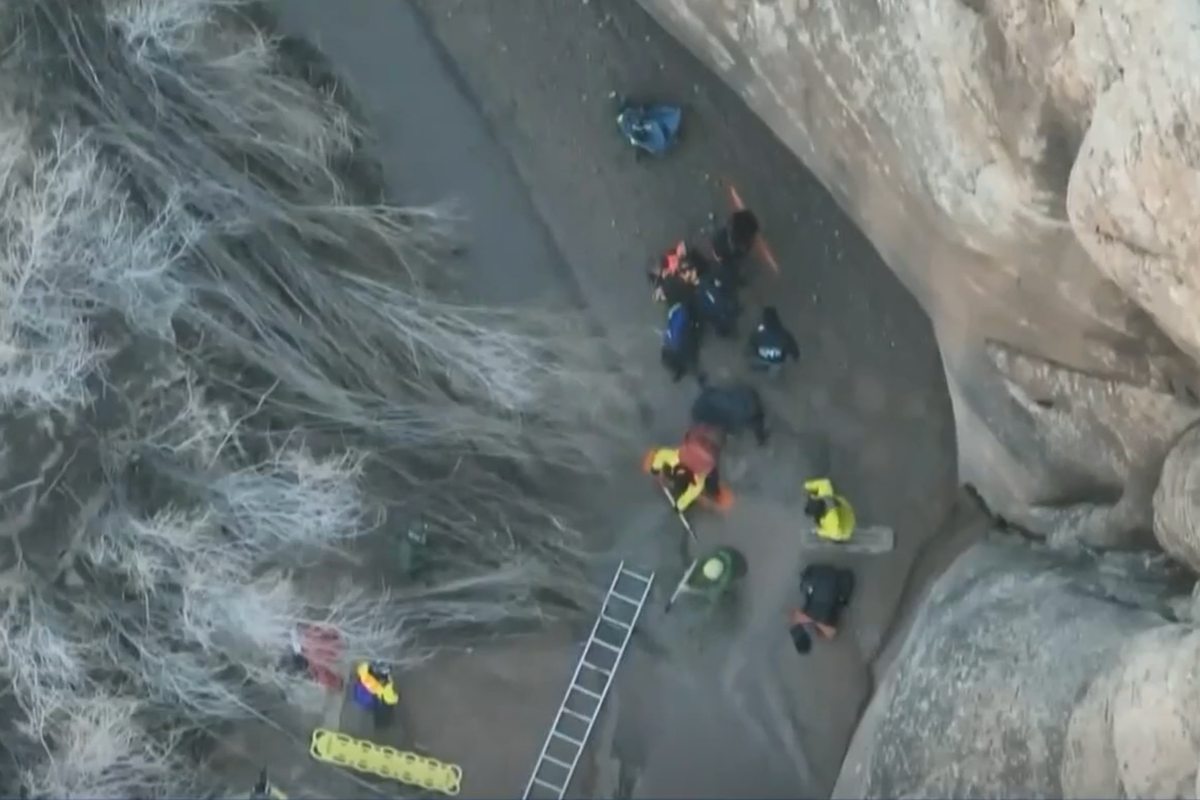
A hiker in Utah who became trapped in quicksand was freed after a dramatic rescue mission this weekend.
Austin Dirks was hiking Sunday in Arches National Park, eastern Utah, renowned for its hundreds of stunning sandstone arches.
Dirks had hit the trail alone in the early morning, in an area called “Courthouse Wash” with incredible views and ancient rock art, when his left leg broke through what appeared to be solid ground.
The experienced hiker quickly realized he was stuck in quicksand.
“I was able to pull it out, and then I shifted all my weight to my right foot and I sunk up to the knee,” he told FOX13 Salt Lake City. “It felt like I had stepped into concrete, and then it hardened around my leg. I couldn’t even move a millimeter.”
While movies often depict quicksand as deadly, it is virtually impossible to die by sinking into it because the sand is denser than the human body, meaning people are more buoyant.
Typically, people do not sink below the waist or mid-chest. However when the sand grains can compact around people’s legs which is what traps them.
This is what happened to Dirks. “Before this trip, I honestly thought quicksand was more of a folklore or a legend,” he told FOX13. “How it’s depicted on TV is nothing like it is in real life. The human body is more buoyant than the quicksand, so you’ll never sink to above your head.”
The experienced hiker was carrying a GPS satellite messenger which allowed him to send out an alert signal.
Authorities from the Grand County Search and Rescue sent up a drone which was able to locate Dirks. Drone footage showed him trapped in the quicksand, struggling to keep his knees above ground, beneath towering rocks.
A ladder and traction board were used to extract Dirks, Grand County Search and Rescue incident commander John Marshall told NBC News.
Marshall noted the temperature of 21 degrees meant conditions were below freezing.
“Where this person was, there was just no sun shining down in this canyon area,” he said. “I was just taken aback by just how cold the ambient temperature was.”
When Marshall was informed of Dirks’ situation, he admits he was in disbelief.
“The page went off and I kind of shook my head and said: ‘Did I hear that correctly? Somebody is stuck in quicksand?’” Marshall said.
Two hours later Dirks was released from the quicksand unscathed. “He was pretty tired and stuck and ready to get out,” the commander added.
