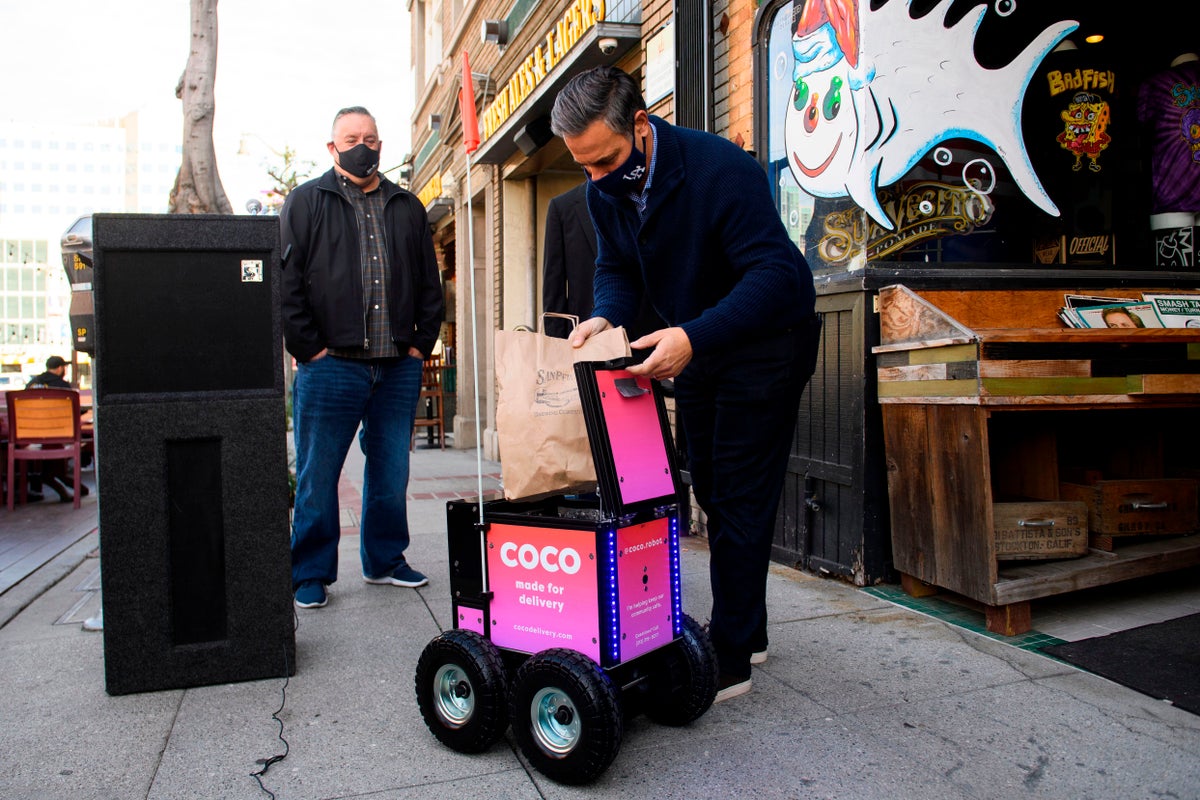
Hundreds of Chicago residents have signed an online petition to ban food delivery robots that are clogging city sidewalks and crashing into pedestrians.
“We’re getting reports of collisions with people, with pets, with bicyclists, getting reports of obstruction,” Josh Robertson, who started the petition, told ABC7.
Viral videos show the boxy robots, operated by companies such as Coco, Serve and Uber, rolling around the city, often hampered by the harsh Illinois weather and becoming stuck in snowdrifts.
Others have reported having close calls with the food carriers.
“The other day I was walking, and one rammed straight into the back of my leg. And it’s not great,” said Caity Collins, who works at a restaurant in the Lincoln Park neighborhood, where the robots are becoming a more common sight.
Robertson’s petition calls for a pause on the “sidewalk-robot program” until the Chicago Department of Transport and Business Affairs & Consumer Protection releases more information on the safety of the robots.
It also calls for a public hearing on the impact of robots on the community and local jobs, as well as the establishment of clear rules governing the use of robots as delivery vessels. So far, it has been signed by more than 2,500 people.
At the initial release, CDOT said they are “assessing whether these delivery robots can be used to safely replace vehicle trips without inconveniencing other sidewalk users.”
According to the BACP, the pilot program will not continue past May 2027 without action by the City Council.
Robertson told CBS News that he had initially been a fan of the robots. “I’m a Star Wars fan. My initial reaction was, ‘Finally, droids are here,'” he told the outlet, before recalling a personal experience with one.
“This was a vehicle coming toward us. It has cameras, its bright headlights were shining in full force, and we instinctively got out of its way,” he said. “That’s what people reflexively do when vehicles are coming in the same lane toward them, but this was pedestrians in the pedestrian space.”
“Sidewalks have to be accessible for everyone; they have to be safe. Those aren’t negotiable,” he added.
However, Vignesh Ram, who works for Serve Robotics, one of two companies that have introduced the delivery bots to Chicago, says the company is open to feedback and that there are still advantages to using the devices – including environmental impact.
“Robots at the end of the day carry 1/3,000th the kinetic energy of a car. They travel more slowly. They don’t present the risk that cars that do deliveries can do,” Ram told ABC7.
