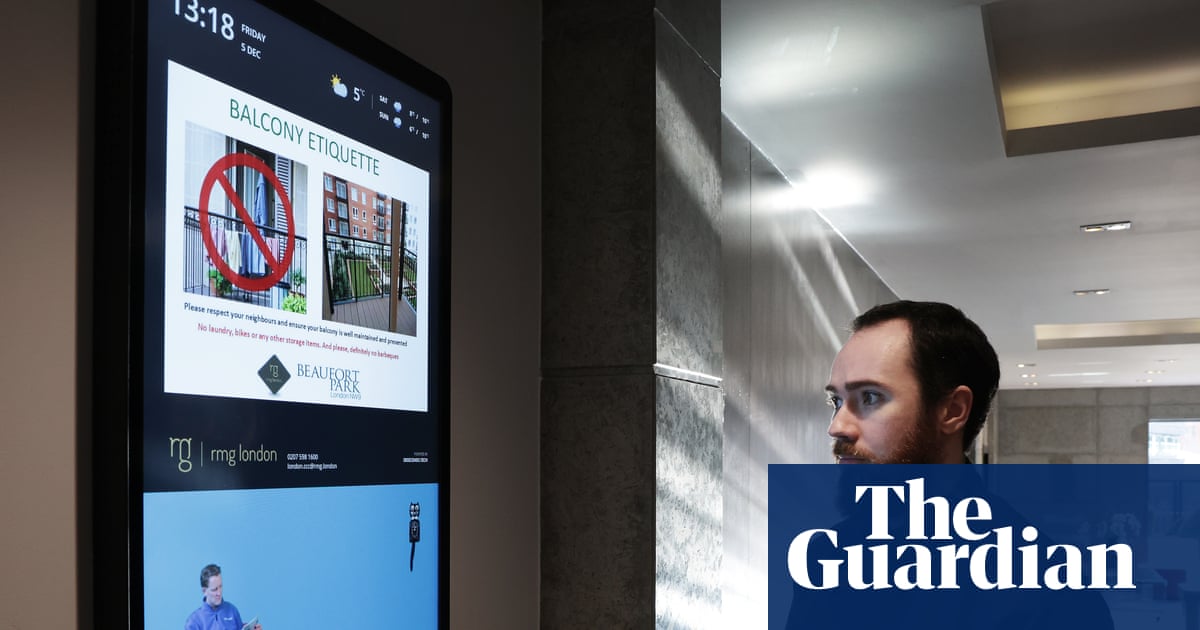
Digital billboards that can film viewers’ responses to adverts have been installed in hundreds of apartment blocks, in a move that civil liberty campaigners called “creepy as hell”.
The supplier, 30Seconds Group, says the cameras allow them to track “occupant engagement” from residents who are a “captive audience” as they wait for lifts to their apartments.
Potential advertisers are told: “With an average dwell time of 30 seconds, our screens provide ample time for viewers to absorb your message. This extended interaction allows for deeper engagement, making it an ideal platform for delivering impactful and memorable advertising content.”
30Seconds Group said it was on course to install electronic noticeboards – all with cameras – in the communal areas of 1,000 buildings by the end of the year.
The Residential Management Group, which is one of almost 50 property companies to have signed up, said the noticeboards improved communication with residents.
In a statement to the Guardian, the group confirmed it had installed the billboards in 126 developments housing 50,000 people. However, it insisted that the cameras in its buildings were not activated.
Conor Nocher, 32, has complained that part of the £209-a-month service charge for his studio flat in Colindale, north-west London, is being used to pay for a device that shows him unwanted adverts.
He said: “Allowing crypto companies and alcohol and gambling to advertise within residential properties seems absurd and really inappropriate. There’s no ability to opt out. You’re stuck with it.”
Nocher said he had not seen adverts for these types of products in his building, but images shared online of billboards elsewhere have shown promotions for drinks companies, a lottery syndicate, non-fungible tokens, a competition site and cage fighting.
He is also wary about the presence of the camera in the billboards. “RMG say I’m not being spied on, but there are cameras in the devices, you can see them,” he said.
“Even if it was at zero cost to residents I would still fight these tooth and nail, nobody wants to be spied on by 6ft garbage adverts in their own building.
“In other buildings, residents are being tracked with the device, because the boss of 30Seconds Group says they are.”
Jesse Liu, the managing director of 30Seconds Group, explained the company’s business model to the tech news site Business Cloud. He said: “Our strongest selling point is that we know who our audience is. All our displays are integrated with cameras so we can get the demographic data and also track the occupant engagement.”
Liu said the devices had been installed in commercial and residential buildings in 20 UK cities – and that by the end of next year, it hoped they would be operational at 2,000 sites.
A spokesperson for Places for People, the parent company of RMG, said residents were not being spied on because “none of the cameras are operational, the camera is pre-installed but not activated”.
Emails to Nocher from RMG about the screens confirmed that the £800 installation costs and running costs were covered by residents’ service charges. The spokesperson said the annual running costs came to £2.60 per resident.
They added: “Their primary purpose is to function as digital noticeboards, providing real-time updates in a cost-effective and environmentally responsible way.
“The vast majority of the feedback has been positive, and the London fire brigade has praised the screens as being a useful tool to get information out to customers quickly and effectively.
after newsletter promotion
“We take all customer feedback under advisement, yet feel that the screens are installed in a way that allows them to be non-invasive.”
Nocher said: “I’ve talked to my neighbours about this and I haven’t found anyone who thinks these things are a good idea.”
In an email to RMG, Nocher asked if residents had been consulted about the digital noticeboards. In reply, an associate director from the company said: “Residents were not formally consulted, nor is there a requirement for us to do so in this case.”
The Places for People spokesperson said only that the owners of the building were consulted.
It emerged last year that RMG was forced to remove two digital billboards supplied by the 30Seconds Group from the Grade II*-listed Park Hill flats in Sheffield after objections from residents.
One of those involved in the discussions, who asked not to be named, said residents objected because the screens were visually “out of keeping” with the design of the flats, the displays of live news updates were “distressing” and they did not want “commercials as they walked in their doors”. They added: “People were also anxious about the cameras, even though we were told they were not activated.”
Jake Hurfurt from Big Brother Watch, a civil liberties campaign group, said the digital noticeboards were “creepy as hell”.
He added: “Billboards equipped with demographic scanning tech have no place in people’s homes. They are the height of surveillance capitalism.
“We should all be able to move around the buildings we live in without being scanned against our will to monitor our personal characteristics or if we paid attention to an advert, and it is even more galling that residents of some buildings have to pay to be watched.”
The 30Seconds Group has been approached for comment.
