A time capsule has been unearthed from the charred remains of St Mungo’s Church in Cumbernauld, North Lanarkshire, following a deliberate fire that destroyed the “iconic” 1960s Brutalist structure.
Designed by Alan Reiach, the B-listed church was renowned for its modernist architecture, including a distinctive pyramid-shaped roof crafted to maximise natural light.
The building contributed significantly to Cumbernauld’s international reputation for post-war design.
The church was intentionally set alight on 2 August, just before 8pm, with local parishioners watching their “landmark” building consumed by flames.
The discovery of the capsule came after a parishioner found a news report from November 1964, commemorating the laying of the foundation stone, which explicitly mentioned the burial of a time capsule.
St Mungo’s had recently amalgamated into Trinity Parish Church in 2024. Adding to the historical finds, Morag Rusk, the session clerk, located the original order of service from the foundation stone ceremony within her mother’s archives.
She notified the demolition teams who were called in to clear away the remains of the burnt-out building and who found the capsule in the rubble.
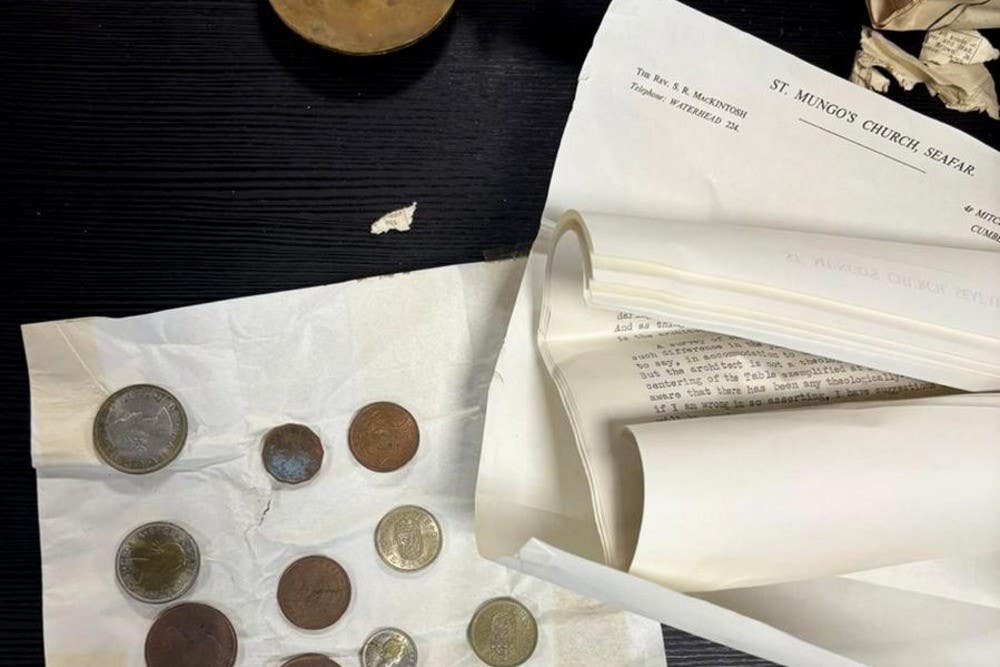
Ms Rusk said: “I had the order of service from 7 November, 1964, kept by my mum, but did not realise there was a time capsule buried in the foundations.
“I also received a phone call from a member of the congregation about it because she also had a copy of the order of service from her parents.
“It stated that ‘a canister containing records and coins shall be laid in the foundations’ and she said she was hoping it could be found.
“I asked the demolition team to look out for it and amazingly they found it in the rubble and handed it over to us.”
The metal canister contained copies of the Cumbernauld News, including an edition from 16 October, 1964, which included a notice about the death of the serving minister of St Mungo’s, Rev Simon Roy MacKintosh, who was heavily involved in the plans to build a distinctive place of worship.
Another edition from 6 November, 1964 reported that the foundation stone would be laid the next day, by General Sir Richard O’Connor, who served as Lord High Commissioner to the General Assembly of the Church of Scotland that year, who acted as a representative for Queen Elizabeth II.
Also in the time capsule was a collection of pre-decimal coins, draft ideas from the parish minister for a potential layout of the building, and papers from the Linlithgow and Falkirk Presbytery regarding the project.
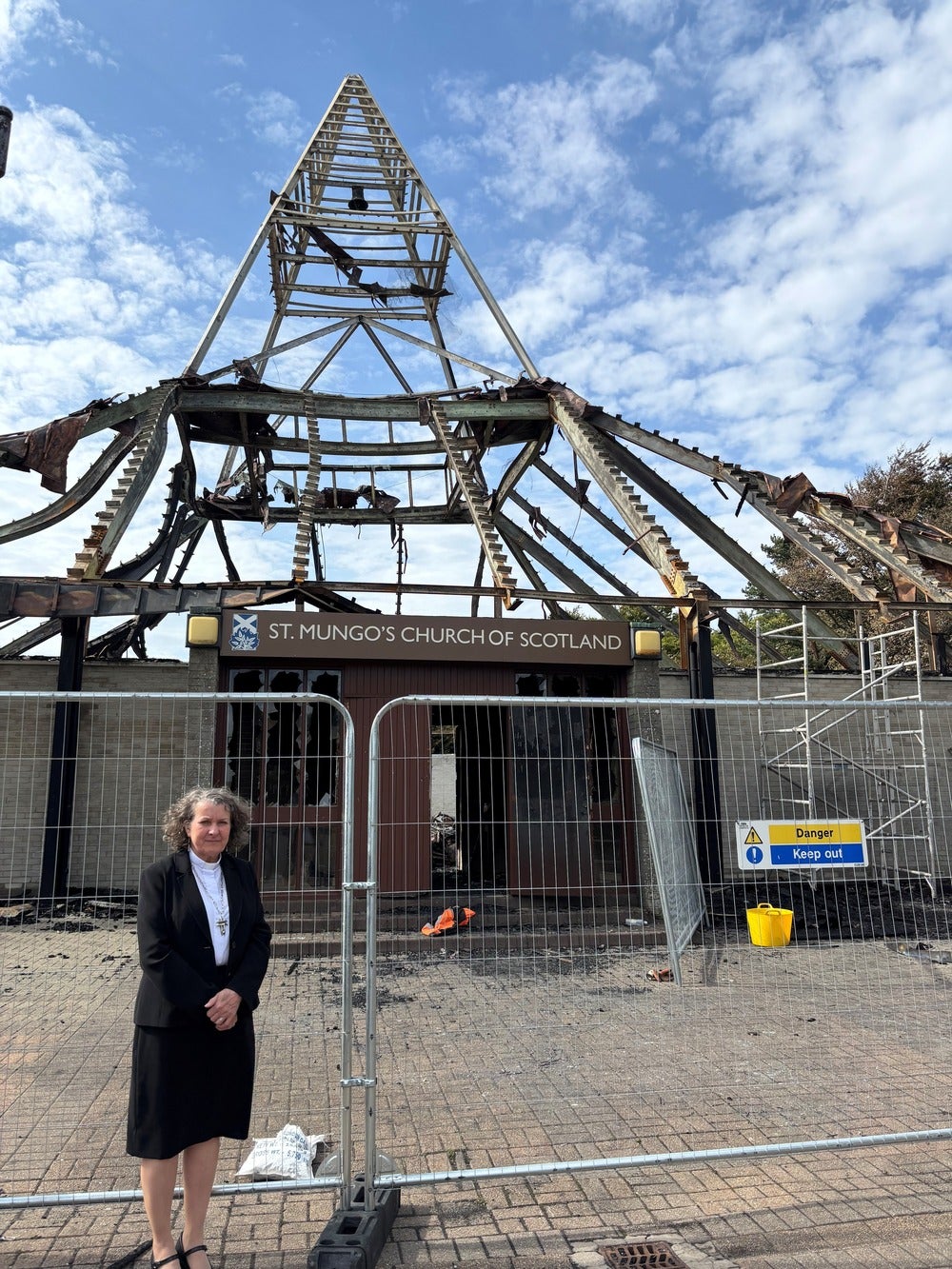
The time capsule was opened in the Cafe Church, and Mrs Rusk described it as a “wonderful and unexpected find”.
Communion pewterware was also salvaged from the remnants of the building.
Mrs Rusk said: “We opened the canister at the Cafe Church a few weeks ago and the contents were tightly packed, it is such a wonderful and unexpected find.
“Despite losing the building in such bad circumstances, the site has now been cleared and the congregation is feeling positive about the future as discussions about the possibility of building a new modern church building on the site are under way.”
Previously she said: “It was an iconic landmark and the pyramid tower could be seen as you drive into the town from whatever direction, Glasgow, Airdrie and Falkirk.”
Mr Reaich, who met famous architect Frank Lloyd Wright while living in the United States, went onto become a renowned architect in his own right.
Police are appealing for information about the blaze.
Detective Sergeant Craig Jeffrey, of Police Scotland, said: “Inquiries so far have established the fire was deliberate. We are appealing to anyone who may have witnessed anything to contact us.
“We’d also ask anyone with footage of the area at the time to please come forward.”
