Donald Trump Jr told a conference that the US president “may walk away” from the Ukraine war, arguing there was “no reason” for Kyiv to pursue peace while US money kept flowing.
He claimed Ukraine’s “corrupt” rich had fled, leaving “what they believed to be the peasant class” to fight.
Trump Jr accused Ukrainian president Volodymyr Zelensky of prolonging the war because “he knew he would never win an election if it ended”. He accused Zelensky of having become a borderline deity on the left and insisted Ukraine was “far more corrupt than Russia”.
Meanwhile, Zelensky provided a fresh update on peace talks with the US, saying they have been “constructive” but “not easy” in a statement on Sunday.
The Ukrainian leader spoke with US president Donald Trump’s special envoy Steve Witkoff and his son-in-law Jared Kushner in a phone call on Saturday.
“The American representatives know the basic Ukrainian positions,” Zelensky said. “The conversation was constructive, although not easy.”
The comments come ahead of key talks between Zelensky, prime minister Keir Starmer, France’s Emmanuel Macron and German chancellor Friedrich Merz in London today.
Putin declares Russia will take all of Ukraine’s Donbas region by force
Russian President Vladimir Putin has declared that Moscow intends to seize full control of Ukraine’s Donbas region through military force, unless Ukrainian troops withdraw – a demand Kyiv has unequivocally rejected.
The declaration, made in an interview published on Thursday in India Today, follows Russia’s full-scale invasion of Ukraine in February 2022, which escalated an eight-year conflict between Russian-backed separatists and Ukrainian forces across the Donbas, comprising the Donetsk and Luhansk regions.
Speaking ahead of a planned visit to New Delhi, Mr Putin stated: “Either we liberate these territories by force of arms, or Ukrainian troops leave these territories,” according to footage broadcast on Russian state television.
How a ‘reassurance force’ could work in Ukraine: will it enrage Putin?
Thousands of allied troops could be sent to cities across Ukraine to help the army recover its strength and stand as an independent deterrent to Russian aggression – if both sides can agree to terms.
The Independent’s James C. Reynolds has more below:
Russian strikes kill 1 as US and Ukraine officials wrap up third day of diplomatic talks
Russian missile, drone and shelling attacks overnight and Sunday killed at least three people in Ukraine, after U.S. and Ukrainian officials wrapped up a third day of talks aimed at ending the war.
A man was killed in a drone attack on Ukraine’s northern Chernihiv region Saturday night, local officials said, while a combined missile and drone attack on infrastructure in the central city of Kremenchuk caused power and water outages. Kremenchuk is home to one of Ukraine’s biggest oil refineries and is an industrial hub.
Watch: President Zelensky says he has had a ‘substantive’ phone call with US peace envoy Steve Witkoff
The Independent View: There is still a way European leaders can help achieve a positive outcome for Ukraine
Still, no doubt, bathed in the warm, if also absurd, glow of being the first ever recipient of the Fifa Peace Prize, Donald Trump might be in the mood to promote a just and lasting peace in Ukraine, it would be nice to think. This would, aside from anything else, strengthen President Trump’s insistent claim on the Nobel Peace Prize, which has not quite been superseded in prestige by the cynical golden trophy that the president of Fifa, Gianni Infantino, presented to him.
Starmer to host Zelensky and EU leaders for peace talks after Russia launches overnight air attacks on Kyiv
Mr Zelensky will meet Sir Keir in Downing Street along with French president Emmanuel Macron and German chancellor Friedrich Merz.
The meeting comes amid continued talks between Ukrainian and US officials on a Washington-backed plan to end the war. Ukraine’s negotiators were in Florida for three days last week for talks with Donald Trump’s envoy Steve Witkoff and his son-in-law Jared Kushner.
On Sunday, cabinet minister Pat McFadden said that Ukraine’s security and self-determination would be “at the heart” of the leaders’ discussions in London. He said that talks were at a “really pivotal moment”.
Meanwhile, Mr Trump’s special envoy for Ukraine, Keith Kellogg, who is due to step down in January, told a defence forum that a deal to end the Ukraine war was “really close” and that it now depended on resolving just two main outstanding issues.
Read more here:
Zelensky says Ukraine peace talks ‘constructive’ but ‘not easy’
Ukrainian president Volodymyr Zelensky has provided an update following a phone call with US President Donald Trump’s special envoy Steve Witkoff and his son-in-law Jared Kushner.
“The American representatives know the basic Ukrainian positions,” the leader said on Sunday.
“The conversation was constructive, although not easy.”
Zelensky is due to meet French president Emmanuel Macron and Prime Minister Keir Starmer as well as German leaders in London on Monday.
As sea drones force Russia to retreat, Ukraine examines ways to launch more complex attacks
The commander of sea-drone operations for Ukraine’s military intelligence agency says more complex strikes against Russian forces are expected next year, after Kyiv’s uncrewed fleet succeeded in curbing the movements of Russia’s once-dominant Black Sea navy.
In an interview with The Associated Press, the head of the specialised maritime drone unit, Group 13, said Ukraine’s attacks have forced Russia to adapt, limiting opportunities for major Black Sea strikes seen earlier in the war.
“Today, we’ve likely reached a plateau,” said the officer, who is identified only by the call sign ‘13th’ under Ukrainian military protocol.
“We are effectively limiting the enemy’s movements, but those dramatic, high-profile strikes we saw earlier haven’t happened for quite some time. That’s because the enemy has adapted.”
Last month, Ukrainian officials said sea-attack drones were used in strikes against vessels in Russia’s sanctions-evading “shadow fleet” of oil tankers.
The commander declined to comment on those operations.
The officer said Russian naval vessels “barely operate,” often venturing only up to 25 miles (40 kilometers) from port to fire missiles before retreating.
“They constantly hide. And in a way, that’s also a result of our unit — because you can imagine the cost of maintaining a fleet that cannot operate at sea.”
The officer spoke in uniform, his face covered and eyes obscured by tinted glasses. For security reasons, the intelligence agency asked that the location and other details of the interview not be disclosed.
Drone technology has become vital to Ukraine’s military, offering inexpensive tools for reconnaissance and strikes in countering Russia’s invasion. Its two sea-drone programs are run separately by its military and domestic intelligence services.
UK will ‘turn the tide’ on illicit finance in anti-corruption summit
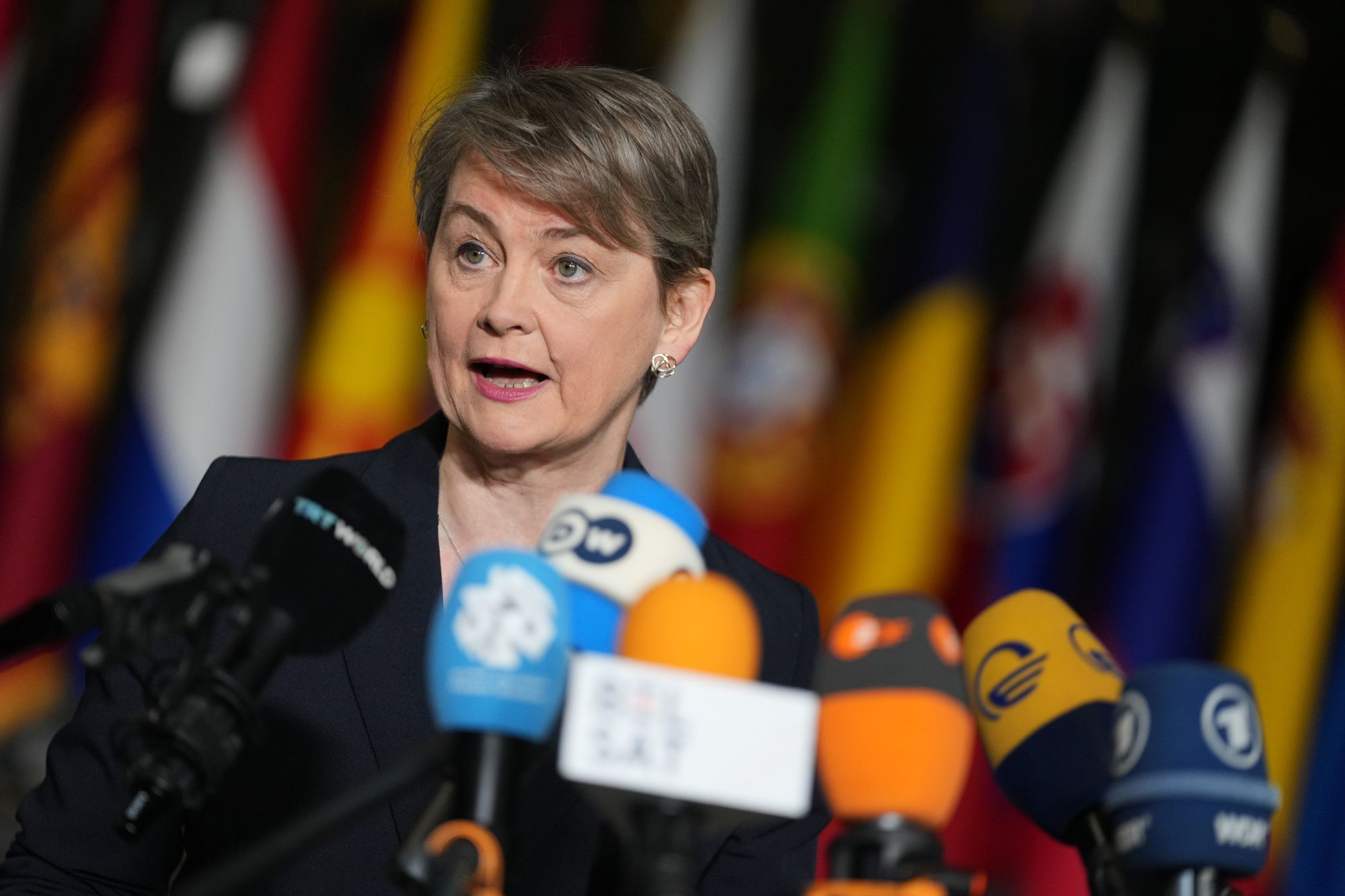
The UK will “turn the tide” on illicit finance at a landmark anti-corruption summit in London next year, the Foreign Secretary has said.
Yvette Cooper confirmed on Sunday that Britain would host the summit at Lancaster House on June 23-24 2026.
The summit, first promised by her predecessor David Lammy, will bring together governments, businesses and campaigners to agree “tough international action” to combat corrupt practices.
Ms Cooper said the summit would target illicit gold used to fund the war in Ukraine; property used by criminals to hide their cash; and cryptocurrency, which she said was “increasingly exploited by people smugglers”.
Arguing that “dirty money fuels crime on the streets of the UK and drives conflict and instability overseas”, she said the government was “committed to turning the tide” on corruption.
Analysis: Europe needs to stop its magical thinking and get ready for war with Russia
It’s been a busy week in the politics of European defence. But every major news point from the week has confirmed how much danger Europe is in, and how little some of its key allies are willing to do about it, writes Keir Giles.
The findings of the UK’s inquiry into the death of Dawn Sturgess, released this week, demonstrate not only Russia’s ruthlessness but also the severe impact that even a limited Russian attack can have on unprepared societies like Britain.
But in the same week, the latest iteration of the so-called “peace process“ over Ukraine demonstrated once again how Europe as a whole is still paralysed by denial and magical thinking over the nature of the threat from Russia and what is needed to withstand it.
In part, this results from a degree of necessary play-acting on the part of European leaders. They know that in public, they have to engage with the United States on its terms, and pretend that US negotiations with Moscow over the heads of Ukraine and Europe are a meaningful step towards eventual peace.
We have to hope that is what lies behind NATO Secretary General Mark Rutte’s nonsensical declaration that Donald Trump is the only man in the world that can bring peace to Ukraine – and that he hasn’t genuinely forgotten that Vladimir Putin can end his war at any moment.
