Chris de Burgh always knows when Christmas is coming: when he’s out and about he hears his own song, “A Spaceman Came Travelling”. “It’s like the first cuckoo,” he says. He hears it in the oddest places. “Public toilets, supermarkets… My family and my grandchildren were at a funfair last week, and they heard it there.” Do people ever recognise him when it plays? “Yeah, it does happen. People point or they smile. Standing at a checkout, maybe the checkout guy sings along. And I sing along as well without telling him that I’m the guy who wrote it. That can be pretty funny.”
Fifty years on from its initial release on de Burgh’s second album, 1975’s Spanish Train and Other Stories, “A Spaceman Came Travelling” is the accidental Christmas classic by stealth. Completely ignored in the UK upon release, after the British-Irish singer-songwriter’s marmite 1986 number one ballad “Lady in Red” – “I’m glad this interview isn’t about that song; I’ve talked about it enough” – it is now the 76-year-old’s most recognised song.
And how unlike the other festive tracks it is. No jingle bells, no Santa Claus, not even a mention of Christmas itself: the warped sci-fi nativity tale – de Burgh imagines the Star of Bethlehem as an extra-terrestrial visitor bringing a message of goodwill to mankind – is an atmospheric, proggy, art-rock wonder, uplifted by its gospel-tinged anthemic chorus. Every year, it sits incongruously next to Slade, Wham!, Mariah Carey, et al. “I had no intention of writing a Christmas song,” he says on video call from his home in Dublin. “At that time, we had Slade and all that stuff. I just thought, ‘No, I can’t compete with these people at all.’ It’s just my idea, my little story.”
The story of the song’s origin is as unusual as the track itself. It was a hot day in London in August 1974 when de Burgh was struck by what he calls “a confluence of ideas”. But at the time he was struggling. “I had no money,” he says. His first album, 1974’s Far Beyond These Castle Walls, was well received but only a minor hit: he was couch surfing in London and taking secondary jobs (flower delivery man, deli worker) to make ends meet.
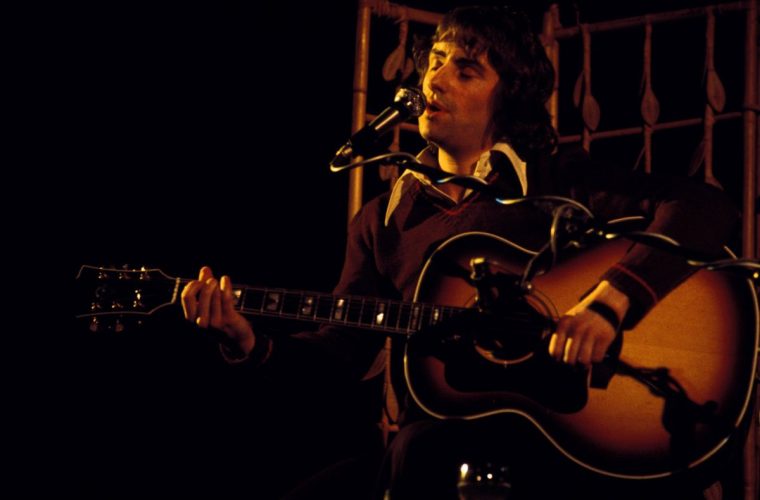
On paper he’d had a gilded upbringing: born Christopher Davison in Venardo Teurto, Argentina – his father Colonel Charles John Davison was a British diplomat. From the age of 11 he’d grown up in Bargy Castle, a 12th-century castle on 170 acres of land in Wexford, southeast Ireland. His grandfather, General Eric de Burgh, a British Army officer in World War II, had bought it for the family in retirement.
He’d had a Christian upbringing in the castle, which was eventually turned into a hotel, where de Burgh first performed for guests. And in 1974, he found himself writing songs with a religious bent: the title track of Spanish Train and Other Stories depicted the Devil beating God in a game of cards (the song was considered so blasphemous in South Africa that the album was banned.) Was he rejecting his own faith? “No, that came later,” he says. “To be blunt, the tenets of Christianity stretch your belief.”
He explains his mindset. “I’m a kind of ‘what if?’ person. I don’t know what I’d been on at the time. Nothing serious,” he smiles. He was never too much into the “late 60s flower power, people getting completely out of their heads” vibe. “Well maybe one or twice. But I never inhaled.”
But he had read some of the era’s key literature, including Eric Von Danik’s 1968 book Chariots of the Gods?, which theorised that the religions, myths and technologies of ancient civilisations were handed to them by extra-terrestrial intervention. The book was controversial – “some people thought he was an absolute nutter” – but de Burgh bought into the thinking.
“So I thought – what if the Star of Bethlehem was in fact a spacecraft? So that was in my head, and the idea that maybe out there in the universe is another, much more sentient and much cleverer, a civilisation far more advanced than ours, who is keeping an eye on us and the stupidity that human beings go through. Particularly creating weapons to destroy ourselves. And I was thinking, ‘Maybe this guy has come down to literally wish peace and goodwill to all men around the birth of Christ’.”
He was also influenced by the 1919 WB Yeats poem “The Second Coming”, and Yeats’s gyre theory – that history moved in cycles of 2,000 years. “That there could be another cataclysmic event, something that would utterly change human civilisation.”
He’s come to the interview prepared. “I know it off by heart, but I just want to read you this.” He then reads me “The Second Coming”. “Powerful words,” he says once he’s finished. “So Yeats, Eric Von Danik, my ‘what if’ attitude – it all went to the track. But I want to stress again: I had no idea it was going to become a Christmas song. Okay, it was about the Nativity. But I just thought it would be a nice child’s story.”
He recorded the song at Air Studios in central London. “I felt that it needed something fairly cosmic.” He says despite the song’s wavy synth line being key, he wasn’t really aware of synths or what they could do. A session player called Ken Freeman introduced him to string synthesizers. “I had never heard such a thing before,” he says. “And I didn’t know him, but he came along to the session and he did all that keyboard stuff. It sounded fantastic.”
De Burgh’s voice was a lot higher back then. “I did all the angel choir voices in the background, which was great fun, triple tracking about four different harmonies to create that entire thing.” Listen closely, and you might even notice a mistake in the song: recording the vocals, somebody forgot to properly link up the 24-track recorder. “So there’s a tiny little delay on the vocal. And we only discovered it when we were mixing. I thought, ‘Do I have to do the vocal again?’ We left it in. But this was early technology.”
“A Spaceman Came Travelling” got its first release on Spanish Train and Other Stories on 1 November 1975, first released as a single in 1976. Given the source material, was there any pushback from religious types? “No, no,” he says. The main criticism came from Private Eye magazine, of all places. “Pseud’s Corner kept on bringing up the point that there’s no such thing as light years of time,” he says, referencing the song’s lyrics (“’twas light years of time since his mission did start”). “Which there aren’t. I mean, it’s poetic licence.”
Mirroring de Burgh’s career, the song was originally a hit in many places other than the UK, where on initial release it sank without trace (it reached No 1 in his native Ireland.) In fact, despite being hugely popular across the world – Canada, Germany and Brazil especially – de Burgh’s first top 40 hit in the UK was actually “Lady in Red”, more than 10 years into his career. “You had to be on Top of the Pops to be somebody. But the interesting thing is in 1986 I was doing three nights in Wembley Arena before ‘Lady in Red’ even came out.” He spins his camera around to show me old 80s tour posters on his walls where around the world he was topping festival bills with Prince and U2. “People think, ‘Oh “Lady in Red”, blah blah blah.’ We used to be fucking rockers!”
He released a slightly re-worked version of “A Spaceman Came Travelling” in the wake of the mammoth success of “Lady in Red”. But he says that’s not the reason why the song became so well known. “It just kind of seeped into the public consciousness. It grew like cellular growth. It was very little to do with me. My management told me one time that every year it was on something like 400 Christmas albums,” he says, which was actually how I first remember hearing it as a child.
And it has indeed travelled well. It eventually went gold in the UK, and has been covered many times. “Some are good, some are… indifferent.” De Burgh has performed it in the most unlikely of places, including the Kremlin.
Your next read
In 2015, for German TV, he even performed it in Bethlehem. “That was amazing. That was in a church above, allegedly, where Christ was born. And I performed for the Palestinian choir and chorus and orchestra. They were absolutely lovely people. I remember getting tingles thinking that the song was written about something that may have happened on the very place I’m standing.” He says every year he’s sent videos of Christmas choirs singing it around the world. “It’s just so beautiful, and that, for me, gives me real happiness and joy, to see the little ones singing along.”
Fifty years on, “A Spaceman Came Travelling” stands alone, the idiosyncratic Christmas staple. “It is esoteric,” he says. “But a lot of people I run into say, ‘Oh, it’s my favourite Christmas song. It’s not like all the rest of it.’”
