Trump’s approval ratings are in freefall, and Maga tribes are turning on each other
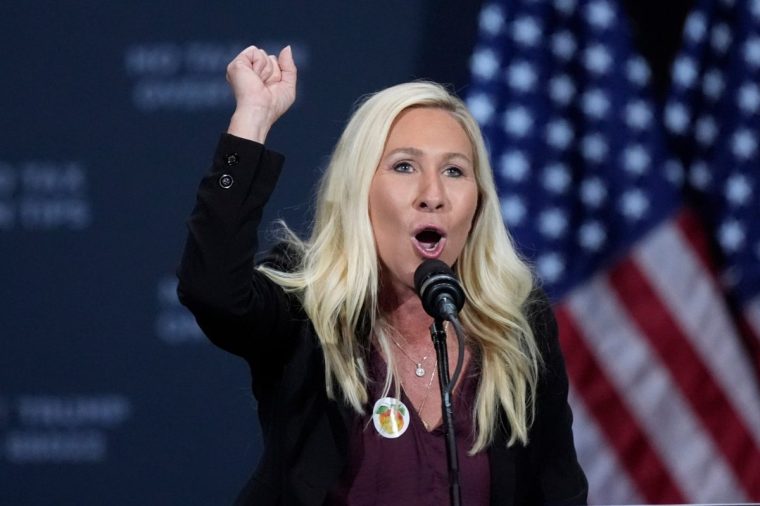
Marjorie Taylor Greene arrived at her election night party in the US city of Rome, Georgia, on 3 November, 2020, in a military-style Humvee decked with pro-Trump flags and bumper stickers and wearing a Make America Great Again cap. She had become famous, by that point, as the “QAnon Candidate”.
The day before, Trump held a rally in her district. “Somebody that gets a little more publicity than I do, Marjorie Taylor Greene right here from Northwest Georgia,” he told a crowd of 20,000 as he endorsed her. “Oh boy. I don’t want to mess with her. No, she’s great.”
For four years, Greene was one of Trump’s staunchest supporters in Congress. But in just a few months following his return to the White House, their relationship disintegrated. “Marjorie ‘Traitor’ Greene is a disgrace to our GREAT REPUBLICAN PARTY,” the president posted in November. Days later, Greene announced her resignation.
Less a conspiracy theory than a sprawling conspiracy ecosystem, QAnon began with a series of cryptic posts on an anonymous message board in 2017 claiming to be from a high-level government insider (Q is a level of US security clearance). The Q “drops” described a vast child sex-trafficking conspiracy, led by Hillary Clinton and the Democrats – and promised a coming “storm” of reckoning.
By 2020, QAnon had metastasised on the political right. Its adherents formed a quasi-messianic cult framing Trump as saviour, a white knight engaged in high-stakes, four-dimensional chess against the deep state “cabal”. Their outrage when Trump lost is a big part of what caused the riot at the Capitol a few months later, on 6 January.
Greene wasn’t the only candidate to adopt QAnon. Trump himself regularly amplified Q-linked Twitter accounts and memes. But while most stuck to dog-whistles, Greene regularly tweeted Q slogans like “WWG1WGA” (Where We Go One We Go All) and referred to the Q-promised “Great Awakening”. She claimed the Sandy Hook shooting was staged, and that wildfires were caused by Jewish space lasers.
Trump’s success lay in bringing fractious right-wing tribes into coalition. Neoconservatives, tech libertarians, far-right QAnon conspiracy ideologues like Greene and isolationist ultra-nationalists like Steve Bannon coexisted uncomfortably – but during the Biden administration and 2024 campaign, it served everyone to ignore the ideological cracks. Now Trump is in government again, with approval ratings in freefall, they are turning on each other.

This part of the base sees Trump’s tariffs, interventionist foreign policy, and cosy relationship with Silicon Valley oligarchs as betrayals of his nationalist, isolationist promises. “I’m so anti-oligarch and anti-Elon and all these guys. I fucking hate them,” Bannon, another leading avatar of the nationalist-populist wing, told the New York Times in July. “They’re not Maga. They’re not conservatives.” Now, it is people like Musk being framed as “the deep state”.
Tension keeps mounting. “I have never felt more betrayed,” Laura Loomer, a Trump confidante and pillar of the isolationist wing of Maga, said after the administration approved a Qatari air force base in Idaho. In June, former Fox News host Tucker Carlson, another icon of the populist axis, went in hard on Texas senator Ted Cruz over strikes against Iran. Neo-conservatism infuriates the populists, because toppling it was what they had been told the movement was all about.
The awkward irony of QAnon is that there really was a child sex-trafficking ring at the highest echelons of power. There is a poetic symmetry in Jeffrey Epstein becoming a key faultline in Trump’s base.
Whatever else, Greene isn’t a hypocrite: she wants the files released and doesn’t care who gets burned. “Loyalty should be a two-way street,” she said in her resignation statement, adding bitterly: “There is no ‘plan to save the world’ or insane 4D chess game being played.”
Your next read
In November, Congress voted to compel the Department of Justice to release the Epstein files by 19 December.
Trump faces a dilemma: release them in full, as Greene (and the law) demands, and face the consequences? Or wriggle out somehow – and trigger not just nationwide outrage, but all-out revolt within his base?
Harnessing the QAnon paedophile conspiracy was always a Faustian bargain. Nurturing it helped propel Trump to power, but now the long-promised storm seems to be at hand, it may be the US President who faces the bitter consequences.
