Ceasefire talks continue for a third day following one of the largest attacks on Ukraine since the war began
Ukrainian and US Officials have called for Russia to de-escalate as ceasefire talks continued on Saturday.
Following Friday’s talks, US and Ukrainian officials offered the assessment that any “real progress toward any agreement” ultimately will depend “on Russia’s readiness to show serious commitment to long-term peace”.
US envoy, Steve Witkoff, has been leading talks with Russian and Ukrainian officials since the although little progress has been made since Donald Trump announced his 28-point plan.
The talks come after a railway hub near Kyiv was attacked during one of the largest Russian drone and missile attacks last night and an accusation by a Ukrainian military chief that Russia is using the peace talks to continue to gain territory.
Ukraine hit by major attack
Ukrainian state railway company Ukrzaliznytsia said on Saturday that the overnight attack had damaged a depot and railway carriages at a hub in Fastiv, about 50 miles south-west of Kyiv. No casualties were reported.
The Russian Defence Ministry said its forces launched a “massive strike” in response to what it called Ukrainian attacks on civilian targets.
The Ukrainian military said Russia had launched 653 drones and 51 missiles on Ukraine overnight. It reported that its forces had downed 585 drones and 30 missiles.
Government officials reported that power and heat generation facilities in four regions were targeted, as well as energy infrastructure in eight regions, causing blackouts.
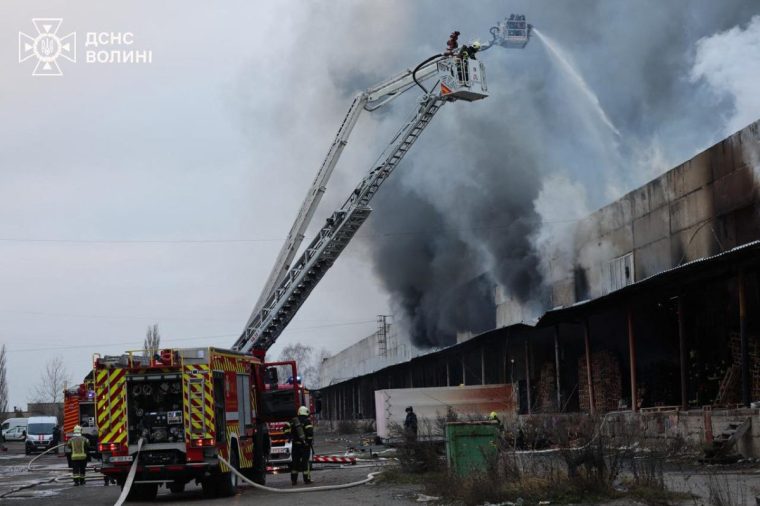
In the southern Odesa region, 9,500 people have been left without heat and 34,000 without water.
Ukrainian Foreign Minister Andrii Sybiha said on X that the attacks showed that Russia continued to “disregard any peace efforts”.
He said: “Instead [Russia] strikes critical civilian infrastructure, including our energy system and railways.”
“This shows that no decisions to strengthen Ukraine and raise pressure on Russia can be delayed. And especially not under the pretext of the peace process,” he added.
In recent weeks, Russia has intensified its attacks on Ukraine’s energy sector and infrastructure, targeting power stations and railway hubs.
In February, the UN’s nuclear watchdog confirmed that a drone attack had damaged an outer wall of the protective dome containing the remains of the damaged Chernobyl nuclear.
Ukraine’s military chief accuses Putin of ‘using’ the peace talks
Ukraine’s top military commander accused Russia of using the peace talks as “cover” to seize more land.
General Oleksandr Syrskyi, the army’s commander-in-chief, told Sky News said that a “just peace” cannot be brokered whilst fighting continues on the front lines.
“There is no pauses, no delays in their operations,” Syrskyi said. “They keep pushing their troops forward to seize as much territory as possible under the cover of negotiation.”
General Syrskyi said he does not allow himself “to even consider” a scenario where Ukraine would have to give up land as part of the peace process.
“For us it is simply unacceptable to give up territory,” he said. What does it even mean to hand over our land? This is precisely why we are fighting.
General Syrskyi said that to him a “just peace is peace without preconditions” and that a ceasefire must be in place before negotiation can take place.
Some experts have claimed that Putin has used the prospect of ceasefire talks to delay further crippling oil sanctions.
In October, the UK sanctioned, Lukoil and Rosneft, Russia’s two largest oil companies.
A Ukrainian artillery battalion commander reported on Thursday that Russian forces are using drones in an attempt to constrict Ukrainian logistics within a 50-kilometer range of Pokrovsk and Myrnohrad.
Putin’s reluctance to halt fighting
Despite progress being made in Florida, the US drafts for a peace plan were given a frosty reception in Moscow earlier this week.
Following nearly five hours spent between Putin and US special envoy Steve Witkoff on Tuesday, the Kremlin said “no compromise” had been reached.
This was again confirmed when, ahead of his visit to meet Indian prime minister Narendra Modi in Delhi on Friday, Putin told India Today that Russia would seize the Donbas if Ukraine did not withdraw.
Trump’s initial 28-point plan, which leaked to the public last month, drew criticism from Ukrainian and European leaders who saw it as ceding to Russia’s demands and a new 19-point plan is now reported to be on the table.
The initial plan included plans for Ukraine to cede the entirety of Crimea, Luhansk and Donetsk to Russia, cut its military forces and abandon plans of joining the NATO defence alliance. It is unclear which draft of the plan was discussed in Moscow.
Continued threats abroad
The Swedish navy has reported encountering Russian submarines in the Baltic Sea on an “almost weekly” basis.
Captain Marko Petkovic, the county’s top navy chief, said Moscow was “continuously reinforcing” its presence in the region.
He said that sightings were “very common” and that these had even increased in recent years.
The UK government announced on Thursday that it had signed a new defence deal with Norway to track Russian submarines in the North Atlantic.
This comes as the Defence Secretary John Healey said there had been a 30 per cent rise in Russian vessels sighted in UK waters in the past two years.
Your next read
The government said that a combined fleet of at least 13 warships will be bolstered by autonomous systems and “will hunt Russian submarines and protect critical infrastructure” such as underwater cables and pipelines.
An inquiry held this week into the poisoning of Dawn Sturgess by a Russian nerve agent near Salisbury in 2018 found that Putin was “morally responsible” for her death.
