This article first appeared on our partner site, Independent Arabia
With a hammer in one hand and a stone in the other, Khalil makes a resolution: “I can’t wait around for promises of reconstruction.”
He climbs up the cracked stairs to his ruined apartment, which is now uninhabitable. Despite this, he still feels that what remains of his house is a small homeland to which he wants to return.
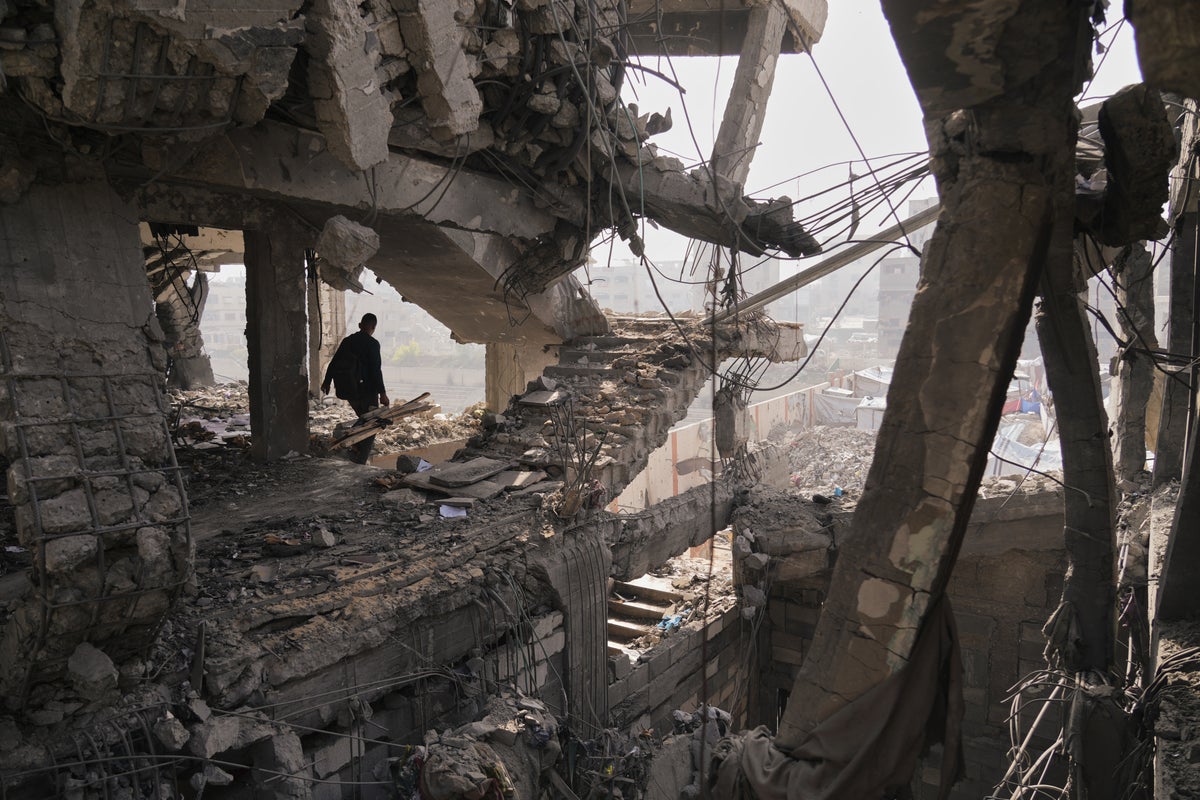
Khalil lives in Gaza City, where Israel carried out the devastating Operation Gideon’s Chariots II in the weeks leading up to the ceasefire. The Israeli army left behind it such terrible destruction that it was as if an earth-shattering quake had hit.
Israeli forces had used military robots rigged with explosives to blow up buildings, causing widespread damage to infrastructure and facilities.
When the Israeli army withdrew from the centres of the Gaza Strip’s cities to the yellow line agreed upon in the peace plan, Khalil immediately returned to check on his house.
He was shocked by what he found: the building’s foundations had been stripped of cement, meaning that the residential structure was at risk of collapse. Looking at the columns, he was overcome with deep sorrow, but he quickly remembered that he was living in a worn-out, impractical tent pitched on the street.
The staircase had been hit by artillery fire and was cracked and broken. He struggled to climb the stairs to reach his apartment, only to find what remained was “nothing but concrete pillars”.
Speaking to Independent Arabia, he recounted: “All the walls had collapsed as a result of the explosions. Despite this, I resolved to rebuild everything traditionally and live there again. Even in its ruined state, my home is better than living in a classroom or in a tattered tent out on the street.”
Khalil looked around and found stones scattered by the bombing. He quickly picked up the suitable ones and carried them up to his apartment, calmly stacking the stones on top of each other to build a new living room wall to replace the one that had collapsed in the explosions.
There are no new building bricks in Gaza because of the war, so Khalil had to buy reinforced nylon sheets to replace the fallen walls in his house. As for the kitchen, he salvaged wood from pallets to make simple shelves to replace the cabinets.
He explains that the makeshift reconstruction of the remains of homes in Gaza is very expensive and requires exhausting, backbreaking effort.
“We start by removing the rubble and repairing the cracked walls, but there are no stairs, doors, windows or furniture. The house is completely empty,” he says.
This is how Khalil repairs his house: a stone on top of a piece of nylon on top of rotten wood. Just being able to live in his home gives him comfort. He points to the piles of stones scattered around him, which he has laboriously turned into building materials.
“I broke the large stones into small pieces of gravel, then mixed them and used them to rebuild a collapsed wall. I am working on repairing at least two rooms, as well as the kitchen and bathroom. I will cover the rest of the house with nylon. We are trying to find any semblance of life.”
Community-led reconstruction
Gaza has turned into a makeshift reconstruction workshop where people are working to rebuild the remains of houses and concrete structures. Men, women and children are working together to repair destroyed, uninhabitable houses.
They are salvaging stones that once formed beautiful buildings from the scattered ruins around them.
Having endured many violent wars over the past 20 years, the people of Gaza have gained extensive experience in reconstruction. Because of this, they view promises to rebuild Gaza as nothing more than media rhetoric.
This time too, they have quickly decided to embark on a grassroots reconstruction project to repair what remains of their homes.
‘Grassroots reconstruction’ is a term that can have many meanings in Gaza. Sometimes it refers to the rehabilitation of damaged buildings, sometimes to youth volunteer initiatives to remove rubble and clean neighbourhoods, and sometimes to the rudimentary repair of buildings and shops.
In all cases, however, homeowners must bear the cost of construction themselves, as this is not included in the compensation allocated for rebuilding the Gaza Strip.
Saleh leans his back against a wall and laughs, saying, “I missed this blessing very much.” In the displacement camps, he was living a bleak life in a tent made of worn-out pieces of cloth. However, when he returned to his semi-destroyed home and rested against its walls, he felt elated.
Saleh describes himself as “very lucky” because his house was not completely destroyed.
“As long as the pillars of the house are still standing, and the roof and floor are intact, I can wake up and sleep freely and enjoy privacy in my home,” he says.
Najah’s house has also been turned into a collective workshop. Her brother hammers windows while her neighbour helps to hang reinforced nylon sheets.
“They left my house burnt and the walls riddled with bullets and shells, but despite the lack of basic necessities such as water and electricity, we have our dignity in it,” says Najah.
Najah’s family uses basic tools. Women clean up and remove debris from the house, while young men straighten bent iron rods to reuse them in reinforcing the walls. Her father mixes cement by hand in small buckets to build one room at a time.
Everybody joins in the work on Najah’s flat. Grassroots reconstruction is not easy. Materials are expensive and no aid is forthcoming, but neighbours lend a helping hand.
One of them gives them an old door while another shares his ladder with them. “Every day, we build stone by stone, and we will gradually return to life,” says Najah.
After a tiring day’s work that left her breathless, Najah prepares a cup of tea.
“We don’t want to wait for our house to be rebuilt, and we’re not waiting for a grant,” she says. “We’re repairing our house with the simplest of things. It’s true that the house is not what it used to be, but the spirit remains the same.”
International pledges
The United Nations Development Programme (UNDP) has estimated the cost of rebuilding the Gaza Strip at around $70bn (£53m).
“There are 61 million tonnes of rubble in the Strip, making reconstruction one of the largest humanitarian and reconstruction missions in the world,” says Special Representative of the Program of Assistance to the Palestinian People, Jaco Cilliers.
Gazans are forced to rebuild themselves, as their tents are worn out and winter is approaching. Ismail al-Thawabta, Director General of the Government Media Office in Gaza, says, “Nearly 1.5 million people in Gaza were left homeless after Israel destroyed their homes.
Displaced Gazans find themselves forced to remain out in the open after more than 300,000 homes were destroyed and the supply of new tents and necessary winter shelter equipment is being blocked from entering.”
Speaking to Independent Arabia, he said that: “125,000 of the 135,000 tents [in Gaza] have collapsed, rendering them uninhabitable. The suffering of the displaced is further exacerbated by Israel’s refusal to permit the entry of temporary housing or tents.”
Due to Israeli restrictions, Gazans are rehabilitating their homes themselves.
Asim al-Nabih, spokesperson for the Gaza Municipality says: “There are significant challenges to clearing debris and rebuilding. Given this reality, citizens have limited options, so they have turned to collective community-based reconstruction. However, clearing debris is very costly and there is a lack of equipment.
“Reconstruction by the people has emerged as a necessary solution and a tool for managing the crisis, as families have begun to repair what they can of their homes using whatever stone, iron and wood they can find. However, there are significant challenges associated with community-led reconstruction.
“Most notably, the repaired houses are structurally unsafe, making them prone to collapse. There is also a lack of basic services such as water, electricity and sanitation.”
Translated by Mirane Abouzaki; Reviewed by Tooba Khokhar and Celine Assaf
