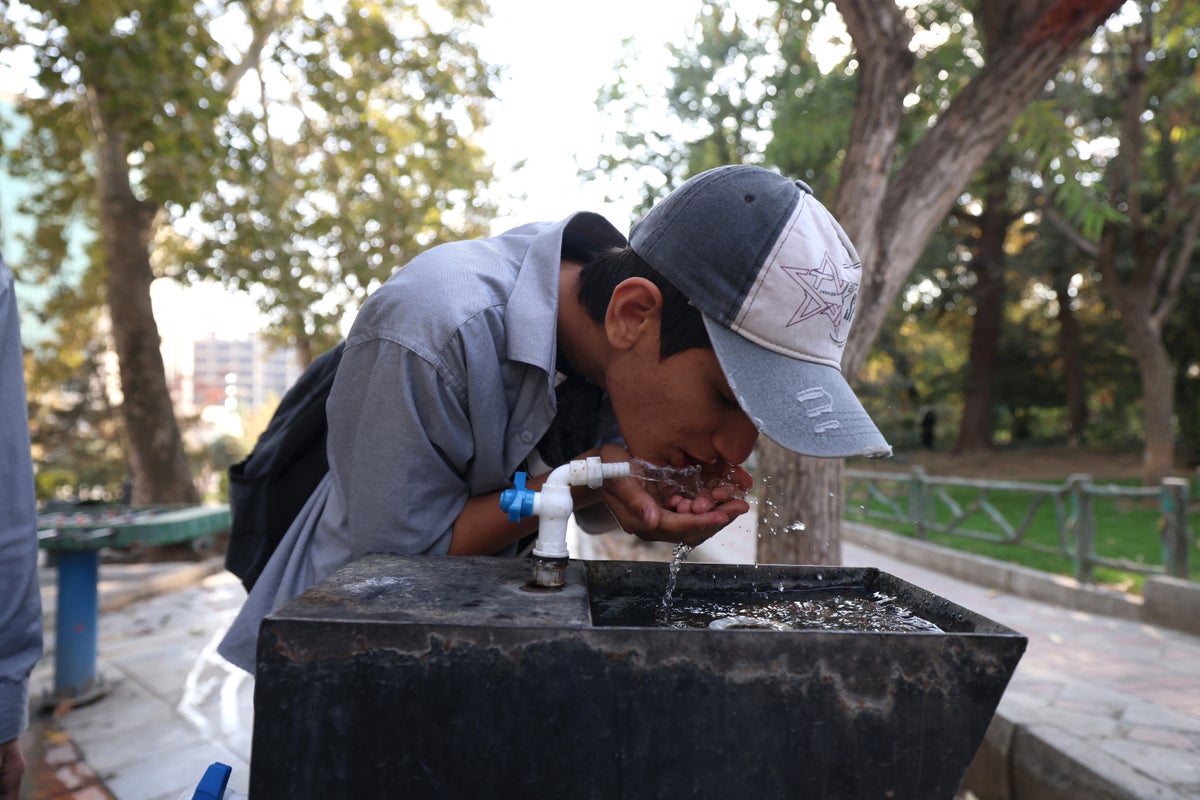
Tehran may be forced to evacuate amid a severe water crisis, with experts warning that all taps in the city could soon run dry.
Officials say that the Iranian capital is facing a ‘Day Zero’ moment in the near future – a moment when all water supplies run out.
Iran has faced severe drought for six years, with Tehran’s rainfall in the first two months of the current water year – which begins on 1 October – at near zero, leaving reservoir supplies at dangerously low levels.
Officials in Tehran have undertaken a number of measures including reducing water pressure, discussing rationing, imposing cuts. They have also suggested more radical solutions such as evacuation or moving the capital if rain does not return.
“We are talking about a few days or even weeks of water left for Tehran,” Kaveh Madani, director of the UN’s University Institute for Water, Environment and Health told Canada’s CBC broadcaster.
“Day zero as we call it in the water sector is near. It’s a day that the taps would run dry.”
In early November, president Masoud Pezeshkian warned: “If it doesn’t rain in Tehran by late November, we’ll have to ration water. And if it still doesn’t rain, we’ll have to evacuate Tehran.”
Typically, rain should start falling in Iran in autumn following Iran’s hot summer. But the September to November period just gone is the driest the country has seen in half a century, the National Weather Forecasting Centre has reported. Rainfall has been 89 per cent below the long term average.
Pezeshkian described the situation as “extremely critical,” citing reports that Tehran’s dam reservoirs have fallen to their lowest level in 60 years, some as low as 10 per cent of capacity. Officials say that in the east of Tehran, the Latyan Dam — one of five key reservoirs — is only about nine per cent full. The Karaj dam, which supplies a quarter of Tehran’s drinking water, is eight per cent full.
Tehran is not the first city to have faced a looming ‘Day Zero’ crisis. São Paulo, Mexico City, Cape Town and Chennai are among the cities which have seen taps run dry – or at least come close.
Some Iranian officials have pointed the finger at the West, accusing the US High-frequency Active Auroral Research Program (HAARP) of “cloud theft” and sophisticated weather warfare. But little evidence has been offered to support these claims.
Along with climate-driven factors, the population of Iran’s metropolitan area has almost doubled from around 4-5 million in the late 1970s to more than 10 million today, according to data from Nasa’s Earth Observatory.
Water consumption has risen at an even faster rate, according to the Centre for Strategic and International Studies. In 1976, Tehran’s water use was at 346 million cubic metres per year. Today, it stands at 1.2 billion cubic metres.
With water levels rapidly running dry, outdated practices and long-standing policies have been heavily criticised for leaving various Iranian industries vulnerable to water shortages.
Iran’s energy system remains highly dependent on hydropower and fossil fuels. After sanctions, investor skepticism and decades of underinvestment, the current water crisis has now laid bare Iran’s lack of diversification into other energy resources.
Policies that placed water-hungry industries — including steel, cement and petrochemicals — in some of the country’s driest regions have also been criticised.
Lawmaker Reza Sepahvand said such “wrong policies” diverted rivers to inland factories that should have been built on the coast. Iran’s National Water and Spatial Planning organization now urges relocating those industries to coastal zones that could use desalinated water.
Meanwhile, agriculture still consumes about 80 per cent of Iran’s freshwater, much of it through inefficient irrigation for thirsty crops in arid areas.
“We must modernise,” Agriculture Ministry official Gholamreza Gol Mohammadi warned in August, saying outdated practices are draining aquifers and worsening power outages as pumping systems fail.
