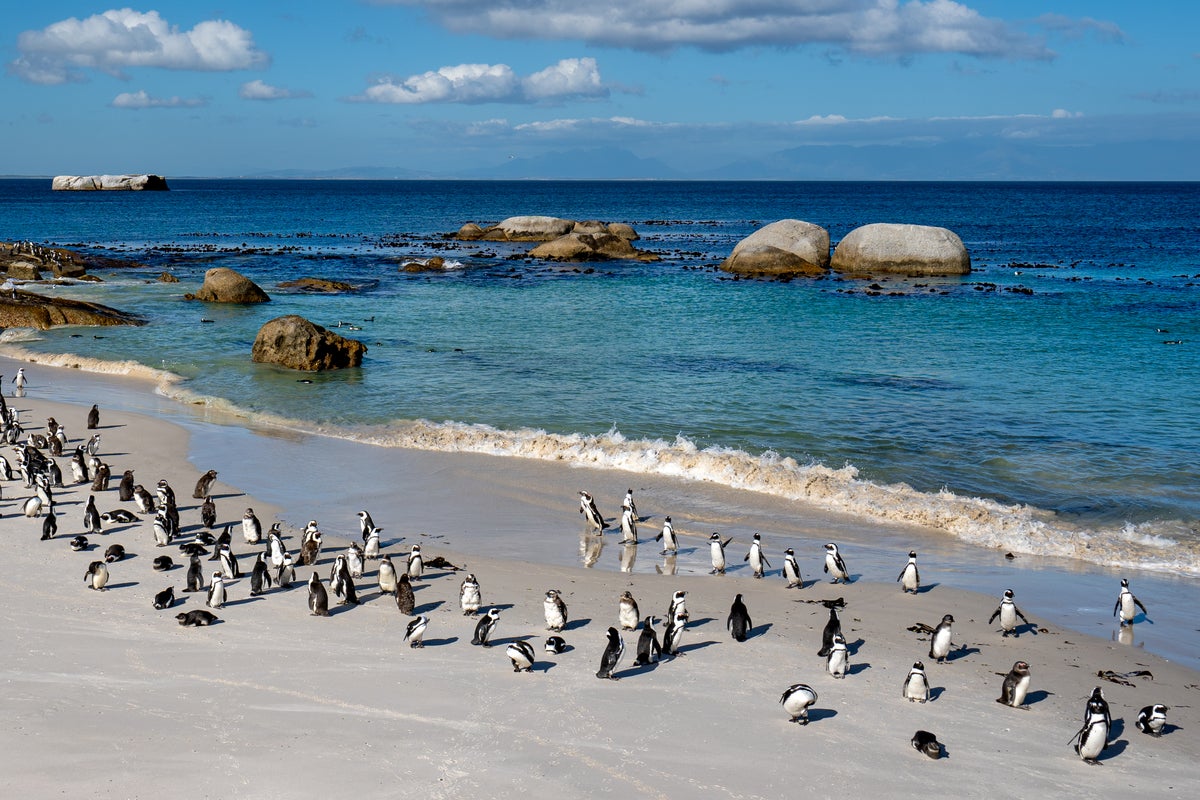
More than 60,000 penguins have starved to death off the coast of South Africa as a result of collapsing sardine numbers, according to a new study.
From 2004 to 2011, more than 95 per cent of the African penguins on Dassen Island and Robben Island died. Researchers said they probably died during the moulting period, the annual event where they replace all their feathers at once over a number of weeks.
The climate crisis and overfishing were both accused of driving declines in sardine levels during the same period. Losses of African penguins were also “mirrored elsewhere”, Dr Richard Sherley, from the Centre for Ecology and Conservation at the University of Exeter, said, with the species witnessing a near 80 per cent population decline in the last three decades.
Penguins need to fatten up before the moulting period, which takes around 21 days, because they have to stay on land and therefore fast.
“They are evolved to build up fat and then to fast whilst their body metabolises those reserves, and the protein in their muscles, to get them through moult,” Dr Sherley said.
“They then need to be able to regain body condition rapidly afterwards. So, essentially, if food is too hard to find before they moult or immediately afterwards, they will have insufficient reserves to survive the fast. We don’t find large rafts of carcasses – our sense is that they probably die at sea.”
The paper, which was published in Ostrich: Journal of African Ornithology, calculates that “in the eight-year period from 2004 to 2011,~62 000 of those birds breeding at Dassen and Robben islands died as a consequence of South Africa’s sardine resource located to the west of Cape Agulhas collapsing below, and remaining less than, 25% of the maximum observed value in that region”.
Fishing levels are high in the region, while water temperature changes and salinity have made spawning less successful.
African penguins, which are Africa’s only native penguin species, are on track to go extinct in the wild within the next decade because of climate threats and dwindling food sources.
In an effort to save the species, researchers have turned to penguin decoys – skilfully crafted concrete replicas paired with recorded penguin calls. These are used to lure African penguins into safer breeding grounds along South Africa’s coastline, encouraging the birds to establish new colonies in food-rich areas protected from human disturbance and predators.
Researchers believe restoring sardine levels could be essential for their long-term survival.
“In 2024, African penguins were classified as Critically Endangered, and restoring sardine biomass in key foraging areas would seem to be essential for their long-term survival,” Dr Sherley said.
