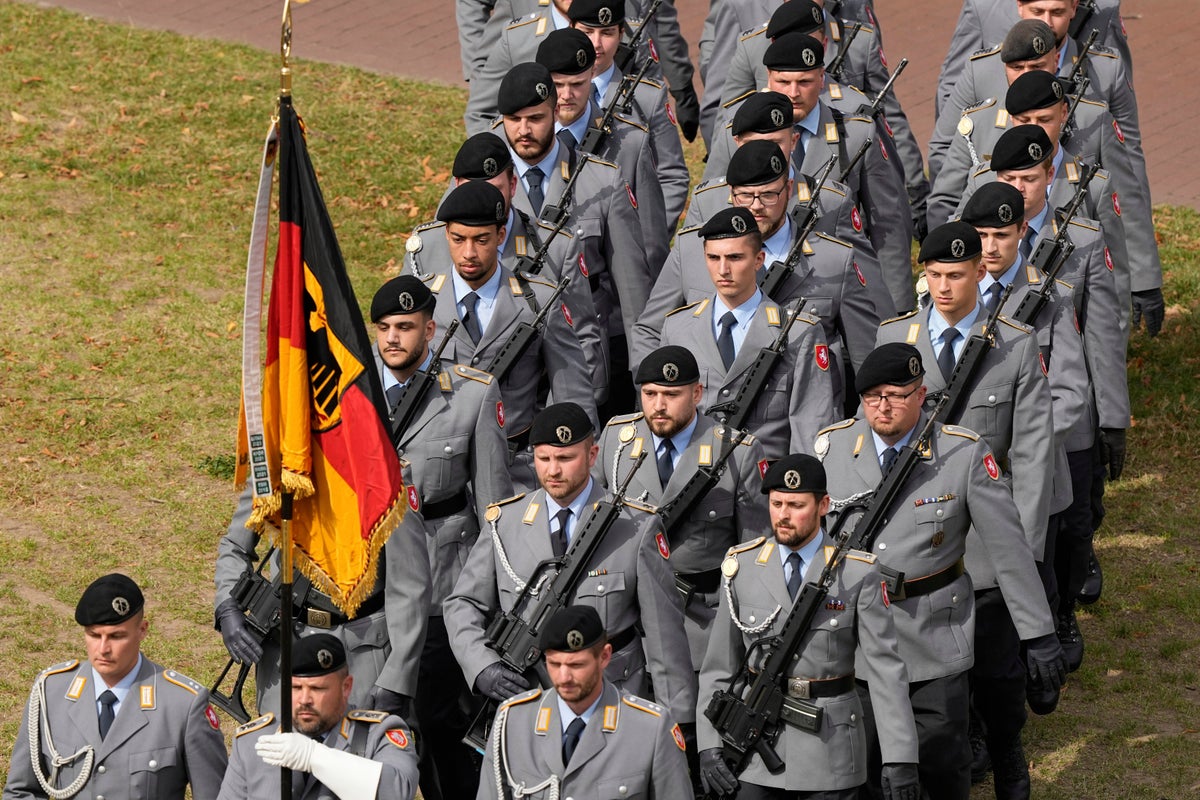
German lawmakers have given their approval to a government initiative aimed at significantly increasing military recruitment, as the nation seeks to bolster its armed forces amidst escalating concerns regarding the threat posed by Russia.
All 18-year-olds in Germany will be sent a questionnaire from January 2026 asking if they are interested and willing to join the armed forces. The form will be mandatory for men and voluntary for women.
Central to the proposal are mandatory medical examinations for young men.
Crucially, the plan stops short of a full reintroduction of conscription, though it explicitly retains the option for compulsory service for a limited number of individuals should circumstances necessitate it.
The Bundestag, Germany’s lower house of parliament, formally endorsed the measure with 323 votes in favour, 272 against, and one abstention.
This approved version is a refined iteration of a strategy initially put forward by Chancellor Friedrich Merz’s Cabinet in August.
The move comes as Germany commits billions of euros to modernising its military equipment, following a period of considerable neglect. The government is now actively focusing its efforts on encouraging more citizens to join the ranks.
Germany is not alone in its endeavour to strengthen its defence capabilities.
Last week, France unveiled a new programme designed to train thousands of 18 and 19-year-old volunteers, set to commence next year. Similarly, Belgium and Poland are also developing plans to attract more individuals into military training or service.
Defense Minister Boris Pistorius told lawmakers that “our allies are looking at Germany” and argued that the country has become a “pacesetter for defense in Europe.” He said that, with the new legislation, “we are taking a further decisive step for our defense capability.”
Germany suspended conscription for men in 2011 and has subsequently struggled to attract large numbers of short-term volunteers.
In recent years, the number of military personnel has hovered just above 180,000 — compared with 300,000 people in 2001, more than a third of whom were conscripts.
Now the government wants to raise the figure to 260,000 over the next decade. It says it will also need around 200,000 reservists, more than double the current figure.
The plan approved Friday foresees more attractive pay and conditions for people who join up on a short-term basis, better training and more flexibility on how long people can serve, starting from a minimum of six months.
The aim is to draw enough recruits without reviving compulsory service, an idea unpopular with the center-left junior partner in Merz’s coalition.
But the plan leaves the door open for parliament to introduce mandatory service at least for a limited number of people, possibly selected at random, “particularly if the defense policy situation or the personnel situation of the armed forces make this necessary.” Many in Merz’s conservative bloc think that conscription will ultimately be needed.
From January 2027, the Defense Ministry will be required to report to parliament every six months on recruitment figures.
The legislation sets annual target ranges over the next 10 years for the size of the military and its reserves, but there is no automatic trigger for any move toward compulsory recruitment.
Starting in the new year, questionnaires will be sent to young men and women turning 18 about their willingness and ability to serve, which men will be required to answer.
That will be expanded into a requirement for young men to undergo medical examinations, though not to sign up for the military. The German military, the Bundeswehr, will need to build up the capacity to process some 300,000 men per year.
Desiree Becker, a lawmaker with the opposition Left Party, called on young people to “strike against the reintroduction of conscription” and inform themselves about conscientious objection.
Pistorius said demonstrations against the plan were welcome. But he insisted that more young people are “prepared to take responsibility” than some opponents say, and they are aware that “no one is forcing us to do anything, other than to fill out a questionnaire … and a medical that hurts no one.”
“This military service is voluntary and will remain so if everything goes as well as we expect,” he said. “But yes … if it isn’t enough, and if the threat situation continues to develop the same way or worse, we won’t be able to avoid a partial compulsory service to protect this country.”
Ten European Union countries have compulsory military service: Austria, Cyprus, Croatia, Denmark, Estonia, Finland, Greece, Latvia, Lithuania and Sweden.
