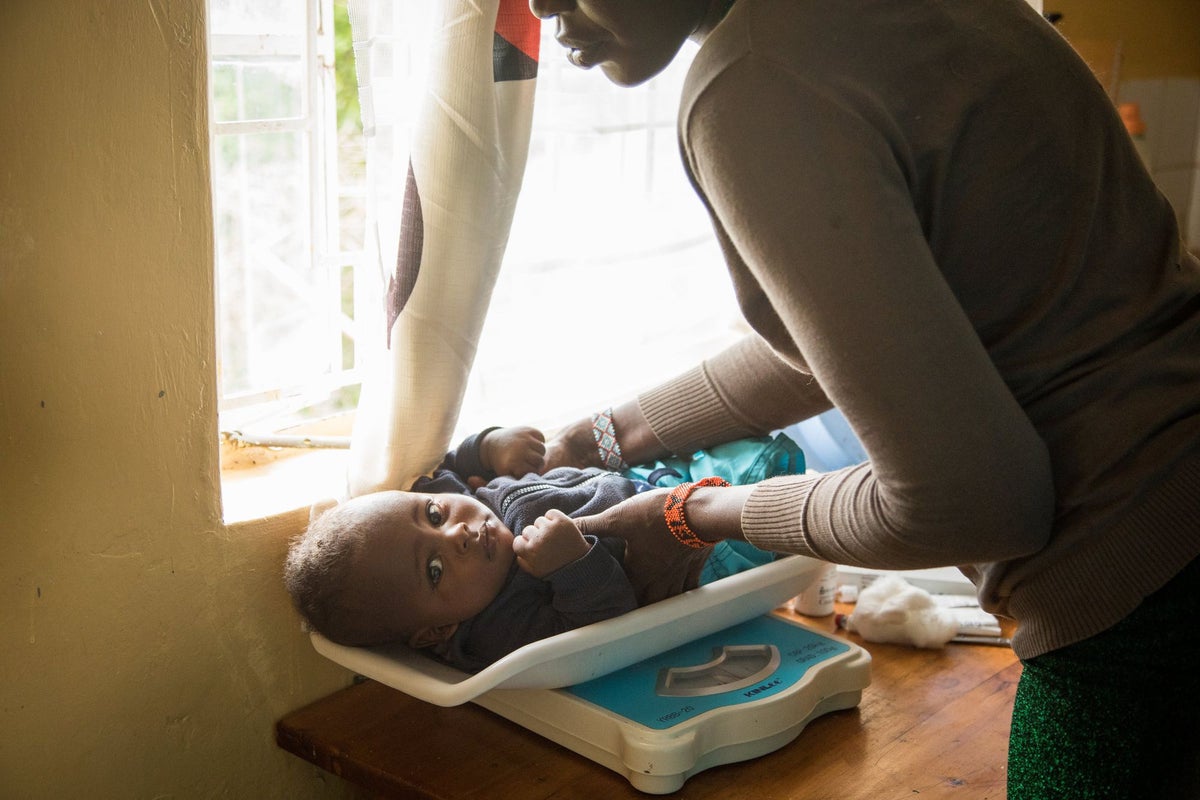
Around 200,000 more children under the age of five are projected to die across the world this year compared with 2024 – the first time this century that has happened – following unprecedented international aid cuts from countries including the U.S.
A report from the Gates Foundation has projected that by the end of 2025, there will be 4.8 million child deaths, compared with 4.6 million the year before. Until now, deaths of under-fives around the world had fallen every year since 2000, when the toll stood at 10 million.
The biggest global aid cuts by far have come from the U.S.. When Donald Trump took office again in January, he cancelled all foreign aid spending overnight.
While some of that cut funding has been switched back on, the disruption “has absolutely led to lives lost”, the foundation said.
Bill Gates, who chairs the foundation, said: “There’s something especially devastating about a child dying of a disease we know how to prevent. For decades, the world made steady progress saving children’s lives. But now, as challenges mount, that progress is reversing.
“That means more than 5,000 classrooms of children, gone before they ever learn to write their name or tie their shoes.”
The Gates Foundation – which supports The Independent’s Rethinking Global Aid project – compiled the report in partnership with the University of Washington’s Institute for Health Metrics and Evaluation.
If funding for health decreases by 20 per cent, in line with the cuts proposed by a number of nations, 12 million more children could die by 2045, the report warned.
“This year, sadly, is almost certain to be the first year of this century where that has not just stopped, but reversed,” Gates Foundation CEO Mark Suzman told The Independent.
“By far, the largest single cause of death is the cuts in international aid. When you pull back at short notice, that has consequences, and sadly those consequences are measured in human lives.
“Those 200,000 additional children who will die from preventable causes are essentially a fairly direct line back to those funding cuts”.
While international aid cuts began with the U.S. at the beginning of the year they have since spread to other major donors like Britain and Germany. Overall, global development assistance for health fell by just under 27% this year compared to 2024, the report says.
In July this year, Democrats opposed to the Trump administration’s cuts to foreign aid argued that the move would damage America’s standing in the world and create a vacuum for China to fill.
Brian Schatz, the Democratic senator for Hawaii, described the cost to save a starving child or prevent transmission of diseases as “minuscule”, and said cuts made to foreign aid programs through Trump’s now-defunct Department of Government Efficiency (DOGE) were having life-and-death consequences around the world.
“People are dying right now, not in spite of us but because of us,” Schatz said in July. “We are causing death.”
The same month it emerged that 500 tonnes of high-energy biscuits intended to feed 27,000 starving children in Afghanistan and Pakistan would be incinerated due to the Trump administration’s decision to shut down the US Agency for International Development (USAID).
Senator Tim Kaine, a Democrat, said lawmakers had specifically warned the government about the food before it expired and had sought to have it distributed.
“Who decides, no, we would rather keep the warehouse locked, let the food expire, and then burn it?” he asked at the time.
U.S. funding for global health remains two-thirds below where it stood in 2024, with one impact being the risk of tens of thousands more children dying of malaria.
Suzman called on rich countries to fund the most effective tools like vaccines and bed nets, “which represent a tiny proportion of their national budgets but have a disproportionate impact in terms of saving lives across low- and middle-income countries”.
“Vaccines remain the most transformative tools in global health, which is why we’re working on vaccines for tuberculosis (TB), for malaria, for HIV, because if those are successful, they can be transformative,” Suzman said. But, he added, “if I had to pick one, I’d pick a malaria vaccine”.
Malaria is the world’s biggest killer of children, who account for more than three-quarters of the 600,000 people who die of the disease each year. Relatively new vaccines have proven it is possible to inoculate against the disease, but they only provide moderate protection that wears off quickly. Trials are underway to find more effective and longer-lasting ways of stopping the deadly parasite.
The Gates report also found that less than $100 per person per year to shore up healthcare systems could prevent as much as 90 per cent of child deaths, while every dollar spent on vaccines gives countries a return of $54.
Under the Trump administration the U.S. has also withdrawn from Gavi, the international vaccine alliance – despite previously being among its largest financial backers. Since 2000, Gavi has helped immunize 1.2 million children around the world and says it has prevented more than 20 million deaths.
In June, U.S. Health and Human Services Secretary Robert F. Kennedy Jr. announced the funding halt in a video message. He urged Gavi to “re-earn the public trust and to justify the $8bn that America has provided in funding since 2001,” Reuters reported.
The Trump administration’s proposed 2026 budget goes further, calling for the closure of the Centers for Disease Control and Prevention’s global health division, a move that would dismantle major vaccination programs targeting polio, measles, and other infectious diseases.
This article has been produced as part of The Independent’sRethinking Global Aid project
