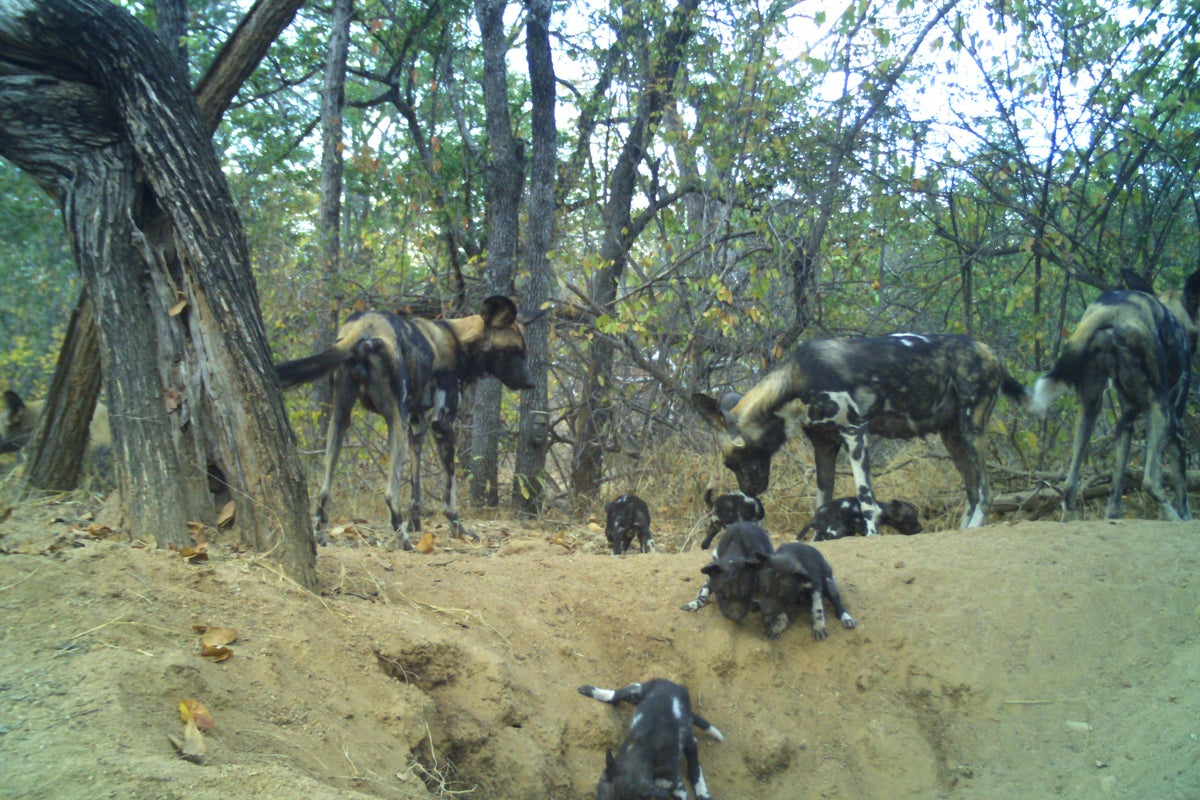
Six African wild dog pups were killed in a single road collision near Zimbabwe’s Savé Valley Conservancy last month, after a fence that was intended to be built with money from the US Agency for International Development (USAID) was left incomplete due to aid cuts.
The loss was described as “heartbreaking” by the African Wildlife Conservation Fund (AWCF) team that found the pups, given their endangered status, with only an estimated 660 breeding packs remaining globally.
“This is a heartbreaking and preventable tragedy,” said Dr. Rosemary Groom, Chief Executive Officer of AWCF, who shared the story exclusively with The Independent.
“These pups represented the future of a stronghold population of wild dogs in Zimbabwe. For a driver to strike six individuals in a single event is unimaginable. It’s devastating not only for this pack, but for the species as a whole.”
The incident occurred on a main commuter road to Harare, while the space of the carcasses just a few metres apart suggested it was the work of just one speeding vehicle.
The section of fence had been earmarked for wildlife protection fencing under a proposed USAID-funded initiative – but after budget cuts took effect earlier this year, the plans were abruptly halted, according to AWCF.
The same stretch of road has also seen an African lion cub, buffalo, brown hyena, spotted hyena and an aardwolf killed: Deaths that would likely have been avoidable had AWCF received the money to repair and maintain the fence and keep wildlife away from the road.
The fence would have cost an estimated $30,000 (£22,500) – and is one wildlife protection project among many hundreds whose budgets whose budgets were slashed as a result of budget cuts at USAID and the US Fish and Wildlife Service, as The Independent has previously reported on in depth.
AWCF saw a USAID grant of $399,947 terminated mid-way through this year, threatening training events and employment opportunities within the organisation, as well as the fence-building programme.
“To lose so many pups to a single, senseless road incident is beyond comprehension, especially when we had the solution ready to prevent it,” said Jess Watermeyer, AWCF Director of Operations. She added that the loss has been deeply distressing for the broader team of consevrationists who have monitored and protected this population for over 20 years.
The reduction of aid from other international funders – including the UK – has further constrained the funding landscape for conservation organisations in southern Africa, Watermeyer added, and is making planning for the future a daunting prospect.
There are only a few thousand African wild dogs left globally in just 39 fragmented subpopulations, with less than 700 individuals in Zimbabwe. Threats faced include habitat fragmentation, poaching, conflict with people and livestock, as well as vehicle collisions.
AWCF is currently fundraising to build more fencing, to strengthen coexistence programmes, and to increase the amount of scout groups available to monitor dog packs.
This article was produced as part of The Independent’s Rethinking Global Aid project
