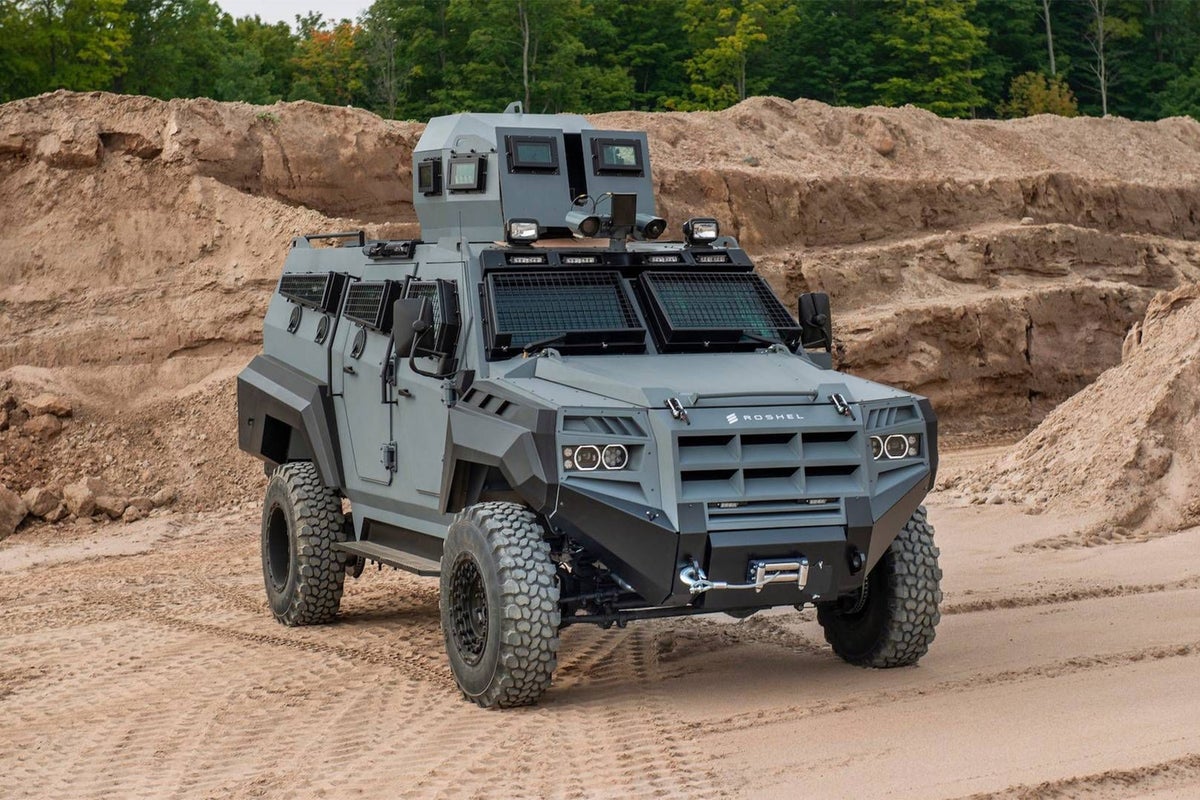
The pending purchase by U.S. Immigration and Customs Enforcement of 20 bullet-and bomb-resistant armored vehicles from a Canadian manufacturer – first revealed by The Independent – has generated intense backlash north of the border, where lawmakers are now exploring ways they might halt the multimillion-dollar sale.
In a so-called sole-source justification document issued the day before Thanksgiving, ICE’s Office of Acquisition Management laid out the reasons why Roshel LLC, headquartered in the Toronto suburb of Brampton, is the only approved vendor “that possesses sufficient inventory to meet the required delivery schedule and the salient characteristics identified by ICE.”
The $7,234,926.20 contract, which was finalized November 28, calls for “twenty (20) Roshel Senator STANG [sic] 4569 Level 2/B7 Emergency Response Tactical Vehicle (ERTV) [sic] armored security vehicles,” according to the document. The Roshel Senator Emergency Response Vehicle, or, “ERV,” is certified as providing Level 2 protection under STANAG 4569, a NATO designation that means it will defend against the equivalent of an 8 kilogram TNT blast. B7 ballistic protection is designed to stop a .50 caliber round, which can penetrate an inch of concrete when fired from a distance of 1,500 meters, or, 16 football fields away.
Roshel will be able to deliver the 20 battlefield-style machines within 30 days, according to ICE, which said it received responses from four U.S.-based manufacturers but all said they would be unable to meet the agency’s strict timeline. Delaying the purchase “would significantly impact” ICE’s “ability to deploy mission-critical resources in a timely manner,” according to the U.S. government.
Thousands of the same armored vehicles have been deployed to Ukraine, for use in its ongoing war against Russian aggression.
Following The Independent’s report on Monday, Jenny Kwan, a New Democratic Party member of Parliament who represents Vancouver East, said she was “deeply” and “profoundly” troubled by the news in light of credible accusations of human rights abuses by the U.S. immigration enforcement agency. It has so far made nearly 600,000 arrests in 2025, and has faced fierce criticism over its aggressive, unyielding tactics.
“I think Canadians expect our industries and our government to uphold human rights domestically and internationally, and not enable the further militarization of an organization whose conduct already puts vulnerable people at great risk,” Kwan told The Canadian Press. “This contract raises serious questions about Canada’s role and responsibility when it comes to our technology and products being deployed abroad.”
Kwan said Canadian law contains intentional loopholes that allow military gear to be sold to the United States without the same level of governmental oversight that would be applied to that same gear being exported to other nations. She told the wire service that she will be proposing revisions to a bill she sponsored in January, prohibiting sales of military items to problematic regimes, that would close those loopholes and prevent such materiel from going to the U.S.
“It’s profoundly concerning that a Canadian manufacturer is supplying specialized military grade vehicles built to withstand bullets and bomb blasts to an agency whose practices have long raised alarms amongst humanitarian organizations,” Kwan told The Globe and Mail.
In a television interview with Global News, Canada’s former Minister of Foreign Affairs Lloyd Axworthy, who served under Prime Minister Jean Chrétien and now chairs the World Refugee & Migration Council, called for the Canadian government to intervene.
“Are we prepared to stand up to Mr. Trump and the illegality of what he’s doing and say that Canada still is a voice for fairness and justice and protection of people’s rights?” Axworthy asked.
Kelsey Gallagher, a researcher focused on Canadian arms exports at Waterloo, Ontario-based Project Ploughshares, an anti-war NGO, pointed out in a separate interview that if the armored vehicles were slated for delivery to “any other security service in the world with the same documented pattern of abuse,” Ottawa would almost certainly step in.
“I’m calling on the government of Canada to follow its obligations under international law. Canada is a state party to the Arms Trade Treaty, as it has been since 2019,” Gallagher said.
According to Gallagher, Foreign Affairs Minister Anita Anand has the power to block exports such as in the proposal. Last year, then-Foreign Affairs Minister Mélanie Joly stopped ammunition manufactured in Quebec from being sold to the U.S. government, which reportedly planned on sending the rounds onward to Israel. Gallagher said the Canadian Department of Global Affairs should similarly consider ICE’s alleged mistreatment of migrants, as well as U.S. citizens, before allowing armored vehicles to be sold to the agency.
However, speaking to reporters Wednesday on a conference call from a NATO meeting in Brussels, Anita Anand, Canada’s present Foreign Affairs Minister – and the government official responsible for overseeing military exports – said that the Carney administration had not been consulted about the transaction.
“I will continue to reiterate that Canada and the United States have a strong bilateral relationship with an open line of communication in which, if necessary, I will raise the issues with Secretary [Marco] Rubio,” she asserted, according to The Globe and Mail.
For its part, the Canadian public has expressed similar levels of outrage over the ICE deal.
“As great as it is to steal companies and business from the USA, I really don’t want Canada to be making armored vehicles for ICE to use to carry out human rights abuses against non-white people,” one social media user posted. “This is blood on our hands. Our government needs to step in and stop this.”
“Oh Canada, arming ICE with bomb-resistant armored vehicles is a complete betrayal of the values we pretend to stand for,” another wrote. “Watching a Canadian company profit while an abusive agency gets militarized is infuriating!”
“I think I can speak for most Canadians: WTF,” a third poster said.
Petitions have begun to circulate, as well, with one titled, “Stop the Contract: No Canadian Weapons to ICE,” receiving nearly 6,000 signatures within 24 hours.
“Prime Minister Carney and Defence Minister McGuinty, stop the $10 million contract between the Brampton-based armoured-vehicle manufacturer, Roshel, and the US. These vehicles are set to support ICE in its violence against migrant families. Canada must not be complicit.”
On the other hand, Ontario Premier Doug Ford, a conservative, exulted over the sale, calling the news “fantastic.”
“I’ve been through that plant,” Ford said, according to Global News. “They make great military vehicles… I know it’s ironic, but that’s alright. We’ll take orders anywhere in the world and thank goodness that the Americans are ordering it off us.”
Roshel founder and CEO Roman Shimonov expressed puzzlement about any concerns over the sale, telling The Globe and Mail, “Why don’t they report on companies that sell socks to the U.S. government?”
On Donald Trump’s first day back in office, he announced his “America First Trade Policy,” calling it “a critical component to national security” that he claimed would lessen America’s “dependence on other countries to meet our key security needs,” and, “above all,” benefit the nation’s workers and businesses.
Trump, who has relentlessly needled Canada about joining the U.S. as the 51st state, subsequently launched a trade war with the country, claiming again and again that America “doesn’t need anything” that its northern neighbor makes. He later lashed out specifically at Ontario, where the company supplying the armored vehicles to ICE is located, when the province aired an anti-tariff TV ad that so infuriated Trump, he threatened additional levies on all goods coming in from the country.
Bilateral trade talks have been stalled since October, and Trump has threatened to rip up the existing agreement between the two countries. Trump will reportedly meet with Canadian PM Mark Carney on the sidelines of the FIFA World Cup draw set to take place Friday in Washington – but the two are not expected to discuss trade.
