‘Trump is in a poker match right now, and he just keeps pushing in more chips,’ one Latin America expert said
Donald Trump could be “boxed in” to a costly conflict with Venezuela and may risk alienating his supporters who oppose US military intervention overseas, analysts have warned.
The US has killed more than 80 people in strikes across the Caribbean Sea, which it claims are targeting boats delivering narcotics into the US, and this week Trump reportedly delivered an ultimatum to Venezuela’s president, Nicolás Maduro, to leave office or face the consequences.
The policy marks a dramatic shift from typical US anti-narcotics operations, in which boats are boarded and passengers detained before being tried in court. It has been condemned by the UN and human rights groups.
As part of this, the Trump White House has recategorised narcotics gangs as terrorists, and pledged to “wage war” on cartels.
It has also doubled the arrest warrant for Maduro to $50m (£38m), describing the Venezuelan leader as “one of the largest narco-traffickers in the world” – something Caracas has dismissed as “propaganda”.
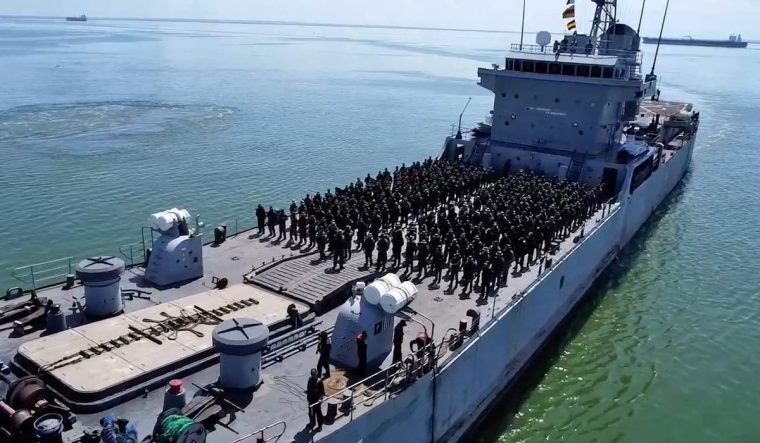
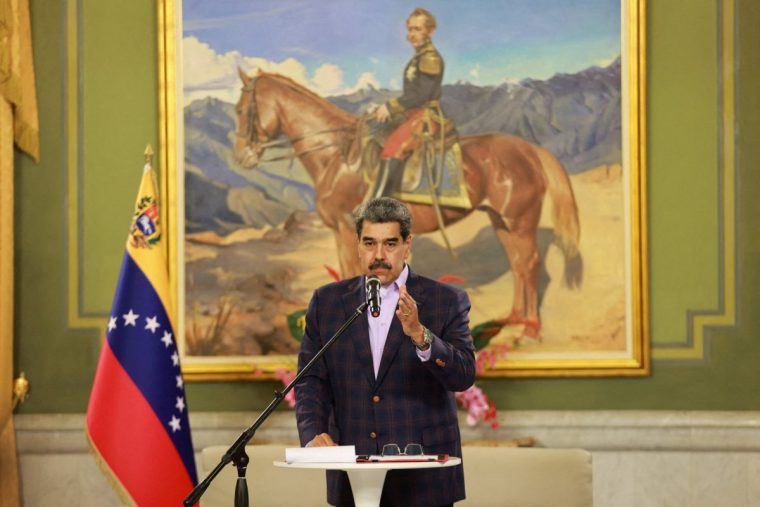
The Venezuelan government has accused the US of threatening its sovereignty, with Maduro saying his country was “confronting the biggest threat that has been seen on our continent in the last 100 years”.
But the threat isn’t just to Venezuela.
Trump keeps pushing in more poker chips
Christopher Sabatini, a senior research fellow at Chatham House, told The i Paper that Trump had “boxed himself in” to a conflict which he had assumed would be an “easy manoeuvre”.
Sabatini said that Trump had a conversation with Maduro, “urged him to leave and Maduro is not only still there but he’s holding a public rally. Trump has got to continue with this escalation. He’s in a poker match right now and he just keeps pushing in more chips.”
Trump could look to ramp up pressure on Venezuela, including by launching drone strikes on military infrastructure in the country or infrastructure like ports, airstrips and storage facilities used in the transport of drugs.
Venezuela is unlikely to match any US escalation because it “suits Maduro to play the victim”, Sabatini said, and harming US service personnel would trigger an overwhelming military and political response.
“I doubt Trump would take the risk of sending planes into drop bombs, given [Venezuela has] surface air missiles. But if he did, I suspect that Maduro would hold fire,” he said.
Sabatini said there was a “sell by date” on the US’s operation, in part because of the large military commitment currently undertaken, and because Trump was unlikely to launch a ground invasion.
Carlos Solar, a senior research fellow in Latin American Security at the Royal United Services Institute, said Trump has both the “political will and the military advantage” to force a negotiation and avoid a long-term military engagement.
“It would be a defeat for Trump to have mobilised such a spectacular force to not move the needle in any way possible in Venezuela,” he said.
“We are still navigating a critical period where conflict can be avoided by both parties, and the US still force the hand of Maduro to relinquish power.”
US operation costing millions – and possibly votes
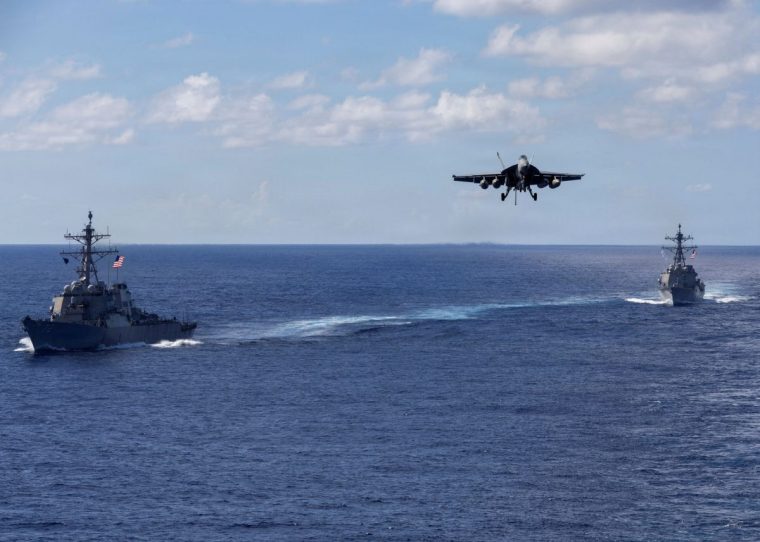
The US has built up its largest military presence in the Caribbean since the 1980s, including the world’s largest warship, the $13bn USS Gerald Ford, which reportedly costs millions of dollars each day to run.
“Anywhere between 10 to 14 per cent of US naval assets are now parked off the coast of Venezuela. That is a huge commitment,” Sabatini said.
He added: “I don’t know how long Trump can go on, but we already see his Maga base, and congressmen and senators who are not seeing the results and are seeing the real risk of war crimes beginning to ramp up pressure.”
Trump is also at risk of appearing to break an election pledge to end US military engagement overseas, which could cost him politically, according to David Andersen, an associate professor of US politics at Durham University.
“Trump campaigned on keeping the US out of foreign wars, decreasing the drug epidemic in the US, and fighting crime,” he said. “None of this will be seriously helped by escalating conflict with Venezuela.”
Trump’s claim to be motivated by stopping drugs entering the US may not convince the US electorate. Venezuela is not a major supplier of drugs to the US, compared with countries such as Mexico and Colombia, Andersen said, and most drugs transiting through Venezuela don’t end up on American shores.
It also does not produce fentanyl, which is fuelling the US’s opioid crisis.
“The US public is highly unlikely to support an invasion of Venezuela in any form, but anything short of that seems unlikely to produce regime change,” Andersen said, suggesting the military operation was a way to distract from Trump’s domestic concerns.
“Trump has picked a fight with a regime that the American people are not hostile to, he has failed to win public support for his attacks on speedboats, and has developed no rationale for why Venezuela is a foreign policy priority,” he said.
“For this to succeed, the American people would have to see Venezuela as a threat, an invasion as justified, and would have to welcome the idea of another drawn-out foreign occupation.”
Trump may use operation to broker a deal
Irene Mia, a senior fellow for Latin America at the International Institute for Strategic Studies, said that Trump may be aiming to force an oil deal with Venezuela, which has the largest proven oil reserves in the world.
“It is clearly not about drugs, and I don’t really think Trump’s concern is the fact that Maduro is a dictator,” she said. “The problem is more obviously, having access to oil in Venezuela.”
She also suggested that Trump may be using the operation to signal to other Latin American countries that he is tough on drugs.
But Jonathan Monten, an associate professor in Political Science at University College London, said that the political cost to Trump is increasing all the time.
Your next read
“If Maduro doesn’t leave, then Trump faces something of a difficult choice. The more he appears to become invested in Maduro stepping down, then the more of a loss to his credibility there would be if Maduro didn’t,” Monten said.
He added: “I think what Trump wants is to create and generate the appearance of strength and dominance. I think he will be very careful to avoid a situation where his only choices are back down or escalate.”
