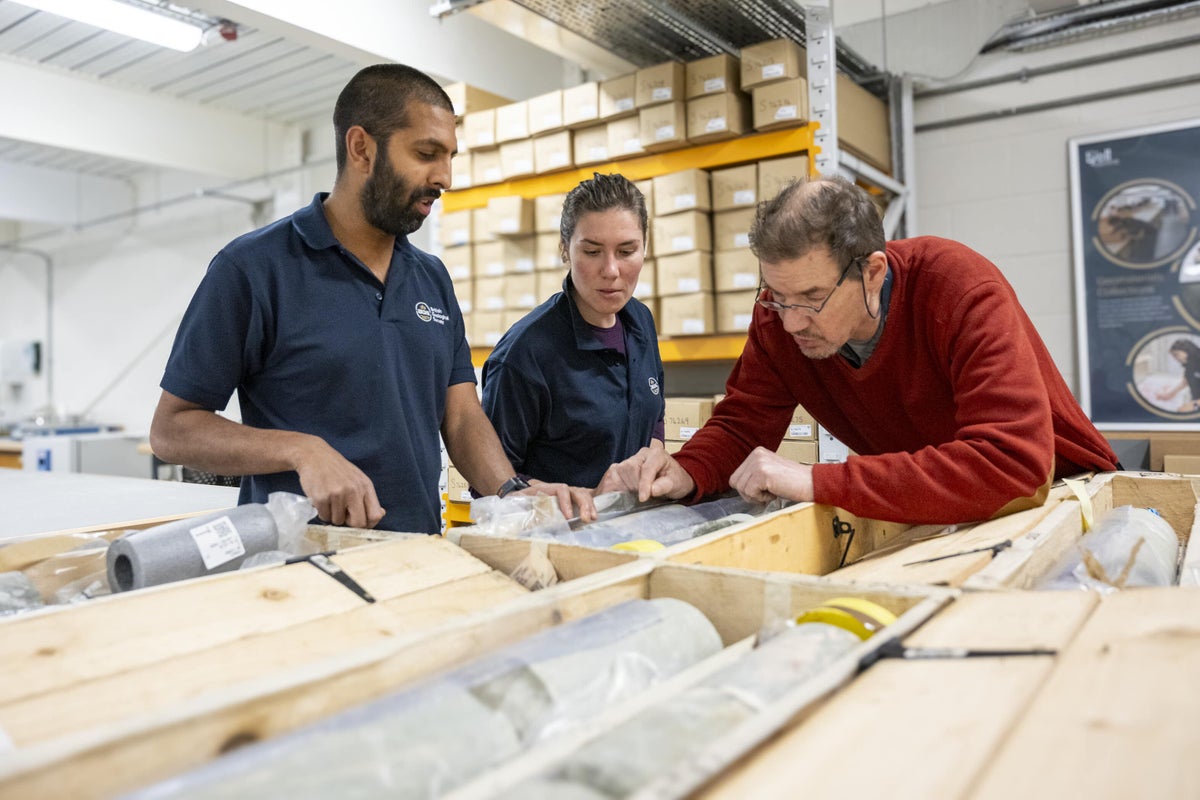
Geologists have been given a “one-of-a-kind” window into Scotland’s geological past as they analyse core rock drilled from the Great Glen Fault during investigations for a hydro-storage scheme.
The Great Glen Fault is the largest geological fault structure in the UK at more than 1,000km long and 40km deep, stretching from Ireland through Scotland to Norway.
Tremors and minor earthquakes are sometimes reported in the area, though rocks associated with the fault zone generally remain mostly hidden to the human eye by the waters of Loch Ness, Loch Oich and Loch Lochy.
Deep drill core was extracted from beneath the Great Glen as part of investigations for a proposed SSE Renewables pumped hydro storage scheme at the Coire Glas site on the shores of Loch Lochy.
Scientists from the British Geological Survey (BGS) were given the opportunity to study 10 metres of the fault zone rocks, which come from a depth of 30-40 metres.
BGS said the rocks offer the opportunity to further understanding of how such fault systems work and how fluids emerging from deep within the Earth’s crust change the properties of the rock, providing a window into the past.
Romesh Palamakumbura, a BGS geologist, said: “It’s such an old fault zone, the fault formed as part of the initial formation of Scotland and that was 400 or so million years ago.
“Then it’s been reactivated at various stages during the kind of carboniferous period, so 300 million years ago, and then during the opening of the North Atlantic, so there is that fundamental geology aspect to it, where we’re understanding basic crustal processes.
“We’ve also been able to look at the reactivation, its geological history, and it’s really helpful for providing that understanding of the fault history of northern Scotland and when it was active, how it was active, and what that tells us about the wider geological history.”
The core was drilled in 2023 when the project began and was delivered to BGS premises in Edinburgh at the end of 2024, where geologists have since been analysing it.
Dr Palamakumbura said it was “incredible” to have access to the rocks and to see something so “spectacular and unique”.
He said: “Newly drilled core from the Coire Glas site has provided a unique opportunity to study fundamental geological processes occurring in the UK’s biggest fault zone.
“The storage of the Coire Glas core at BGS will allow access for the scientific community and will ensure that these rocks are preserved for future generations.”
Other bore holes have been drilled at the site including to a depth of around 650 metres, and it is hoped BGS will have access to more segments of it in the future.
BGS said: “The core has the potential to help us answer fundamental geological questions about the history of the Earth as well as better understand major crustal-scale faults in seismically active regions elsewhere.
“It will also enable us to understand rock properties that are important for major renewable infrastructure projects, energy storage and geothermal targets.
“These cylinders of rock truly are one-of-a-kind windows back into our distant geological past.”
BGS has been providing independent expertise on the complex geology of the Great Glen area to SSE Renewables as part of the project.
An SSE Renewables spokesperson said: “SSE Renewables is delighted to support the advance in scientific understanding of the Great Glen Fault and similar structures worldwide, thanks to the core that was recovered during the ground investigation for Coire Glas.
“As well as being of scientific value, the recovered core has been critical for understanding ground conditions and managing ground risk as the project progresses towards a final investment decision.”
