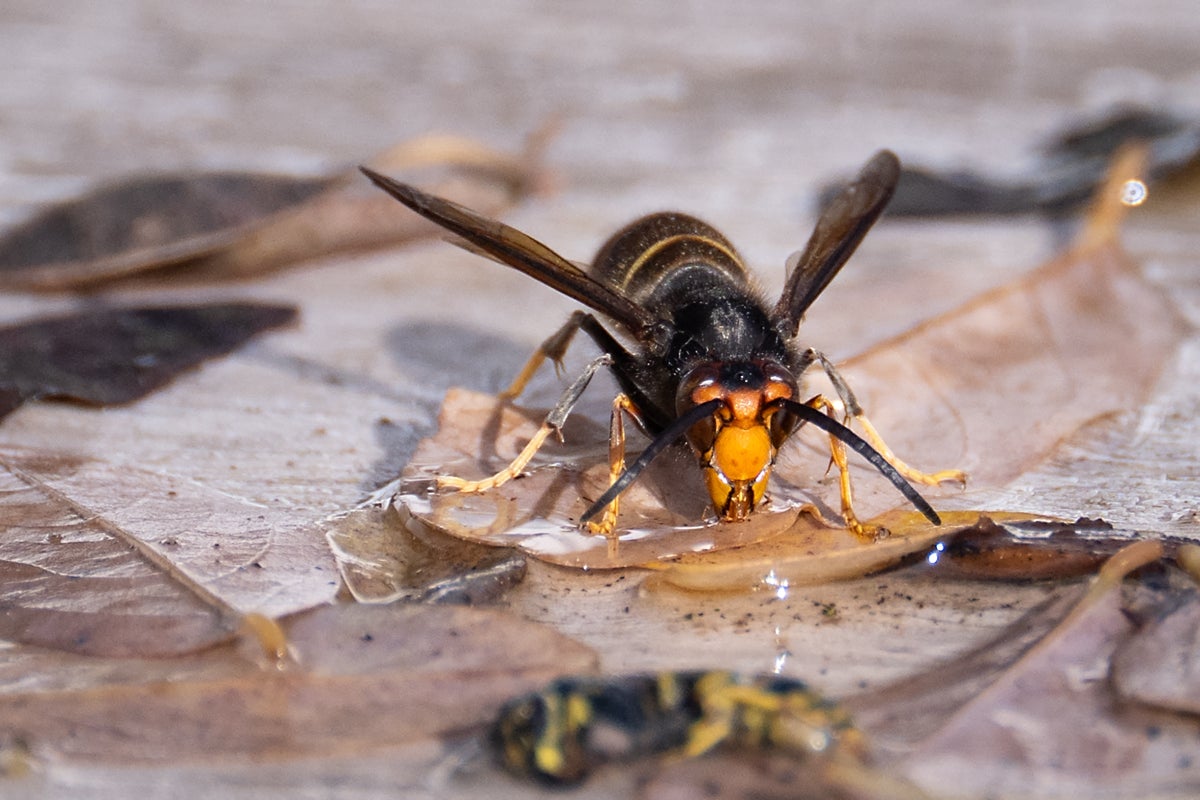
New Zealand is urging the public to look out for nests of invasive Asian yellow-legged hornets that are threatening the country’s biosecurity by feeding on bees as the “narrow window” to curb the insect’s spread closes.
The Ministry for Primary Industries said that it had so far discovered over two dozen queen hornets, 19 of them resting in developed nests or showing evidence of nesting, hinting there could be more hornets in egg-laying stages.
With nearly 70 per cent of the Asian hornet’s diet consisting of bees and other pollinating insects, Biosecurity New Zealand warned the invasive species could compete with native insects and birds for food.
Studies suggest a single hornet, which packs a painful sting, can prey on 25-50 bees per day.
The hornets were first detected in Auckland in 2025, likely introduced into the country accidentally via imported goods.
“New Zealand is fortunate to be free of hornet populations, and we want it to stay that way,” Mike Inglis, north commissioner at Biosecurity New Zealand, said. “It is a highly adaptable predator with a broad diet, primarily feeding on bees, wasps, and flies, but also ripe fruit and flower nectar, posing a risk to growers. It may compete with native insects and birds for food, and it has a painful sting.”
Asian hornets have already wiped out 30 to 80 per cent of honey beehives in parts of Europe, ecologist Phil Lester from the Victoria University of Wellington, said.
“New Zealand now has a narrow window to stop the Asian yellow-legged hornet,” Dr Lester noted in The Conversation.
He cautioned that the country could be staring at a “potential nightmare” unless it rapidly scaled up its search effort.
New Zealand employs strict biosecurity protocols to protect the island nation’s unique and vulnerable native ecosystem.
The country relies strongly on its agriculture and tourism sectors, both of which are highly susceptible to pests and diseases.
“We could soon be confronting an incursion far tougher and costlier to stamp out. Or worse, we could end up with this pest as a permanent resident,” Dr Lester said.
The first Asian hornets were spotted in the country only last month, but their number is rapidly increasing, with 29 queens found so far.
“New queens are still being found in Auckland, and the capture rate is increasing,” Dr Lester warned. “Whatever the reason, the increasing captures are a major concern.”
“The more we search, the more hornets we find. That trend must reverse.”
The ecologist called for more searches covering a much wider area.
Currently, authorities have expanded the search to detection areas of 200m around each nest in line with international guidelines.
But citing observations of hornet invasions in Europe, Dr Lester said this strategy could not be enough.
New nests, he said, could even appear kilometres from previous sites.
“If these European patterns apply even partially to New Zealand, the search radius must expand dramatically, requiring many more people in the field and a careful watch from the public in the wider region around Auckland,” he warned.
The biosecurity authority announced on Monday that “further extensions are being made as needed”.
