“I have never seen a statue of a movie critic. Have you?” shrugs Kunal Nayyar when I ask how he feels about the critical mauling of his new film, Christmas Karma.
It’s hard to believe the 42-year-old – best known for his role as shy nerd Raj in US sitcom The Big Bang Theory – isn’t hurt by reviews of Gurinda Chadha’s East Asian spin on Charles Dickens’s A Christmas Carol, in which he stars as an Indian Scrooge, Mr Sood. Despite quirky star turns from Hugh Bonneville, Eva Longoria, Billy Porter and Boy George as the ghosts, The Daily Telegraph gave the film zero stars, condemning it as “the worst thing to happen to Christmas since King Herod”, while The Guardian gave it just one star, finding the whole “nausea-inducing” musical extravaganza “as welcome as a dead rat in the eggnog”.
But, zooming cheerfully in his baseball cap from his home in Los Angeles, Nayyar briskly dismisses those who say “Bah Humbug” to Chadha’s “big-hearted” film. Cinema goers, he points out, ignored the critics and went anyway. “We came in sixth at the box office, which is huge for an independent movie, made for £8m, being pitted against movies with budgets of £200m.” He’s got experience of this sort of thing: “The Big Bang Theory got panned by critics at the beginning – 279 episodes later, I think we got the last laugh.”
Then Nayyar gets serious. “This is the nature of what it is to tell South Asian stories. People continually try to silence our voices.” He exhales. “But it doesn’t beat us down. It actually makes us braver and more creative and more excited to push narratives that cause cultural change…”
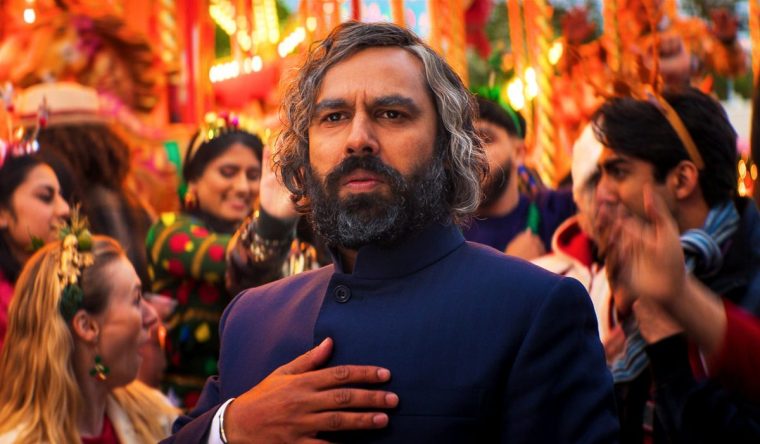
Chadha – who has a track record of charming audiences with original tales of the Indian diaspora, most famously with the 2002 classic Bend it Like Beckham – uses Dicken’s classic to explore the immigrant struggle for belonging. Her Scrooge/Sood is one the 80,000 Asians expelled from Uganda in 1972 by Idi Amin. The dictator accused the minority (many of whom held British passports) of sabotaging the economy and gave them just 90 days to leave the country. Many of those refugees lost everything and struggled with racism after resettling in the UK.
Scrooge/Sood experiences a violent assault by far-right thugs and – as his family left everything behind in Uganda – is rejected by the parents of the girl he wants to marry. His obsession with making money is kickstarted by an anxious need for safety, security and acceptance.
Born in London and raised in New Delhi from the age of three before moving to the US for college at 18, Nayyar says it was this “untold story” of the Ugandan Asians that drew him to the role. “When Gurinda first came to me, I said, ‘Are you nuts? I’m too young to play this part!’” He recalls. “But she said she saw a ‘quiet melancholy’ that I carry. I thought that was quite interesting.” But he hesitated before accepting the role. “That came from fear, to be honest. To play Scrooge is to be pitted up against some of the greatest actors of all time.”
But he says his resistance crumbled as he began to read about the Ugandan Indian experience. “Some of those people were killed. Others lost all their wealth,” he explains. During his research, Nyaar went to lunch with a friend who exclaimed: “Oh my god. This is the story of my father.’” He shakes his head in amazement. “What we thought would be a quick catch-up turned into a four-hour conversation about how my friend’s father lost everything and still suffers from depression as a consequence. My friend says his dad has never seen joy since he lost his home. Every day tells his son: ‘Only money and status can save you. Without it you lose all respect.’ That was drilled into him as a child.”
And that’s what’s happened to his Scrooge/Sood? “Precisely, yes,” Nayaar nods fervently. “That conversation made me realise this film is so much bigger than me wanting to play a character; this is a story about a marginalised community that needs to be told. We are trying to shine a light on a horrific historical event through a children’s story here. We are trying to change the world. That is why, when you talk about reviews? Who cares, man?”
Nayaar leans towards his laptop camera and asks what I thought of the film. This is awkward. I did find it patchy – and agree with the Empire critic who said it felt more like an EastEnders Christmas special than a big screen event. I definitely cringed at the moment it turned out that the “poor” Cratchit family – who couldn’t afford lifesaving medical treatment for poor Tiny Tim – lived in a Notting Hill mews house worth millions. But I also enjoyed the way film and music genres and characters of all races and sexual orientations were jumbled merrily together, like decorations on a family Christmas tree.
“And did that make you feel something?” asks Nayyar. I confess it did. I grew up in Leicester in the 80s and 90s, celebrating Hindu festivals Diwali and Holi, with neighbours part of the city’s large South Asian population. I did a paper round for a Bangladeshi boss who served me hot samosas in his jangling reindeer antlers at Christmas.
Nayaar’s family celebrated Christmas in New Delhi. “We were an anglicised family,” he says. “I went to an English-speaking school where we studied Dickens and Shakespeare. So at Christmas we had a skinny fake tree – you’re not getting real Christmas trees in India – and a skinny Indian uncle with a big belly dressed as Father Christmas.” He chuckles.
The Nayyar family also celebrated Hindu Diwali and Muslim Eid. “The beauty of being Indian is celebrating all religions. It’s our spiritual nature to allow that there is space for all of us,” he explains. “So I want to make it clear that Christmas Karma isn’t a movie about South Asians versus the white people. It’s a movie where we see a community of all faiths and colours come together. That is the London, the England, that I love.”
Did Nayyar experience racism in the UK and the US? “Of course,” he says. “I’ve experienced it all over the world. I cannot crawl out of my skin and change its colour. It is the suit I have to wear for the rest of this life.” He is frank that overt racism – like that faced by Sood in the film – “is coming back now, with the flag-waving, the far right, the recent march of 300-400 people in central London. We cannot sugar coat that. We are living in a divisive world.”
In interviews, Chadha has explicitly linked Sood’s journey with that of some of the “Asians in the Tory party empowered by taking a hard rightwing stance… In a way it’s them wanting to be accepted more.” But Nayyar would prefer to give politics a swerve. Instead he focuses on the film’s message of forgiveness and acceptance.
“People experience racism and sexism, all kinds of isms in this life, because of how narrow-minded people are,” he sighs. “For me, whenever I face hardship, I try to approach it with compassion and understanding, because I don’t believe you can change someone’s mind by beating them in the mouth. I think that, with grace, you can help heal their inner child. Whatever is screaming out inside of them, you can hold that and say: I am here with you.”
As a man who’s gone from cleaning toilets for a living – during his early years in the US – through to gaining his masters in drama and going on to star in both classical theatre with the Royal Shakespeare Company and in one of the most popular sitcoms of recent times, Nayyar said he has learned to become “more quiet” as he matures. Married to former Miss India-turned-fashion designer Neha Kapur, he’s still “a sicko for acting” and relished the opportunity to “spend three months being grumpy as Sood”.
Unlike Sood, he is also happy to give away money. At the height of The Big Bang Theory’s success, he was earning an estimated $1m per episode, with Forbes ranking him as the world’s third-highest-paid TV actor in both 2015 and 2018 (with annual earnings of $20m and $23.5m, respectively). Today he tells me that wealth does not “weigh heavy” on him.
“Money,” he says, “has given me greater freedom and the greatest gift is the ability to give back, to change people’s lives.” He and Kapur fund university scholarships for young people from disadvantaged backgrounds. “We also support animal charities because we love dogs. But what I really love to do is go on GoFundMe at night and just pay random families’ medical bills. That’s my masked vigilante thing!” He smiles, gently. “So, no, money doesn’t feel like a burden. It feels like a grace from the universe.”
Nayyar believes that while we don’t all have this luxury, we can all find a way to lift our own spirits by helping those less fortunate. “Right now people are not happy,” he argues, “because we are all expecting someone else to be kind. We are expecting a president or a politician, some leader, to come and bring us world peace.” He shakes his head. “But there is no world peace if your neighbour comes to your door wanting some sugar for their tea, and you lock it against them and say ‘get away’.” He hopes audiences leave cinemas this month learning Dickens’ old lesson: “That no one is going to come and change the world for you. You have to do it for yourself.”
‘Christmas Karma’ is in cinemas now
