Ukraine faces one of the ‘most difficult moments in our history’, its President said, as it mulls peace plan some analysts describe as ‘suicide’ for Kyiv
Donald Trump’s peace deal makes Ukraine a “tethered goat” for future invasions by Russia and agreement would be “suicide” for Kyiv, analysts have warned.
Ukraine’s European allies this week tacitly rejected Trump’s peace proposal, a 28-point plan created with Russia, which featured many of the Kremlin’s demands.
The plan was strongly criticised as kowtowing to Putin, with European leaders warning it would “leave Ukraine vulnerable to future attack”.
Many military analysts and academics have warned that Russia may use a ceasefire in Ukraine to regroup before reattacking.
Trump said the plan was “not his final offer”, and later announced an “updated and refined peace framework” created in partnership with Ukraine.
Trump’s plan – and why it plays into Putin’s hands
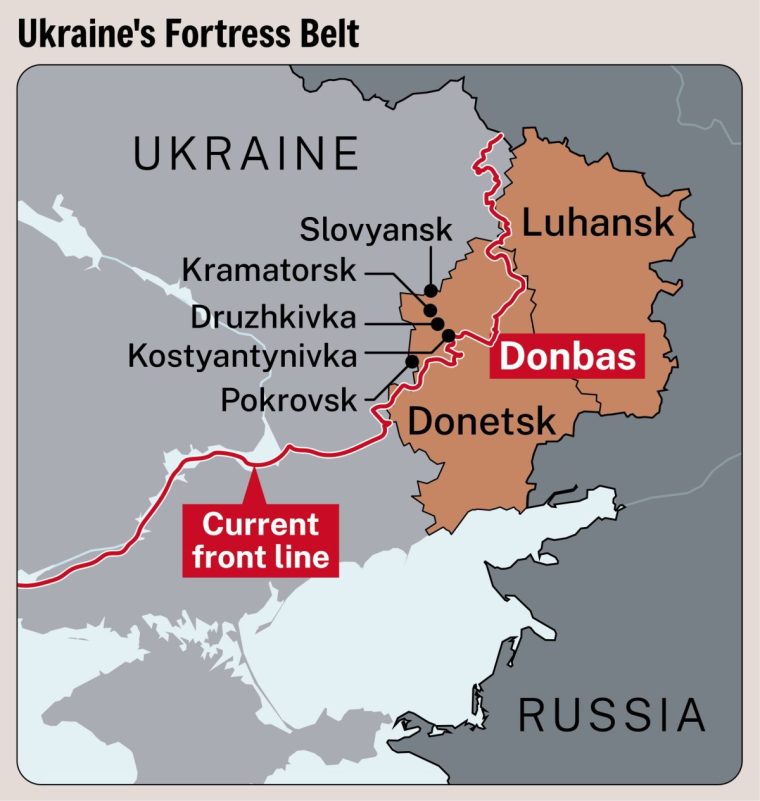
Trump’s plan would hand over the Donbas – an eastern region made up of Donetsk and Luhansk oblasts – to Russia.
Russia currently controls almost all of Luhansk and a large portion of Donetsk.
Areas that Ukraine still holds in Donetsk would become a demilitarised zone belonging to Russia, which Russian forces would supposedly not enter. Ukrainian forces would have to pull out of these areas.
Crimea – which was annexed by Kremlin forces in 2014 – would be formally recognised as Russia.
This would fulfil Putin’s long-held goal of expanding the borders of Russia. He has been open in his belief that Ukraine has no right to exist and that this war will reclaim historically Russian lands.
In 2022, Russia changed its constitution to lay claim to four areas of Ukraine – Donetsk, Luhansk, Zaporizhzhia and Kherson – which it did not fully control.
The cession of territory would also open the door to future invasions, both by weakening Ukrainian militarily and by rewarding this violation of international law.
Handing over the Donbas would mean losing Ukraine’s so-called “fortress belt”, a group of heavily fortified cities, which could enable Russian forces to storm through parts of the country at ease in any future attack.
Under the US President’s plan, Ukraine would have to limit the size of its military to 600,000 and commit not to join Nato, also hindering its ability to respond to future invasions.
It would also prevent Nato troops from being stationed in Ukraine after the war, after Prime Minister Sir Keir Starmer said the UK was ready to put “boots on the ground, and planes in the air” to ensure Ukraine’s security post-war.
Defence insiders told The i Paper that planning was ongoing for a range of options for British involvement after a ceasefire, and that the UK’s willingness to send troops has not been changed by Trump’s plan.
The plan stipulates that $100bn in frozen Russian assets will be used to rebuild Ukraine; the US will receive 50 per cent of the profits, and the remainder of Russian assets would go into a joint US-Russia fund, for a purpose that so far appears vague.
There would be an amnesty for both sides, removing the possibility of war crimes trial and Ukraine would be expected to hold elections within 100 days of a deal.
Plan would give Putin ‘the key to Kyiv’
Dr David Dunn, professor of international politics at the University of Birmingham, said the 28-point plan was Putin’s “wishlist and dreamsheet” and showed his ability to “manipulate” the “dysfunctional” American decision-making.
“Russia still thinks it can take a maximalist position. They haven’t changed their war aims for the subjugation and pacification of Ukraine, reduced to a vassal state with a weakened army and weakened capacity,” he said.
Dunn described the peace plan as “the creation of Ukraine as a tethered goat for future attacks that Russia could carry out once it remustered its position”.
“It’s an extraordinarily ambitious set of goals that the Russians still have,” he added. “And remarkably, they have completely turned round the pressure the Trump administration was starting to put on Russia.”
Dr Greg Mills, senior associate fellow at Rusi, said that while elements of the plan – confirmation of Ukraine’s sovereignty, military response to any further Russian invasions, reintegrating Russia to the global economy and using some frozen assets to rebuild Ukraine – might be reasonable, other parts would be “suicide for the Ukrainians to agree to”.
“Under the terms of this proposal, Ukraine would effectively give Moscow the keys to Kyiv by giving up the strategically vital areas around Kramatorsk in the Donbas, cutting the size of its army by around 30 per cent and foregoing its long-range weapons,” he said.
“They do not make the same demands of Russia, and together with the end of sanctions, are an invitation to another round of war.”
Mills said that such early Ukrainian elections would be an “invitation for Russian meddling if ever there was one, along with administrative bedlam, not least given around ten million Ukrainians have been uprooted by the war”.
Europe’s counter plan hands Kyiv back some control
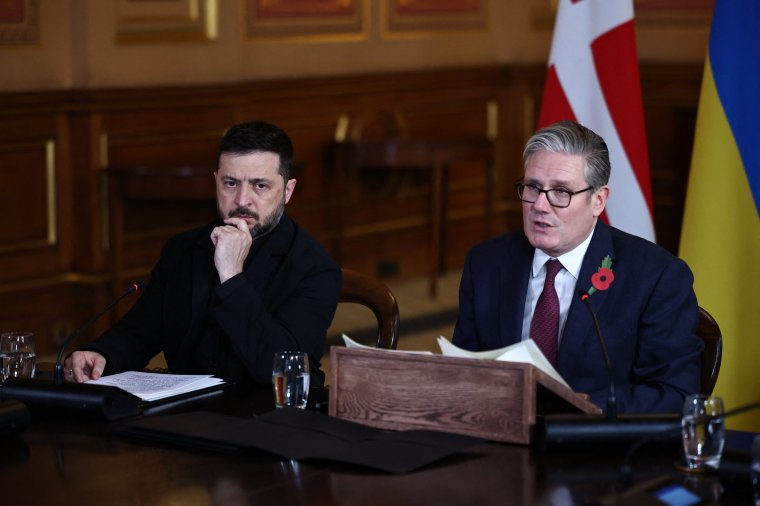
European leaders have drafted their own peace proposal for Ukraine, which removes many pro-Russian elements of Trump’s plan.
The proposal, drawn up by the UK, France and Germany and first revealed by The Telegraph, would allow Ukraine’s forces to stand at 800,000 in peace time. This is close to its current size, which Zelensky says is 880,000.
Under Europe’s plan, Ukraine would commit not to recover its occupied territory militarily, and negotiations on territorial swaps would start from the current line of contact.
It would leave open the possibility of Ukraine joining Nato.
The European plan also suggests a security guarantee from the US similar to Nato’s Article 5, which would commit America to treat an attack on Ukraine as an attack on an ally.
Under Nato’s agreement, an attack on an ally is treated as an attack on all.
Both plans would compensate the US an undisclosed sum for providing this security backstop.
Your next read
After a meeting in Geneva on Sunday, the US and Ukraine said they had created an “updated and refined peace framework” to end the war.
US Secretary of State, Marco Rubio, said he was “very optimistic” about the progress of the talks, while a joint statement from the two countries said that any eventual deal would “fully uphold” Ukraine’s sovereignty.
Neither side has released details of the new plan, but it will have to move the dial significantly from the first draft to be palatable to the thousands of Ukrainians suffering through the war.
As Zelensky put it, Ukraine faces “either 28 difficult points, or an extremely harsh winter, the harshest ever and further risks. Life without freedom, without dignity, without justice.”
