The rivalry between Constable and Turner, the most celebrated of British landscape painters, was intensely nurtured by the critics of the day, but that doesn’t make it any less real. Theirs was an opposition as charged as that between Matisse and Picasso, Leonardo and Michelangelo, and it shows no sign of dimming 250 years after their births.
You may already have picked a side, in which case the points of difference between the two painters are so clear and compelling that setting them against each other feels deeply unfair. Why would you back privileged country boy Constable over urban self-starter Turner, whose raw talent saw him enrolling as a student at the Royal Academy aged 14? How could you fail to be seduced by Turner’s magnificent evocations of awe-inspiring nature, against Constable’s nostalgic scenes of rural Suffolk?
Clearly, for any right-thinking person Turner is the hero, whose radical influence was acknowledged by Claude Monet and Mark Rothko; Constable doesn’t stand a chance, tainted for a generation (my generation), whose GCSE History textbooks contained a reproduction of The Hay Wain, cementing an unforgivable association with English agricultural reform, from Enclosure Acts to Corn Laws.
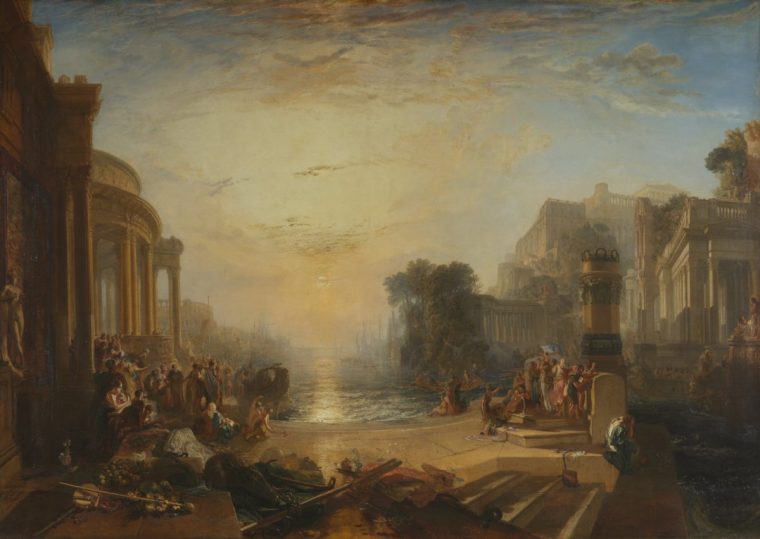
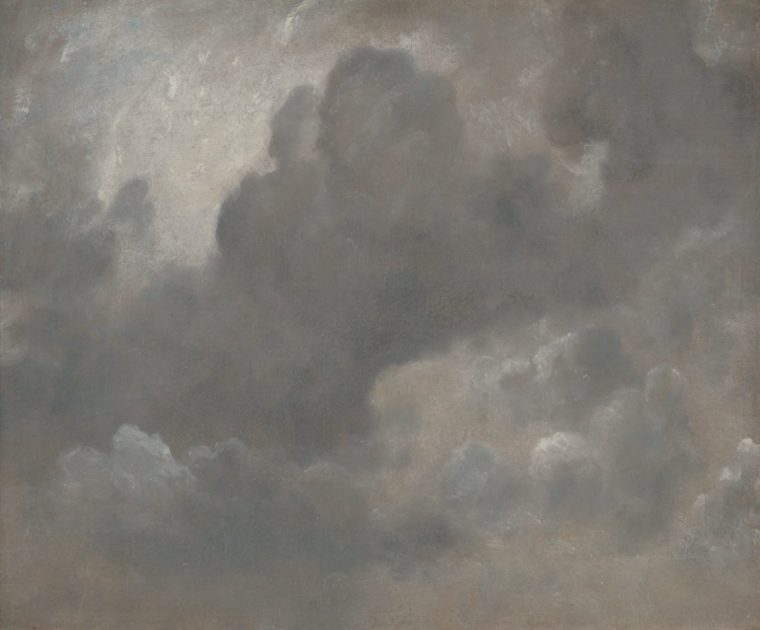
Having arrived with all these prejudices, and plenty more that revealed themselves to me as the show unfolded, I was immediately wrongfooted by Tate Britain’s new exhibition, which is most of all about finding common ground between the two artists. Though the title hypes their rivalry, the show makes minimal fuss of even the genuine friction between its two protagonists – and sets about exploring their differences and significant similarities in a nuanced and sympathetic way.
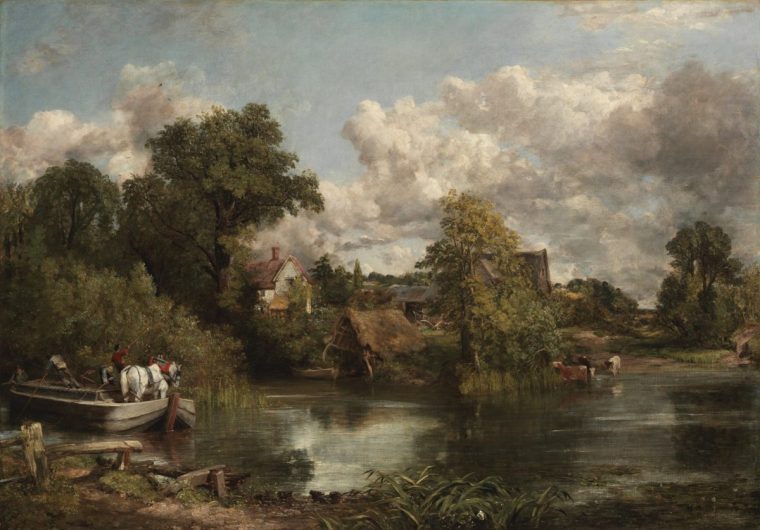
Billed as a once in a lifetime exhibition, it is the first major show to explore their lives and legacies, with several rarely seen works on public display for the first time in decades, and even centuries in some cases, as well as palettes and brushes, sketchbooks, and even Constable’s sketching chair. Constable’s The White Horse (1819), his first “six-footer”, is on loan from the Frick Collection in New York, as well as Turner’s first exhibited oil painting, long thought lost.
Though born just a year apart, Turner’s extreme precocity was equalled by Constable’s relatively slow start, and in 1799, where the exhibition begins, the two artists were already at quite different points in their careers: just as Constable arrived in London from Suffolk to take up a place as a student at the Royal Academy, Turner was elected an Associate Member.
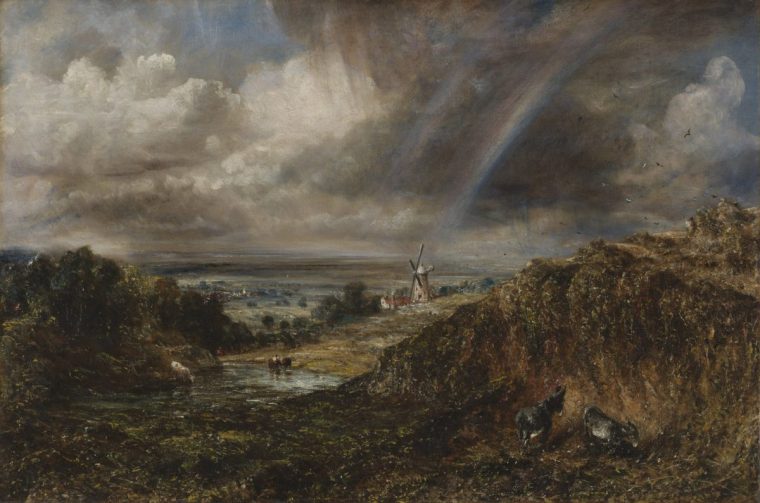
Turner would be elected a full Academician, one of 100 artists elected to run the Royal Academy, three years later, an accolade eventually matched by Constable in 1829. The latter marked the occasion with a perfectly calculated dig at Turner, presenting the Royal Academy with his homage to the 17th century French artist Claude Lorrain’s Hagar and the Angel, the very same painting that Turner honoured at the time of his own election all those years before.
Then, Turner’s quasi-classicising fantasy set in an idyllic, golden-hued version of the West Country’s Tamar Valley earnt him comparisons to Claude, whose idealised landscapes, compositional flair, mastery of aerial perspective, and storytelling ability made him a revered figure.
Constable’s retort (if that is what it was) finds the spirit of Claude in the down to earth surroundings of Dedham Vale, on the Essex-Suffolk border, which he casts not in an Italianate glow, but in a cool, unapologetically northern light. Even so, the figures of a mother and baby in the foreground, suggestive of a Virgin and Child, introduce a timeless grandeur to this busy, ostensibly very 19th-century, rural scene.
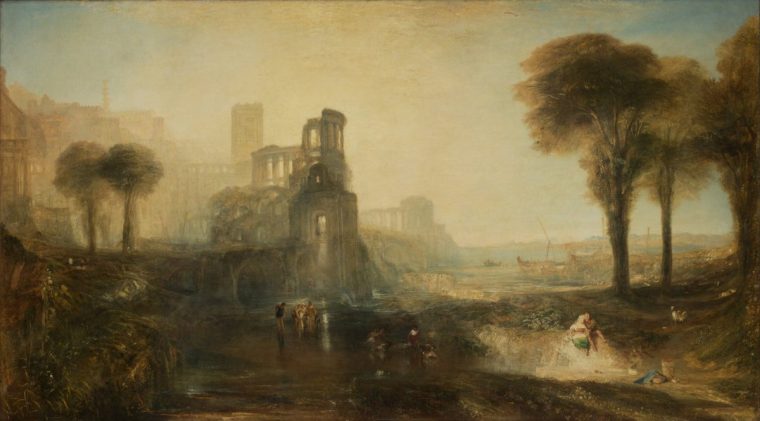
Enjoyable as it is to view these paintings as a contest, Claude Lorrain himself is the key element in the story, the common thread linking the two painters and inspiring their different, but related attitudes to landscape painting.
Perhaps not emphasised quite enough in the exhibition is the low to non-existent status of landscape painting prior to Turner and Constable. Claude was their lodestar, but his classical themes ennobled his landscapes, and allowed them to qualify as history paintings. It’s Bridget Riley who points out, in a specially made film at the end, that before Constable, a landscape was simply a setting, a backdrop for the Virgin Mary, or a view seen through a window.
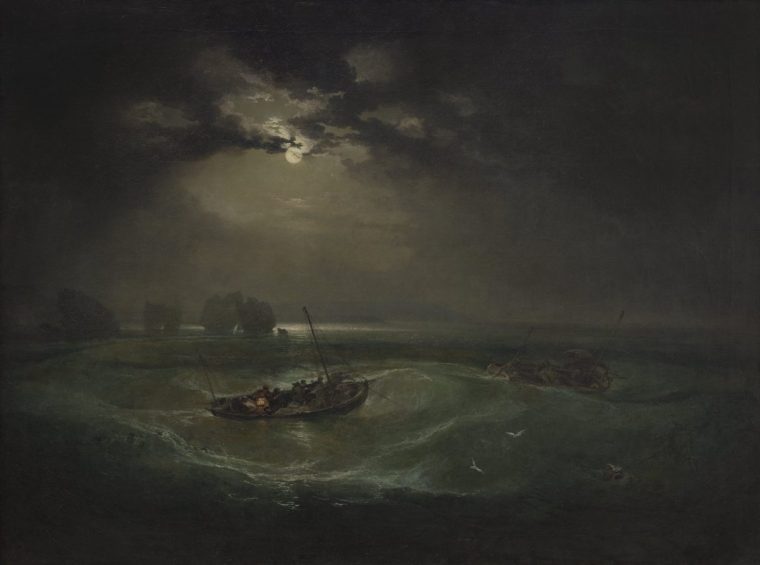
In this sense, and it’s quite a stretch to really appreciate this now, Constable is the more radical of the two, boldly making the landscape a worthy subject in itself. The contrast with Turner’s flights of imagination and feeling – as in Fishermen at Sea (exhibited 1796), in which he makes us participate in a terrifying ordeal by boat – which like Constable’s paintings were rooted in the observation of nature, was described by one critic in 1819, who saw that Constable had “none of the poetry of Nature like Mr Turner, but … more of her portraiture.”
Both artists were equally committed to working in nature, as their rain-mottled sketchbooks show. But while Turner’s Marylebone studio was where he developed and finished ideas seeded in trips not just around Britain, but in Europe too, Constable completed his increasingly ambitious, large scale paintings outdoors. “I live wholly in the fields and see nobody but the harvest men,” he wrote in 1814.
But while he cultivated the idea that he was a humble servant of truth, there is plenty of artfulness in Constable’s compositions, which were planned in preparatory sketches, and peopled like a stage set, with animals and labourers. His naturalism is easy to confuse with realism, but Constable steadfastly refused to engage with the harsh realities of life for agricultural workers at this time, or with the march of industrialisation that Turner was so fascinated by.
Constable’s The Wheatfield (exhibited 1816) is a perfect example of his idealising tendencies, that in their own way were every bit as inventive as Turner’s flights of fantasy. In this contented scene there is no trace of the poverty and disempowerment that plagued labourers many years into the Napoleonic Wars, when food shortages caused by blockades and poor harvests were exacerbated by high prices – and the systemised removal of land from ordinary people.
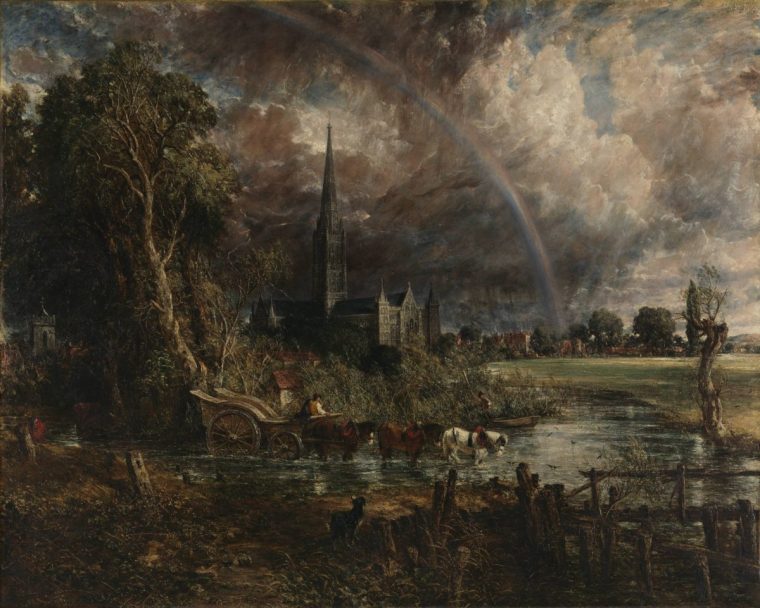
A comparison of the two painters’ treatments of Salisbury Cathedral, sadly not hung side by side here, encapsulates the differences, and again the similarities between the two painters. Turner’s glorious watercolour from 1802 frames the cathedral in a dramatically crumbling cloister arch, a romantic gesture that with the little boy and his hoop in the foreground, evokes the passing of millennia. Constable’s Salisbury Cathedral from the Bishop’s Grounds (exhibited 1823) does something similar, but with a very different result, framing the building not in stone, but in a natural arch formed by trees, through which the cathedral – and so God – makes the natural centre to a harmonious world.
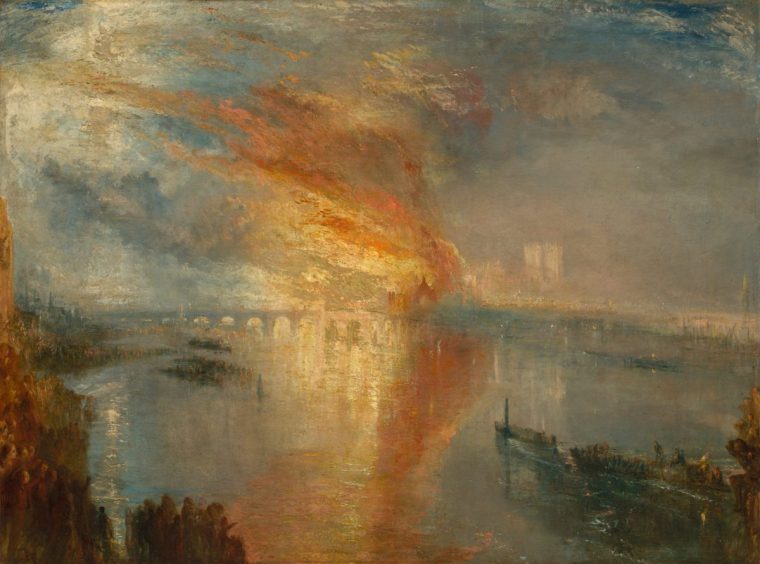
Funnily enough, Constable’s moody rain clouds displeased his patron, the Bishop of Salisbury, who preferred a “more serene sky”. It was just this sort of turbulent weather that Turner is celebrated for, typified by his 1812 painting Snow Storm: Hannibal and his Army Crossing the Alps, in which a pale malevolent sun forms the epicentre of a terrifying storm.
Your next read
Looking at Constable close up is a reminder that though he never pursued the abstraction for which Turner is perhaps most prized today, his own treatment of paint, light and colour defied convention too. Both Constable and Turner enjoyed colour in a way that the admired Claude, famous for muted, honeyed tones, had not. And Constable’s commitment to depicting light, which he achieved through an unorthodox use of pure white – his “snow” as his critics had it –and choppy brushstrokes that were said to look rough and unfinished.
By the end, as Turner was flooding canvases with light, Constable was raining paint onto canvases flecked and spattered with colour. What emerges in this thoughtful and illuminating exhibition, is the fickle nature of reputations, and the sense that the dominance of abstraction in the 20th century pushed Turner to the fore as one of its antecedents.
By looking at the painters’ similarities, a more nuanced understanding of their difference emerges, encapsulated by the painter George Shaw who in the accompanying film notes that Constable grounded his art in the Suffolk soil, where Turner grasps always for what is not quite there.
Turner and Constable: Rivals and Originals is at Tate Britain 27 November to 12 April 2026
