Donald Trump may hand Russia a crucial bit of Ukrainian territory. The consequences would be devastating
Among the key details of the 28-point peace plan handed to Ukraine by Trump’s envoys on Thursday was that the regions of Luhansk and Donetsk, along with Crimea, would be recognised as de facto Russian territory.
Areas that Ukraine still holds in Donetsk would become a demilitarised zone belonging to Russia, which Russian forces would supposedly not enter. Ukrainian forces would have to pull out of these areas.
It would be a huge concession for Ukraine, and beyond the loss of territory and population, would massively impact the country’s ability to defend itself from future Russian aggression.
The loss of Ukraine’s so-called “fortress belt” in particular could enable Russian forces to storm through parts of the country at ease in any future attack, analysts told The i Paper.
Ukraine’s so-called fortress belt is made up of a handful of key cities in the eastern Donetsk region, which have been heavily fortified in recent years. Though there is no formal definition, it usually refers to the cities of Kramatorsk, Sloviansk, Kostyantynivka and Druzhkivka, and sometimes Pokrovsk.
These areas are the focus of a major Russian offensive, and Russia is eager to try to wrestle them out of Ukraine’s hands as part of any Trump-brokered peace deal.
Christina Harward, Russia deputy team lead at the Institute for the Study of War, told The i Paper that the belt is the “backbone of Ukraine’s defense in Donetsk Oblast.”
It is comprised of “large, heavily fortified cities” along a 50-kilometre stretch of the H-20 highway which collectively had a pre-war population of over 380,000 people.
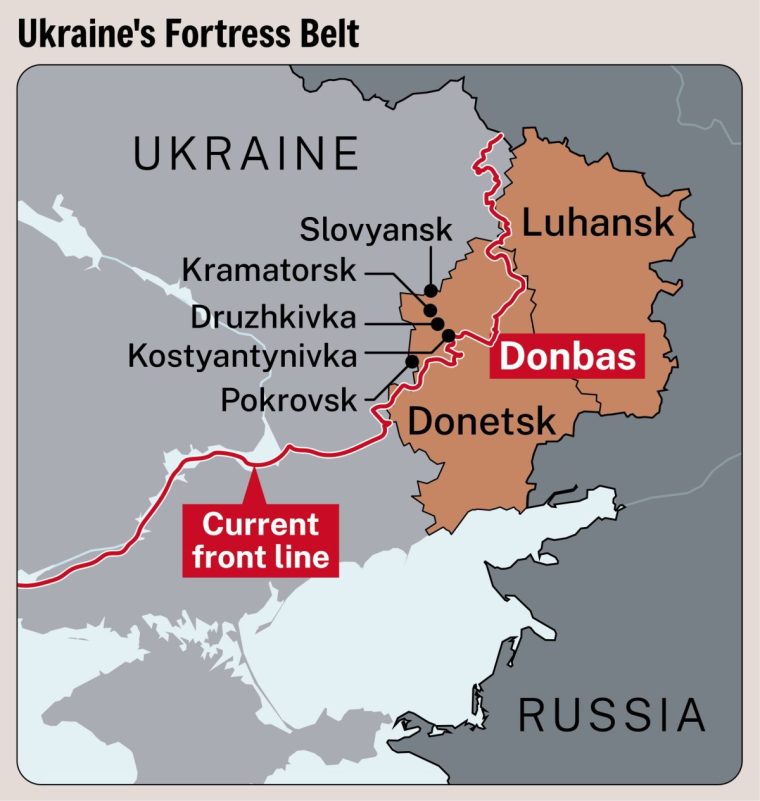
“Ukrainian forces have been heavily fortifying the cities for 11 years, since the battles there in 2014,” Harward said. “The Russians are definitely threatening the cities currently on the battlefield. We are seeing Russian forces intensify their strikes against the supply lines that support Ukrainian forces in Sloviansk, Kramatorsk and the surrounding areas – likely to set conditions for future ground attacks.”
The Trump-backed peace plan could see the fortress belt all but lost to Russia.
Harward said that ceding Dontesk to Russia would “only set Russia up to be in a better position to reinvade Ukraine in the future.”
“Ukraine would be in a less defensible position should it lose the whole oblast,” she added.
Natia Seskuria, an associate fellow at the Royal United Services Institute (RUSI), said that the belt was integral to the protection of “critical hubs” like Sloviansk and Kramatorsk. Its loss could pave the way for a series of Ukrainian setbacks.
“It prevents Russian forces from breaking into the open terrain west of the line, where Ukraine would struggle to build new defences quickly or hold ground effectively,” she said.
Seskuria added: “For Russia, capturing the belt, or having it ceded to Moscow under a peace deal forced on Ukraine, would eliminate one of Ukraine’s strongest military barriers, provide a valuable staging area for further potential Russian operations and deliver significant political leverage.
“Its fall, or concession in a deal, would put Ukraine at a major disadvantage in any future conflict and potentially provide Russia with more leverage to demand further territorial concessions over time.”
Having previously ruled out handing over territory, Ukrainian President Volodymyr Zelensky has said that Ukraine “needs peace” and “will do everything so that no one in the world can say we are upending diplomacy.”
But, there are signs that the proposed deal is already falling apart, with Ukraine and Europe resistant to many of its details.
Kevork Oskanian, a Russia expert at the University of Exeter, said that it was clear that the peace plan was negotiated without Ukrainian or European involvement and would be a “bitter pill” for Kyiv to swallow.
“If reports are true, it is far worse than any preceding plans proposed by the Trump administration: it includes not just de-facto territorial concessions, but withdrawals by the Ukrainian armed forces from currently held positions in the country’s east, a more than halving of its armed forces, a ban on foreign – that is, presumably, Western – troops on its territory, among others,” he said.
“It is difficult to see how Zelensky could agree to an actual withdrawal from positions which, over the past year, have been fought for at great human cost,” he added.
But, Oskanian said that Kyiv may have little choice but to ultimately concede.
“Combined with the departure of one of its main advocates, General Keith Kellogg, from his post as Washington’s Ukraine envoy, this does not bode well of Kyiv,” he said.
Your next read
Harward said that the Kremlin “has time and again shown us that their idea of a negotiation is one where Ukraine – and the West – capitulate to all of Russia’s demands that date back to 2021 and 2022.”
When it comes to aspects like the effective dismantling of Ukraine’s fortress belt, it is a demand that could prove critical for any future peace.
“Kremlin officials have repeatedly expressed – as recently as a few days ago – that their desires extend beyond the four oblasts that Moscow illegally annexed in 2022,” she said. “Caving to Russia’s demands will only strengthen Russia’s ability to start the war up again at a time of its choosing.”
