As well as being a documentary presenter, comedian, author and I’m A Celeb 2025 campmate, Ruby Wax was one of the first household names to be candid about her mental health struggles in public.
Even on the latest series of I’m A Celeb, which began on 16 November, she opened up to Alex Scott and Shona McGarty about how, even at the peak of her success while she was hosting the Ruby Wax Meets… documentary series on BBC, she was dealing with depression. ‘It felt like you’re in the centre of something, a storm, so you don’t feel anything,’ Ruby reflected on that period. ‘You feel the high, but that’s really unhealthy. So it’s like fight and flight the whole time. And you’ve still got depression, do you know what I mean?’
What has Ruby Wax said about her mental health?
Ruby has been open about struggling with bipolar disorder and depression throughout her adult life. In 2010, her stand-up show Losing It tackled her mental illnesses head on, including time she spent in a psychiatric clinic. In response to the audience reaction to her show, Ruby founded a mental health website, which is now part of the SANE charity.
In 2012, she released a documentary with Channel 4 called Ruby Wax’s Mad Confessions, where she charted her own battle with clinical depression, which became public knowledge after she agreed to be involved in a high profile poster campaign by Time To Change – a mental health anti-stigma programme run by the charities Mind and Rethink Mental Illness. Her photograph was used across billboards to spread the message that one in four people has a mental illness. Ruby later quipped, ‘I’ve become the poster girl for mental health.’
In the documentary she asked, ‘Why is it that every other organ can get sick and you get sympathy, except the brain? Stigma is the real illness and it’s at its worst in the workplace, so that’s what we’re focusing on.’
In 2020, Ruby appeared on Louis Theroux’s Grounded podcast and said she thinks of depression as a ‘physical disease’. Adding, ‘You sort of go to sleep, but your body’s moving. That’s what depression feels like… You’re gone. Nobody’s home.’ She explained that simple acts such as moving her arm or taking a shower felt like a ‘miracle’.
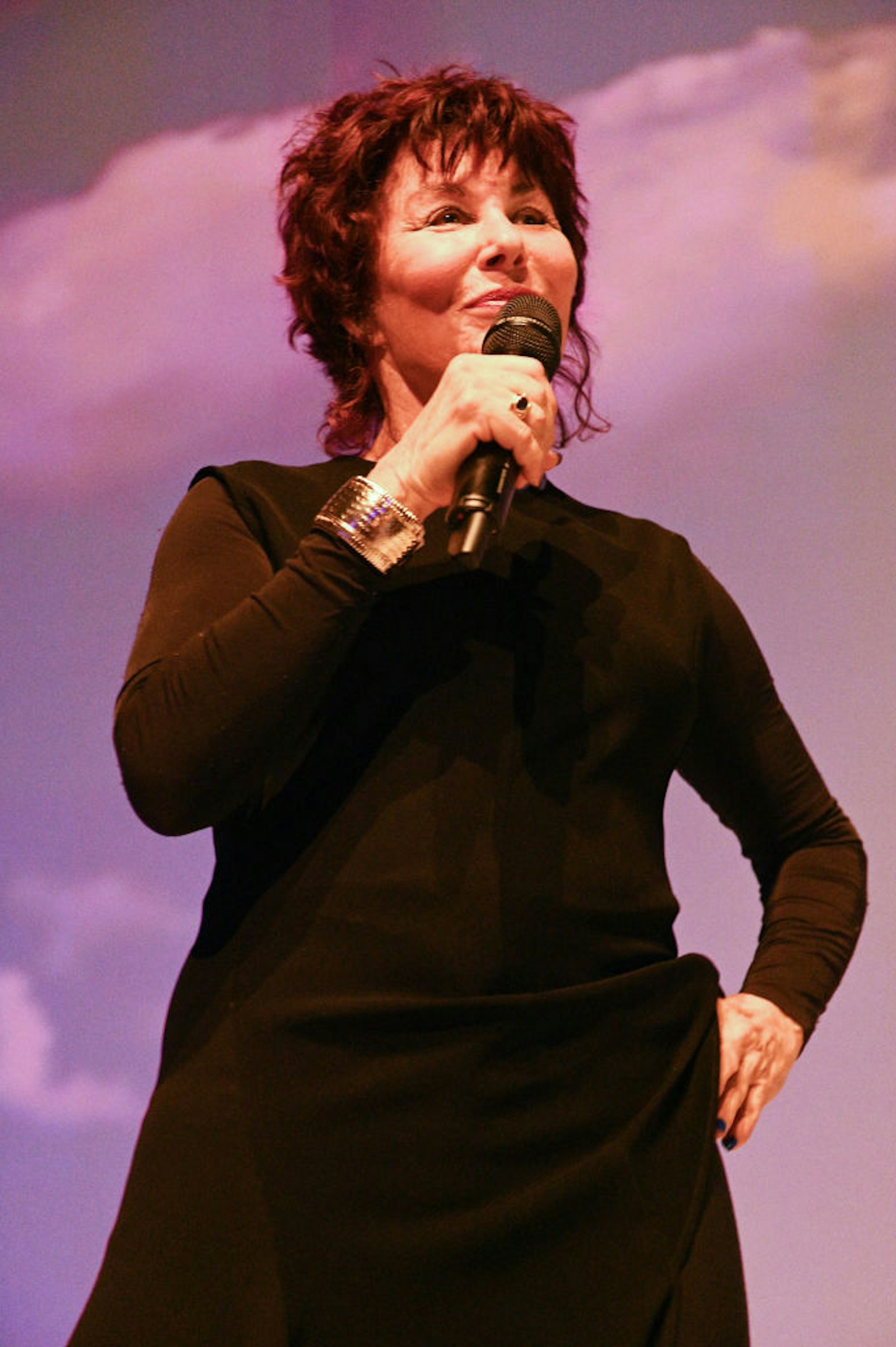
Ruby Wax at The Eternity Charity Fundraiser hosted by Lola Bute in support of Action On Addiction, James’ Place, Place2Be and Grow in 2022. (Photo by David M. Benett/Dave Benett/Getty Images)
Does Ruby Wax have a mental health masters degree?
Yes! To improve her knowledge and expertise on the subject, Ruby undertook a master’s degree in mindfulness-based cognitive therapy from Kellogg College, Oxford in 2013. In 2015, she was appointed a visiting professor in mental health nursing at the University of Surrey. And in 2015, she was appointed an Honorary Officer of the Order of the British Empire for services to mental health.
Ruby also released a book, Sane New World: Taming the Mind, in 2013 which climbed to the top of the Sunday Times bestseller list. It teaches readers why and how our minds can send us mad and how we can rewire our thinking to calm ourselves in a frenetic world. In 2016, Ruby published another number one bestseller, A Mindfulness Guide for the Frazzled, which offers tips on how to be more mindful and live in the moment. The Times described Ruby as ‘whip-smart on the subject’ and said ‘she teaches the art of doing nothing in a way that doesn’t send you to sleep’.
In 2023, she released another book and accompanying audiobook I’m Not As Well As I Thought I Was, which details her experience receiving psychiatric treatment. She also toured a one-woman show based on the book.
What has Ruby Wax said about her bipolar diagnosis?
Ruby has described the use of antidepressants and antipsychotics as ‘vital’. She has been open about spending time in mental health institutions like The Priory and has undergone repetitive trans-cranial magnetic stimulation (rTMS), which according to the NHS uses magnetic fields to active or suppress the brain centres association with medical and psychiatric disorders.
Ruby said the treatment is what ‘saved’ her. On social media, she said rTMS ‘whacks your neurons into action, like rebooting a stalled car’.
Does Ruby Wax endorse mindfulness?
As her string of best-selling books suggest, Ruby is an advocate for mindfulness practices. ‘Sometimes when a situation is stressful and I could have a trigger reaction, I can hold it back for a few seconds,’ she said. ‘You can become the driver of your thoughts’ rather than being ‘driven by them’.
‘With mindfulness practice, you eventually tame, calm, and befriend that bucking bronco of a mind, gentle taking the reins and steering it where you want,’ she once wrote on Instagram. ‘If you’re self-critical and demanding, not only do you suffer but you admonish yourself for your suffering.’
She continued, ‘When the mind gets agitated and negative, if you are patient and gentle with yourself, it eventually settles down and you experience something we call peace and, at best, happiness.’
What is Ruby Wax’s mental health charity?
In 2017, Ruby set up The Frazzled Cafe, a safe, non-judgemental space for people to discuss the stresses of everyday life. It’s a service that is available to anyone 365 days a year.
The charity offers a range of group sessions, including one run by Ruby every two weeks for around 100 people, facilitator-led sessions for 15-20 people and 30-minute weekly mindfulness sessions to ‘bring you back to yourself’.
What are Ruby Wax’s mental health tips?
While more comprehensive advice is available in Ruby’s various books or the hundreds of mental health charities currently operating in the UK, Ruby says she stays sane by getting out of the house and walking in nature to let go of some of those nagging voices in your head.
‘After a walk, you might realise how much you’re driven by thoughts, which are as fickle as the wind,’ she wrote on Instagram. ‘They aren’t solid, nor are they facts. They come and go like weather conditions. Some are thunderly, sunny, rainy and foggy. They come and go, unless you latch onto one of them, and then you’re caught in the hamster wheel of rumination.’
‘If you learn to observe your thoughts, rather than obey them, you’re free. Even better, you’re truly evolved if you’re able to laugh at them. So get out there and smell the roses, listen to the birds, or feel the breeze on your face. This is the only way to come to your senses. And if you can come to one of your senses, you’re present, and that’s the gift of all gifts. Look after yourself.’
For anyone struggling, help is available all day, everyday. You can call the Samaritans on 116 123 or email them at jo@samaritans.org. Or call Mind’s 24/7 support line on 0300 102 1234.
