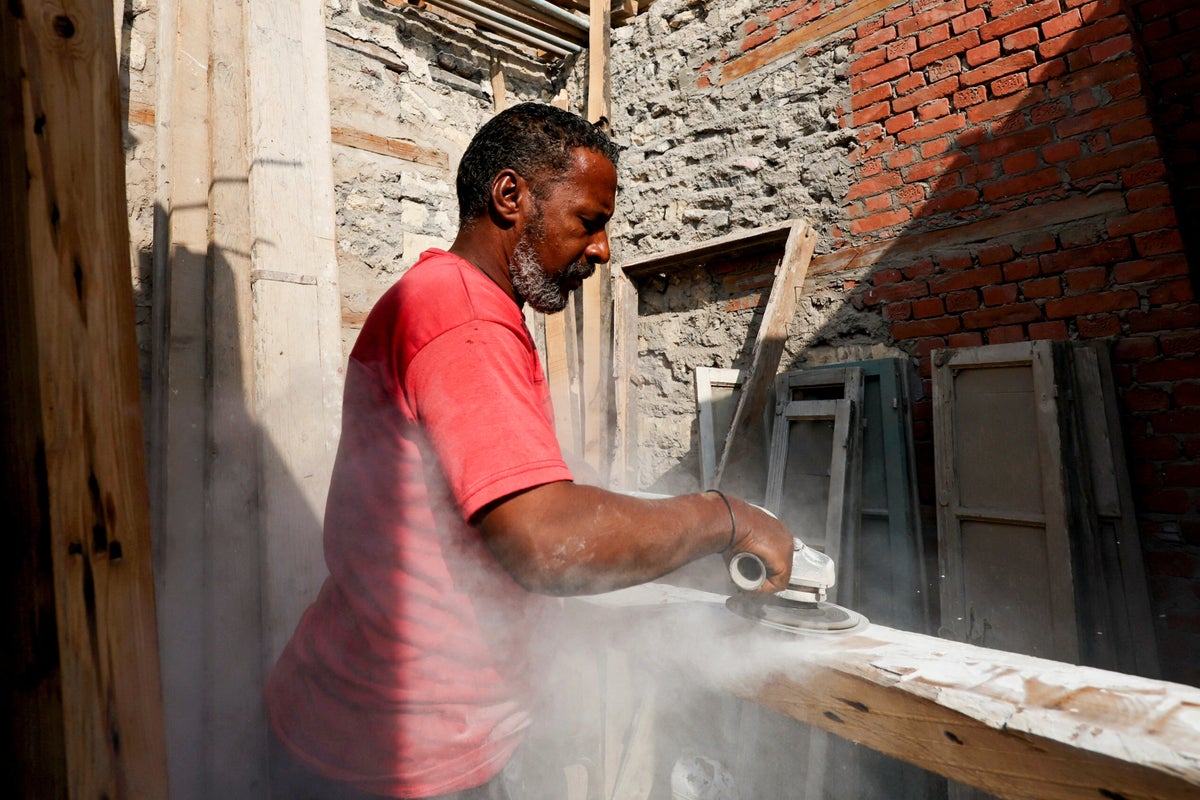
Egyptian restorers are undertaking an ambitious project to revitalise a dilapidated neighbourhood within Cairo’s historic centre, meticulously dismantling and then rebuilding homes in Darb al-Labbana using materials salvaged from the original structures.
This innovative model is envisioned as a blueprint for similar restoration efforts across other districts.
The Darb al-Labbana area, nestled directly beneath Cairo’s more than eight-century-old citadel, a landmark established by Muslim general Saladin, and bordering a historic hospital complex, had become largely uninhabitable in recent decades.
Its ancient street pattern, with narrow lanes and alleys, has remained virtually unchanged for centuries, even appearing on maps drawn by French cartographers during Napoleon Bonaparte’s occupation of Egypt between 1798 and 1801.
Many of the existing houses, constructed over a century ago on unstable ground, were deemed too small by contemporary standards and critically lacked essential infrastructure such as plumbing.
The restoration plan’s core objective is to create liveable residences while meticulously preserving the area’s original street layouts and architectural facades.
Foundations have been significantly strengthened, and modern sewage, plumbing, and electricity systems have been installed throughout the revitalised neighbourhood.
“It’s a mini, modern version of the old,” said Nairy Hampikian, an architectural engineer who advised on the project.
The government has been tearing down buildings in other dilapidated areas, and Hampikian has been trying to show that there is a way to preserve them instead.
The Darb al-Labbana neighbourhood was part of the original endowment, or Waqfiya, of the Bimaristan of al-Mu’ayyid, a hospital built in 1420 A.D.
The conservationists spent 2021 and 2022 documenting the buildings in the neighbourhood’s narrow lanes and alleyways, inside and out.
“Fifty per cent of the buildings were completely destroyed. Just heaps. Another 20 per cent were half destroyed,” Hampikian said. “The remaining buildings were not livable.”
Residents were given three choices: move to a new apartment provided elsewhere, accept money to vacate, or accept money to rent a place to live temporarily until the restored apartments were ready.
In 2023-24 restorers began dismantling the buildings, removing the stones, numbering them, then making new structures, many with their original facades.
The project rebuilt 23 completely destroyed buildings and constructed another 15 atop those that were only partly destroyed. Of the 102 families who lived in the area, 52 have decided to return when the project is due to finish next year, 20 of them to their same address.
