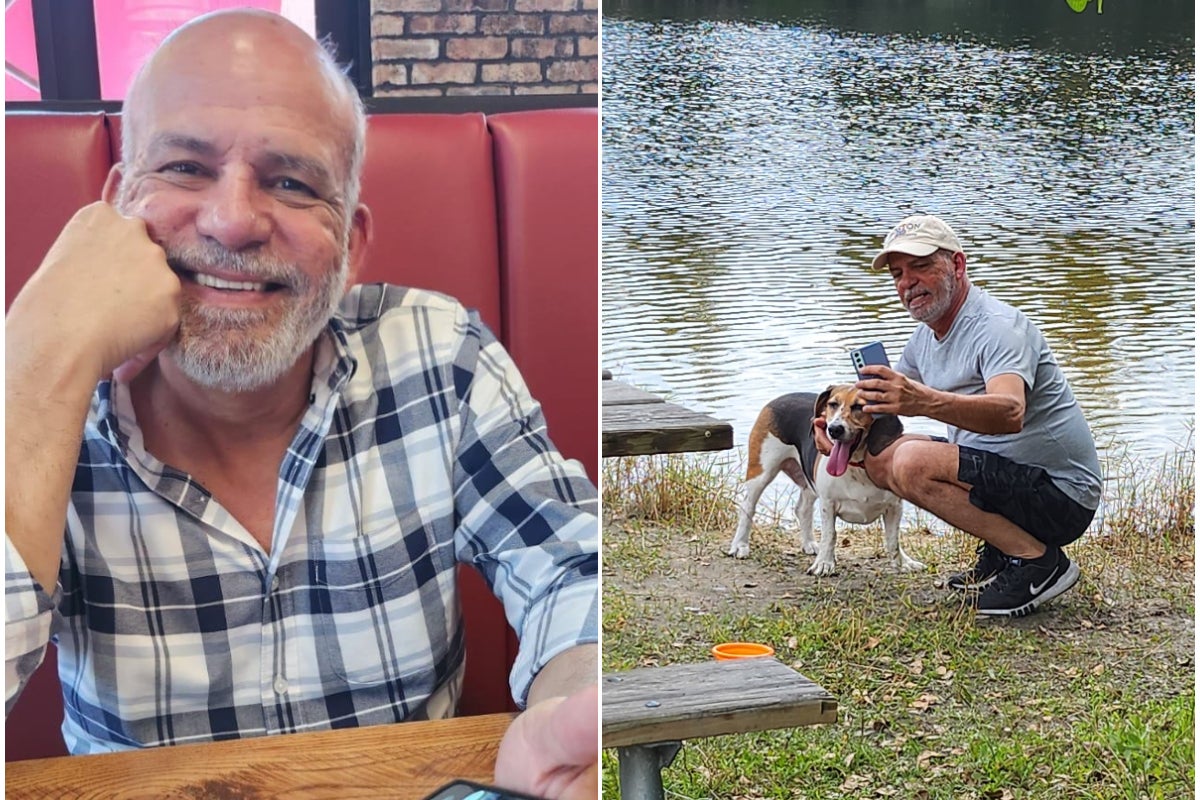
Ricardo Páez and his wife have lived a quiet life outside Miami for over a decade. He works in distribution; she is an accountant. Together they take care of a 9-year-old adopted dog they named Millie.
Páez, though, is not like most of his neighbors in Pembroke Pines, a suburb lush with palm trees and littered with golf courses. The 66-year-old Venezuelan native is in the U.S. on a protected status — or at least he thought it was protected.
But after a recent check-in with ICE, the family’s American dream has turned into an unending nightmare.
On Halloween, Páez was handcuffed and transported to the Krome Detention Center, a Cold War-era military base turned immigration facility on the edge of the Florida Everglades. Weeks later, he remains there, trapped in legal limbo and with a potentially life-threatening heart ailment that saw him rushed to a hospital.
His wife, while tirelessly fighting for his release, is consumed by worry.
“We have 40 years of marriage,” his wife, who asked not to be named, told The Independent.
“If something happens to his health, or if he is deported to I don’t know what country — I feel so terrified.”
His detention highlights a shift in how the government is treating individuals granted withholding of removal — a legal protection offered to immigrants deemed at risk of violence in their home countries.
In the past, people with this status were largely allowed to remain living and working in the U.S. But under President Donald Trump — who pledged to carry out the largest deportation program in American history — the government has targeted them for removal and sought out third countries as final destinations, according to immigration law experts.
“We are applying the law as written,” Tricia McLaughlin, a Department of Homeland Security spokesperson, told The Independent. “If a judge finds an illegal alien has no right to be in this country, we are going to remove them. Period.”
She said Páez “overstayed his visa and has a final order of removal from a federal judge.”
An ICE spokesperson did not respond to questions from The Independent about Páez, stating that “medical questions take a bit longer to research.” This account is based on interviews with Páez’s family and legal documents they provided.
‘Managed to escape’ kidnapping
Born in Caracas in 1959, Páez spent his early years leading a successful Venezuelan construction firm with his brother-in-law, Fernando Mesquida.
“He was the best partner that I ever had…he’s a workaholic,” Mesquida, who also lives in Florida, told The Independent.
Following Hugo Chávez’s election in 1999, Páez grew increasingly outspoken against the government, which was criticized for eroding democracy and silencing opposition. He eventually joined the Christian Democratic Party, known as COPEI.
“He was one of the youngest leaders in Venezuela who was politically active against Chávez,” his wife, 68, said.
At one point, perhaps because of his antiestablishment links, Páez was kidnapped. “He managed to escape,” Mesquida said, noting that abductions were not entirely uncommon.
Fleeing persecution in Venezuela, Páez and his wife, who worked as a journalist, moved to Mexico in 2010 and later settled in Florida in 2012. They entered the country legally on 10-year visas.
The pair slowly began building a life together in Pembroke Pines. Páez found work as an operations manager at a South Florida distribution firm, which described him in a letter as an “exemplary employee.” He spent his down time reading novels and obsessing over Formula 1 racing.
‘Extremely rare’ case
Before their visas expired in 2015, the pair applied for asylum, Mesquida said. Their claims were denied.
But both were granted withholding of removal orders by an immigration judge in 2014, who determined it was not safe for them to return to Venezuela.
“To win withholding of removal under the Immigration and Nationality Act, a person must prove that it is more likely than not that they would be persecuted in a country based on their race, religion, nationality, membership in a particular social group, or political opinion,” Elora Mukherjee, an immigration law professor at Columbia Law School, told The Independent. “It is a very challenging standard to meet.”
It’s a precarious status, though.
It offers no path to permanent residency and it requires recipients to check in with ICE at least once per year. It also authorizes deportation to a third country, Muzaffar Chishti, a senior fellow at the Migration Policy Institute, explained to The Independent.
“But, before this administration, it was extremely rare to deport people who had withholding,” Chishti said.
Of the few who were removed, most “were charged with criminal offenses,” Mukherjee added.
In 2017, for example, only 1.6 percent of the 1,274 people granted withholding of removal orders were deported to a third country, according to the American Immigration Council.
But, things changed when Trump returned to office. In February, ICE issued a new directive encouraging officers to evaluate immigrants with withholding removal orders to “determine the viability of removal to a third country.”
“It may be unreasonable, but it’s not illegal,” Chishti said.
The administration has since negotiated deportation agreements with multiple countries — including Panama, Costa Rica and El Salvador — paving the way for detained migrants to be sent to far-flung nations where they may have no ties or connections.
In 2025, at least several people with withholding removal orders have been detained by ICE, including a 52-year-old Iranian immigrant in Maryland.
‘It messed with his heart’
As the sun rose on the last day of October, Páez stepped into a small office in Miramar for his annual appointment with ICE. After 10 years of these check-ins, he knew the drill.
He presented his ICE officer with proof of his law-abiding life in Florida: copies of his passport, tax filings, work authorization and his withholding of removal order.
But, the paperwork he had long relied on was suddenly deemed inadequate.
“That doesn’t work anymore,” the officer told him. Hours later, he was whisked away to the Krome Detention Center.
When he first entered the secluded compound, Páez struggled to adjust to his confinement. He was “really anxious” and refused to eat, Mesquida said.
The facility’s conditions didn’t help, he said, noting that Páez shares a living space with dozens of other detainees and that the lights are kept on around the clock. Still, he said the guards treat him well and refer to him as “grandpa.”
Accusations of overcrowding and substandard living conditions have long dogged Krome. In April, it swelled to nearly three times its 600-person capacity. And in June, a detainee died after being hospitalized, becoming the third death linked to the facility this year. The same month, a group of detainees assembled on the grounds to create a human “SOS” sign.
Páez’s family endured another scare on November 10 when they lost communication with him after he didn’t show up for his regular evening phone call.
“We found out he was in the hospital. He blacked out,” Mesquida said. “It looked like there was some kind of fight, and Ricardo was really anxious. It messed with his heart.”
It’s unclear what exactly happened as the family has not received a medical report confirming a diagnosis. Mesquida suggested he may have had a heart attack, adding that healthcare providers regularly administered anticoagulants.
Páez’s wife noted that he suffers from emphysema and sleeps with a CPAP machine.
Three days later, Páez was returned to Krome at midnight “chained hand and foot,” his wife said. ICE records indicate he remains in custody as of November 19.
He now faces a future shrouded in uncertainty.
It’s not clear whether he will be set free, kept in detention or thrust into the unknown of a far-off country. Hoping to ensure the former, his family has frantically made calls and written letters to attorneys, state officials and even Trump himself. But so far, they’ve had no luck.
“The lawyers say there’s nothing that we can do,” Mesquida said. “But, they’re not supposed to deport him. He came to the country legally. He went to every single ICE presentation. He never even got a parking ticket.”
As the days tick by, Páez’s wife endures mounting worry. It’s made worse by the recent loss of her job — which came on the same day her husband was detained.
At home, one of her sole comforts is the couple’s 9-year-old dog, Millie, who often waits by the door for the man who cared for her since she was small.
“He should be there,” Mesquida said. “We’re talking about a 66-year-old with emphysema. We know that it could be a mistake, but this mistake is taking too long.”
