The Epstein Files Transparency Act has cleared the first hurdle – but it still has a long way to go
Donald Trump was filmed telling a female reporter “Quiet, piggy” after she questioned him about the Jeffrey Epstein files, shortly before Republicans in the US House of Representatives voted overwhelmingly for the documents’ release, in a massive blow to the President.
The US President was speaking to the media on board Air Force One when he was asked about his relationship with Epstein, the paedophile financier who killed himself in 2019.
The journalist, understood to be Catherine Lucey from Bloomberg, was heard asking him: “If there’s nothing incriminating in the files, sir, why not act?”
In response, Trump is seen pointing at her and snapping: “Quiet, quiet piggy.”
The footage, which has gone viral on social media, comes as Trump finds himself under growing pressure to release remaining documents relating to Epstein.
Large numbers of his own party joined Democrats in backing the files’ release in the House of Representatives vote, with 427 members in favour and only one Republican lawmaker voting against, in an incontrovertible signal that the issue has become too big for the government to resist any longer.
The Epstein Files Transparency Act would force the Department of Justice (DoJ) to release all unclassified materials relating to the paedophile financier. The DoJ would have 30 days to release all files and communications related to Epstein.
The vote comes after Trump’s U-turn this weekend, when he urged Republicans to vote for the bill – after it became apparent that many were already planning to do so. He has claimed for months that the files are a “Democrat hoax” and pushed back on demands to release them.
On Tuesday the Republican congresswoman and Maga firebrand Marjorie Taylor Greene, whom Trump labelled a traitor for backing the bill, stood with survivors of Epstein’s abuse outside the Capitol to lend them her support.
But while the bill has cleared one hurdle, it still has a long way to go.

Trump, as the US President, could release the documents at any point now if he chose, with or without Congress.
But notwithstanding his recent U-turn on the House vote, he has persistently resisted the files’ release. It is not clear why, since he has never been accused of wrongdoing in relation to Epstein.
The President is not expected to suddenly change course and release the documents. More likely, the bill will continue its movement through Congress.
The bill faces Senate vote
Having passed the House, the bill will move to the Senate, where its progress is by no means certain.
Of the 100 senators, 60 would need to back the bill to overcome its filibuster rule. The Republicans hold 53 seats against 47 for Democrats and Independents, meaning, 13 Republicans would need to join them.
The Senate majority leader, Republican John Thune, has not suggested he has any intention to bring the bill to the floor as a matter of urgency, and has said he trusts the DOJ to release information relating to Epstein of its own accord.
At the end of the week the Senate is due to break for a Thanksgiving recess, which could delay the measure being taken up until December at the earliest.

Depending on the scale of the House vote, pressure for Republicans in the Senate to vote for the bill may become impossible to resist.
On Tuesday, Epstein abuse survivors criticised Trump for politicising the issue and fighting the files’ release. Their testimony may leave senators feeling morally unable to vote against the bill.
“We are exhausted from surviving the trauma and then surviving the political conflicts that surround it,” said survivor Jen-Lisa Jones. “I beg you Donald Trump, please stop making this political… show that you actually care about the people other than yourself.”
Thomas Massie, the Republican congressman who co-sponsored the bill, said the Senate should take into account the mounting public anger over Trump’s obstructiveness that forced him to back down.
“It may be tempting for [senators] to get cute and to do things that will limit the release of these documents,” Massie said. “They are afraid that people will be embarrassed. Well, that’s the whole point here. They need to be brought to justice, and embarrassment is no reason to stop it.”
Presidential veto
Even if the bill passes the Senate, there is still no guarantee that it will be signed into law – which needs to be actioned by the President.
Trump could still use his presidential veto power to block the bill’s passage.
This veto can only be overridden if both chambers back it by a two-thirds majority.
However, the risks of choosing to keep the files secret against the wishes of Congress, and at the last minute, would be likely to incite outrage and enflame suspicions that Trump is trying to hide something.
Investigations could keep back details
The White House could use other tactics to stop the files’ release while shifting responsibility from Trump.
Last week, the President instructed the DOJ to investigate prominent Democrats including former US president Bill Clinton and former Treasury secretary Larry Summers, as well as the US bank JP Morgan for alleged Epstein connections. The government could use those investigations as legal justification for withholding the files, or parts of them.
The bill does not permit the withholding, delaying or redacting of information “on the basis of embarrassment, reputational harm, or political sensitivity, including to any government official, public figure, or foreign dignitary”.
However, it allows the DOJ to hold back any documents that “jeopardise an active federal investigation or ongoing prosecution, provided that such withholding is narrowly tailored and temporary”. The DOJ could also withhold or redact portions of records containing information that “would constitute a clearly unwarranted invasion of personal privacy”.
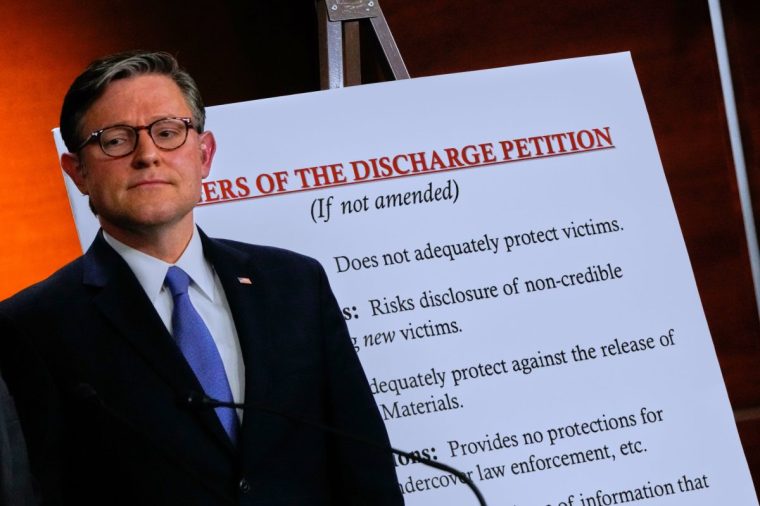
The Republican House Speaker Mike Johnson, has already said he wants the Senate to amend the bill, since it “fails to fully protect victim privacy”, adding that the attorney general should have broader authority to redact all victim information.
However, Massie called his claim a “red herring”, saying that survivors of Epstein’s abuse “have always been in favour of this legislation”.
Your next read
Another list
Some Epstein survivors have said they could release their own list of people connected with the paedophile if the bill is thwarted.
In September, one of the women, Lisa Phillips, said victims had begun compiling a confidential list of names who were involved in Epstein’s abuse.
Haley Robson, a survivor, said on Tuesday that she would stand next to Greene if she decided to read that list on the House floor.
However, some victims have expressed fear that releasing such a list would put them in danger, opening them up to physical and legal threats.
Jennifer Freeman, a lawyer representing victims who have accused Maxwell of abuse, said victims putting their own list together would be “dangerous”.
“It puts them at risk and puts the burden of action on them, when it should be the government and institutions that are sworn to protect us,” she said.
