Saudi Arabia’s Crown Prince Mohammed bin Salman has no more staunch friend and ally than Trump
Saudi Arabia’s Crown Prince Mohammed bin Salman – known as MBS – arrives at the White House later today for a welcome that will include a Marine Corps band playing the Saudi national anthem and perhaps even a 21-gun salute.
MBS will attend a black-tie dinner, hosted by Donald Trump, with all the trappings of a state visit, even though he is not a head of state. At one time a “pariah” to Joe Biden, when he was president, the crown prince now has no more staunch friend and ally than Trump.
And Trump is hoping the friendship will lead to something he craves more than attention or, even, money.
A Trump love affair
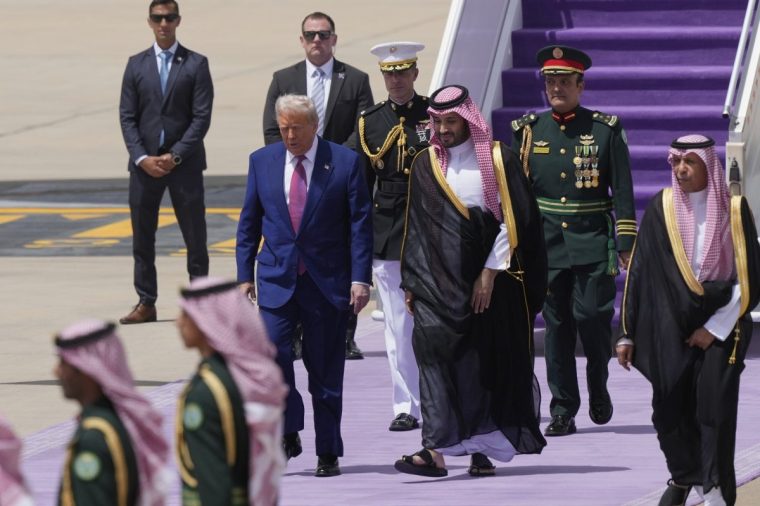
The depths of the Trump-MBS bromance were evident when Trump visited Riyadh, the Saudi capital, in May.
Trump lavished praise on MBS: “Critics doubted that it was possible, what you’ve done, but over the past eight years, Saudi Arabia has proved the critics totally wrong.” MBS looked adoringly at Trump and placed his hand on his heart in a gesture of appreciation.
Trump went on: “I like him a lot. I like him too much. That’s why we give so much, you know? Too much. I like you too much.”
Amid all the ceremonial, spare a thought for the family of Turki bin Abdulaziz al‑Jasser, a Saudi blogger put to death in June. Al-Jasser had once written, prophetically, that: “The Arab writer can be easily killed by their government under the pretext of ‘national security’.”
He wasn’t the first journalist the Saudi state has killed with MBS in charge. The Washington Post columnist Jamal Khashoggi was murdered and dismembered in the Saudi consulate in Istanbul, with many pointing the figure at MBS. Trump once boasted to Bob Woodward that he had “saved MBS’s ass” after Khashoggi’s killing.
Trump will not be so impolite as to complain to MBS about another dead journalist.
‘We are not here to lecture’
Human rights groups and the UN Special Rapporteur on Torture said al‑Jasser endured beatings, electric shocks and years in solitary confinement. Before his incarceration, al-Jasser was an eloquent – and moderate – critic of the regime. He knew he was being watched, writing that “journalism in Saudi Arabia walks a road lined with eyes and ears, and paved with silence”.
So far this year, Saudi Arabia has executed around 320 people. Most are put to death by the sword, especially for “terrorism” cases, though firing squads may also be used.
Those killed include two young men, Jalal al-Labbad and Abdullah al-Derazi, who were convicted of going to a street protest when they were 15 years old.

A US president might once have raised such cases. But as Trump said on his first visit to Riyadh in 2017: “We are not here to lecture.” Instead, it’s all about doing business.
In many ways, Trump’s approach is less hypocritical than Biden’s. On the campaign trail, Biden declared MBS a pariah for his part in Khashoggi’s murder. But in office, and desperately needing Saudi Arabia to ramp up oil production, he was forced to give MBS a humiliating fist bump at a summit in Jeddah.
Trump, on the other hand, is refreshingly open about his motives. Last week, he told reporters: “They wanna buy a lot of jets. I’m looking at that… They want to buy a lot of ’35’”.
Saudi Arabia reportedly wants to purchase 48 F-35 stealth fighters, two full squadrons. The country has already signed deals for $142bn in US-made weapons – and has promised another $600bn in investment for the US.
And there is one US business doing especially well out of Saudi Arabia: The Trump Organization.
Trump Inc
Trump has always liked the Saudis because he likes money. In 2016, he said: “They buy apartments from me. They spend $40 million, $50 million. Am I supposed to dislike them?”
Those sums are small potatoes compared to the money flowing into the Trump Organization these days. There’s a deal to license the Trump name to a hotel and golf complex in Saudi Arabia, and another to develop a luxury resort in Oman with backing from a Saudi real estate firm. A $500m Trump Tower is also being built in the Serbian capital, Belgrade, with Saudi money routed through the investment firm belonging to Jared Kushner, Trump’s son-in-law.
According to Forbes, in 2024 alone, Trump and his extended family collected $50m from deals connected to Saudi Arabia. This makes the row over Saudi lobbyists spending $270,000 on rooms in Trump’s Washington DC hotel in 2016 look rather quaint.
In his first term, Trump promised he wouldn’t do any “foreign deals” because of the emoluments clause of the US Constitution, which forbids federal officials from receiving gifts or payments from foreign governments. That seems to have gone out the window.
The Founding Fathers could not have imagined someone like Trump monetising the presidency on such a vast scale.
Kushner’s money
Kushner is the Trump family member benefiting the most from Saudi largesse.
After leaving office as Middle East envoy following Trump’s defeat in 2020, he was given $2bn by MBS for his private equity fund. The committee that advises MBS on his investments said Kushner’s fund was a bad bet, but he went ahead anyway.
It’s a measure of how much Trump has debased standards in US public life that most people just shrugged when Kushner took the money. Today, Kushner has no formal role in Trump’s administration but remains, unofficially, Trump’s key advisor on the Middle East. He was in Israel last week for high-level meetings on Trump’s plan for Gaza.

As Middle East envoy from 2016-2020, Kushner helped deliver the undeniable diplomatic triumph of the first Trump administration: the Abraham Accords, which brought peace between Israel and Arab states including the United Arab Emirates and Bahrain.
The main aim of hosting MBS at the White House now is to try to get him to sign the Accords. “I think [Saudi Arabia is] gonna join,” Trump told CBS. “I think we will have a solution.”
Other Arab states could then follow Saudi Arabia, bringing a historic peace to the Middle East. That’s the hope, anyway. But Trump’s vaunted deal-making skills will be tested.
The big prize
Saudi Arabia has always maintained that for it to make peace with Israel, Palestinians must finally get their own state. After two years of horror in Gaza, Arab rulers like MBS fear that anything less will inflame their citizens, threatening their power.
Israel will resist any move towards Palestinian statehood, but it is also opposed to the Saudis getting F-35s unless there is a peace deal – Israel is just a few minutes flying time from Saudi Arabia by fast jet.
MBS is desperate for a defence pact with the US. The Saudis were shaken by attacks on their refineries carried out by drones sent from Yemen on Iranian orders. They fear what would happen in a wider war with Iran – there’s been speculation they may even want US nuclear weapons stationed in Saudi Arabia.
Trump probably couldn’t get a treaty to defend Saudi Arabia through the Senate, but he could sign an executive order to treat attacks on Saudi Arabia as “a threat to the peace and security of the United States”. He did the same with Qatar in September.
Your next read
Meanwhile, MBS might be prepared to accept “a credible path” to statehood for Palestinians, rather than an actual state.
This could open the doors to broader peace between Israel and the Arab states, and a lasting settlement of the Israeli-Palestinian conflict. Trump would be in the running for the bauble he craves most: a Nobel Peace Prize.
The Oslo committee would hate to give it to him, but they might just have to. MBS is the key to all this. No wonder Trump said his and America’s strongest relationship is with the Saudi leader. This bromance will last and last.
